Váltás nyomtatványra
 Összes részlet megjelenítése







































 A bármely oldalsó méretét túlszálaló 105 cm (kb. 41 hüvelyk) meghaladó műalkotások vagy reprodukciók esetében a keret összeszerelhető készletként, szétszerelve kerül szállításra. Ez a módszer biztosítja a biztonságos szállítást, és megakadályozza a szállítás során fellépő sérüléseket.


A Moment Frozen in Time: The Essence of Rural England
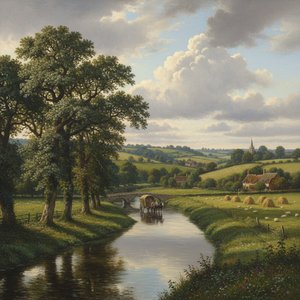
John Constable’s “Malvern Hall from the South West,” painted in 1809, isn't merely a landscape; it’s a distillation of the English countryside at its most serene and evocative. This oil on canvas, currently residing within the Bristol Museum & Art Gallery, offers a glimpse into a specific moment – a fleeting interplay of light, atmosphere, and human presence captured with an unprecedented sensitivity to detail. The painting immediately draws the eye into a vast field, punctuated by the dark silhouettes of trees that frame a cloudy sky, hinting at both drama and tranquility. It’s a scene brimming with quiet observation, inviting the viewer to step into Constable's world and share in his profound connection to the land.
Constable’s genius lies not just in his technical skill – though undeniably impressive – but in his ability to imbue ordinary subjects with extraordinary emotional resonance. He was a pioneer of “plein air” painting, working directly from nature, and this is vividly apparent here. The brushstrokes are loose and expressive, capturing the movement of the clouds and the dappled light filtering through the trees. Notice how he doesn’t attempt to render every leaf or blade of grass with meticulous precision; instead, he focuses on conveying the *feeling* of the scene – a sense of openness, freedom, and the subtle shifts in color and tone that define the English countryside.
The Significance of Detail: Peacocks and Presence
While the vastness of the landscape is captivating, it’s the smaller details that truly elevate this painting. The inclusion of two figures – likely landowners or estate workers – standing in the foreground adds a vital element of human scale to the scene. They are not imposing subjects; rather, they appear absorbed in contemplation, suggesting a harmonious relationship between humanity and nature. And then there are the peacocks, proudly displaying their iridescent plumage on the lawn – a touch of aristocratic grandeur amidst the rustic setting. These carefully placed details speak volumes about Constable’s meticulous observation and his desire to capture not just the outward appearance of the landscape but also its social and cultural context.
The sky itself is a masterpiece of atmospheric perspective, rendered in delicate shades of grey and blue. Constable masterfully uses light and shadow to create a sense of depth and distance, drawing the eye into the heart of the scene. The subtle variations in color – from the pale blues of the distant hills to the darker greens of the trees – are achieved through a masterful understanding of color theory and his ability to capture the fleeting effects of light on different surfaces.
A Revolutionary Approach: Constable’s Legacy
“Malvern Hall from the South West” is more than just a beautiful painting; it's a pivotal work in the history of landscape art. Constable’s innovative approach to capturing the fleeting effects of light and atmosphere profoundly influenced the development of Impressionism, paving the way for artists like Monet and Renoir. His commitment to working outdoors, his emphasis on subjective experience, and his willingness to embrace the imperfections of nature all contributed to a radical shift in the way landscape painting was conceived and executed.
Furthermore, this painting reflects the burgeoning applied arts scene in Birmingham during Constable’s time. The city's manufacturing prowess – particularly in ironwork and decorative arts – provided materials and inspiration for artists like Constable, who sought to capture the beauty of the natural world with a level of detail and realism previously unseen. “Malvern Hall” stands as a testament to this cultural exchange, demonstrating how artistic innovation could be fueled by technological advancements and industrial progress.
Today, “Malvern Hall from the South West” continues to resonate with audiences around the world. It’s a reminder of Constable's extraordinary talent, his deep connection to the English landscape, and his enduring legacy as one of the greatest painters in British history. A high-quality reproduction offers a remarkable opportunity to bring this timeless masterpiece into your home or office, allowing you to experience its beauty and tranquility firsthand.
Kérdések és válaszok
Hol tekinthető meg az eredeti „Malvern Hall from the South West”, John Constable alkotása?
Az eredeti "Malvern Hall from the South West" mű megtekinthető a Bristol Museum And Art Gallery, Bristol, Egyesült Királyság múzeumgyűjteményében.
Milyen méretben ajánlott a "Malvern Hall from the South West" nyomtatása?
A „Malvern Hall from the South West”, John Constable alkotása alkotáshoz egy Large méretű reprodukciót javasolunk. A méret az arányok megőrzésével módosítható.
Mekkora méretű nyomtatás Malvern Hall from the South West alkotást illene a szobámba?
A(z) „Malvern Hall from the South West”, John Constable alkotása ajánlott párosítása: egy Large méretű nyomat egy Living Room-ban.
Több információ erről a festményről
 Megtekintés
 Küldés
 Megosztás
 Részletek
 Útmutató

 Letöltés
 Hasonló darabok
 X-ray felvétel
 Diavetítés
 Kérdések és válaszok
 Statisztika