

 Megtekintés
 Küldés
 Megosztás
 Részletek

 Letöltés
 Hasonló darabok
 X-ray felvétel
 Diavetítés
Fruit

 Összes részlet megjelenítése
Kézzel készített olajfestmény reprodukció
Kézzel festett olajvastú vászon, az Ön által választott méretben és keretben, művészeink készítik meglévőre. ( Nyomat rendelése Kép letöltése)




































Válasszon előre meghatározott méreteink közül, amelyek megfelelnek a műalkotás eredeti arányainak.

Ön megadhat saját méreteket egy adott kerethez vagy térhez igazításhoz. Ha a kiválasztott méret nem egyezik az eredeti kép arányával, akkor a műalkotást levágjuk, vagy további kézzel festett elemekkel meghosszabbítjuk a festményt. A gyártás megkezdése előtt küldünk Önnek egy digitális előnézetet jóváhagyásra.
Kérjük, vegye figyelembe, hogy a képernyőn megjelenő előnézet nem tükrözi a tényleges vágást vagy kiterjesztést. Csak az előnézet fog pontosan mutatni a végső kompozíciót.
Bár egyedi méretek állnak rendelkezésre, javasoljuk, hogy válasszon egy méretet az előre meghatározott listából az eredeti arányok megőrzése érdekében.
A rendelést követően a OriginalUniqueArt.com csapata e-mailt küld az ügyfélnek az instrukciókért, és biztosít egy előnézeti képet (mockup).
Világszerte elérhető szállítás () 3-4 hét alatt a szokásos 5 hét helyett. (22 augusztus). A minőség nem kérdőjelezhető.

Ingyenes globális expressz szállítás

Prémium minőségű len vászon

Teljes körű szállítási biztosítás

Vámvisszatérítési Garancia

Hiteles színpontosság garancia

60 napos visszaküldési lehetőség (csak hibás termékek esetén)

100% pénzvisszatérítési garancia

Több darab vásárlása esetén kedvezmény
 Az üvegkeretes opció csak 110 cm alatti méretben érhető el

Fruit
Reprodukciós technika
Reprodukció mérete
-


Összesített ár
$ 300
A művész életrajza
Johann Wilhelm Preyer: Life and Legacy
Early Life and Education
- Born in Düsseldorf, Germany, in 1803, Johann Wilhelm Preyer emerged from a family with artistic inclinations. His father was a merchant, and his brother, Gustav, also pursued a career as a painter.
- Growing up in the old town of Eschweiler, Preyer displayed an early aptitude for art. A playful anecdote recounts how he and his brother, both small in stature, would occasionally disguise themselves as children to play pranks.
- Formal training began at the Düsseldorf Art Academy in 1822, where he studied under Peter von Cornelius. He later became a master student of Wilhelm von Schadow, solidifying his foundation in classical artistic principles.
Artistic Development and Influences
- Preyer’s education extended beyond Düsseldorf; he embarked on extensive travels throughout Europe between 1835 and 1843. These journeys took him to the Netherlands, Munich, Northern Italy, and Switzerland, exposing him to diverse artistic styles and traditions.
- Influences from Dutch still life masters are evident in his meticulous attention to detail and realistic depiction of textures. The Düsseldorf School’s emphasis on precise observation also shaped his approach.
- Upon returning to Düsseldorf in 1844, Preyer dedicated himself primarily to still life painting, establishing a reputation for exceptional skill within the genre.
Major Works and Artistic Style
- Specialization: Preyer became renowned for his exquisitely detailed paintings of flowers and fruit. His works are characterized by their vibrant colors, realistic textures, and careful compositions.
- Notable examples include “Fruit and a Goblet,” “Fruit Still Life with Sculpted Ceramic Bowl,” and numerous depictions of grapes and floral arrangements.
- His style is often associated with the Biedermeier period, reflecting a focus on domesticity, simplicity, and meticulous craftsmanship.
Achievements and Recognition
- Preyer quickly gained recognition as one of the leading still life painters of his time. His works were highly sought after by collectors, with a significant portion eventually finding their way into American collections.
- Founding Member: He was among the founding members of the Association of Düsseldorf Artists in 1844, demonstrating his commitment to fostering artistic community and collaboration.
- Preyer also took on private students, including Helen Searle, an American still life painter who further disseminated his techniques and influence.
Personal Life and Legacy
- Around 1844, Preyer married Emilie Lachenwitz, the sister of painter Siegmund Lachenwitz. They had two children, Emilie and Paul, both of whom also became painters, continuing the family’s artistic legacy.
- Historical Significance: Johann Wilhelm Preyer is considered one of the earliest masters of the Düsseldorf School of Painting and a pivotal figure in 19th-century German still life art.
- In recognition of his contributions, a road in Eschweiler, where he grew up, was renamed Preyerstrasse in 1974.
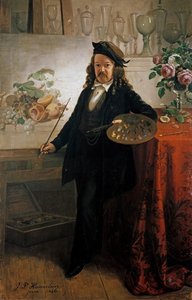
Johann Wilhelm Preyer
1803 - 1889 , Germany
A művészről röviden
- Birth Date: 1803
- Birth Place: Düsseldorf, Germany
- Death Date: 1889
- Influenced By:
- Peter von Cornelius
- Wilhelm von Schadow
- Movement: Düsseldorf School of Painting
- Name: Johann Wilhelm Preyer
- Nationality: German
- Notable Works:
- Fruit and a Goblet
- Fruit Still life
- Flowers in a Jug

