A szöveg mérete

() ·

Egy Önnek készült, kézzel festett alkotás

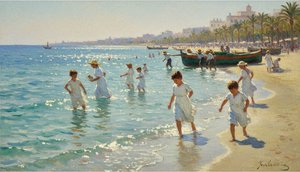
Swimmers, Jávea

Kézzel készített olajfestmény reprodukció

Kézzel festett olajvastú vászon, az Ön által választott méretben és keretben, művészeink készítik meglévőre. ( Váltás nyomtatványra Áttérés digitális képre)

A gyűjtemény leírása

Joaquin Sorolla's 'Swimmers, Jávea' (1905) captures the vibrant Mediterranean light and movement with stunning brushstrokes. Explore this iconic Spanish Impressionist masterpiece.

A művész életrajza

Sorolla: A spanyol festőművész, aki a fény és szín mesterese! Élénk portrék és tengerparti tájképek a mediterrán élet esszenciájából. Fedezd fel örökségét!

előbb ·

1. fejezet

Mekkora méretű legyen?

Húzza a csúszkát a méret megváltoztatásához; a bal oldali kép a keret valós szélességét mutatja. Az eredeti arányok megmaradnak.

Standard méret
egyedi méretű
CM
INCH

Válasszon előre meghatározott méreteink közül, amelyek megfelelnek a műalkotás eredeti arányainak.

szélesség
magasság

Írja be a kívánt szélességet és magasságot, hogy illeszkedjen a keretéhez vagy a falához. Mivel ez kézzel festett alkotás, egy eltérő formájú méret esetén a művész akár festhet is valamivel többet a kép körül, vagy korolathat is belőle — az Ön döntésének megfelelően. A festés megkezdése előtt küldünk egy digitális tervezetet jóváhagyásra. Az oldalon látható kép nem tartalmazza a végeredményt — csak a tervezet mutatja meg a valódi eredményt.

2. fejezet

Hogyan érkezzen meg?

Válaszd ki a feszített vászon széleit

Válassza ki a keretet

Corner sample of the WhiteWrap canvas edge finish, stretched on tömörfa bars
Fehér Ft1
Corner sample of the BlurSideWrap canvas edge finish, stretched on tömörfa bars
Elmosódott szélek Ft1
Corner sample of the ExtendedWrap canvas edge finish, stretched on tömörfa bars
Kiterjesztett Ft1
Corner sample of the P118B picture frame: formázott polisztirol, 5 cm wide and 3 cm thick
P118B Ft10
Corner sample of the P118H picture frame: formázott polisztirol, 5 cm wide and 3 cm thick
P118H Ft10
Corner sample of the P118W picture frame: formázott polisztirol, 5 cm wide and 3 cm thick
P118W Ft10
Corner sample of the P438Z picture frame: formázott polisztirol, 5.5 cm wide and 3.5 cm thick
P438Z Ft10
Corner sample of the P508JH picture frame: formázott polisztirol, 7 cm wide and 3.5 cm thick
P508JH Ft12
Corner sample of the P508YH picture frame: formázott polisztirol, 7 cm wide and 3.5 cm thick
P508YH Ft12
Corner sample of the P805H picture frame: formázott polisztirol, 5 cm wide and 3.5 cm thick
P805H Ft10
Corner sample of the P805Z picture frame: formázott polisztirol, 5 cm wide and 3.5 cm thick
P805Z Ft10
Corner sample of the P919BZ picture frame: formázott polisztirol, 7 cm wide and 3.5 cm thick
P919BZ Ft10
Corner sample of the P919G picture frame: formázott polisztirol, 7 cm wide and 3.5 cm thick
P919G Ft10
Corner sample of the P919XJ picture frame: formázott polisztirol, 7 cm wide and 3.5 cm thick
P919XJ Ft10
Corner sample of the P959ZH picture frame: formázott polisztirol, 5 cm wide and 3 cm thick
P959ZH Ft10
Corner sample of the P968JZ picture frame: formázott polisztirol, 6 cm wide and 4 cm thick
P968JZ Ft12
Corner sample of the W106C picture frame: tömörfa, 5 cm wide and 3 cm thick
W106C Ft8
Corner sample of the W218G picture frame: tömörfa, 5 cm wide and 3 cm thick
W218G Ft10
Corner sample of the W218JH picture frame: tömörfa, 5 cm wide and 3 cm thick
W218JH Ft8
Corner sample of the W218Y picture frame: tömörfa, 5 cm wide and 3 cm thick
W218Y Ft10
Corner sample of the W307PJ picture frame: tömörfa, 6 cm wide and 3 cm thick
W307PJ Ft10
Corner sample of the W316G picture frame: tömörfa, 6 cm wide and 3 cm thick
W316G Ft10
Corner sample of the W316PJ picture frame: tömörfa, 6 cm wide and 3 cm thick
W316PJ Ft8
Corner sample of the W316Y picture frame: tömörfa, 6 cm wide and 3 cm thick
W316Y Ft10
Corner sample of the W398PJ picture frame: tömörfa, 5 cm wide and 3 cm thick
W398PJ Ft8
Corner sample of the W4111J picture frame: tömörfa, 6.5 cm wide and 3.5 cm thick
W4111J Ft10
Corner sample of the W500HY picture frame: tömörfa, 7 cm wide and 5 cm thick
W500HY Ft15
Corner sample of the W500JH picture frame: tömörfa, 7 cm wide and 5 cm thick
W500JH Ft15
Corner sample of the W692G picture frame: tömörfa, 8 cm wide and 4 cm thick
W692G Ft12
Corner sample of the W849H picture frame: tömörfa, 5 cm wide and 3 cm thick
W849H Ft8
Corner sample of the W940BG picture frame: tömörfa, 7.5 cm wide and 4.5 cm thick
W940BG Ft15
Corner sample of the W953PJ picture frame: tömörfa, 6 cm wide and 3.5 cm thick
W953PJ Ft8
Corner sample of the H24-GOLD picture frame: faragott fa gesszóval, 10 cm wide and 6 cm thick
H24-GOLD Ft30
Corner sample of the H24-SILVER picture frame: faragott fa gesszóval, 10 cm wide and 6 cm thick
H24-SILVER Ft30
Corner sample of the H36-GOLD picture frame: faragott fa gesszóval, 15 cm wide and 6.5 cm thick
H36-GOLD Ft45
Corner sample of the H36-SILVER picture frame: faragott fa gesszóval, 15 cm wide and 6.5 cm thick
H36-SILVER Ft45

Keretprofil: . A kerettel együtt vett teljes méret: .

3. fejezet

Ki festi, és változtatni kellene-e bármit?

Példák a módosíthatóságra: Az arc kicserélése a vásárló fotójára; háziállat hozzáadása (pl. macska kicserélése kutyára); rejtett üzenet elhelyezése a háttérben; a háttér tájéképének vagy elemeinek megváltoztatása.
A megrendelést követően a OriginalUniqueArt.com csapat e-mailt küld a vásárlónak az instrukciókkal, és biztosítja a tervezeti előnézetet

Világszerte elérhető szállítás () 3-4 hét alatt a szokásos 5 hét helyett. (5 november). A minőség nem kérdőjelezhető.

4. fejezet

Az utolsó finomhangolás

Egy felirat, mint egy múzeumban?

A gravírozott bronztábla részletei

This elegant plaque features the artist's name and the title of the artwork, finely engraved for a timeless presentation.

It is made from bronze with a refined, elegant finish. The text is precisely laser-engraved for a sharp and permanent result. Measuring 9x2 cm, the plaque is compact yet easy to read. It's built to be durable and scratch-resistant, offering a professional, museum-quality look. Mounting is simple thanks to the included adhesive backing.

Átlátszó akril tábla részletei

The plaque includes essential engraved details such as the artist's name, the title of the artwork, the date it was created, the type of media used-like oil on canvas or watercolor-a brief description of the piece, and a QR code that links to the complete artwork information.

It is crafted from clear acrylic, offering a sleek, modern appearance. The text is UV-engraved in black to ensure strong visual contrast. With a size of 10x15 cm, it ensures optimal readability. It comes equipped with two metal hooks for secure wall mounting. The plaque is designed to be weather-resistant, making it suitable for various environments, and it includes interactive features that work seamlessly with smartphone scanning.

Fekete akril tábla részletei

This elegant plaque includes engraved information such as the artist's name, the title of the artwork, the date it was created, the type of media used (like oil on canvas or watercolor), a short description of the artwork, and a QR code for quick access to more information.

The plaque itself is made from refined black acrylic with a premium finish. The text is laser-engraved in white for high contrast and readability. Its size is 10x15 cm, designed to be easy to read. It comes with two metal hooks for professional mounting. The design is sleek and fits any interior style. It is also weather-resistant and durable, with built-in digital integration for mobile compatibility.

Egy védőréteg?

Mikor lenne szüksége rá?

5. fejezet

Az Ön által megrendelt festmény

Swimmers, Jávea

Reprodukciós technika

Reprodukció mérete

-

Kiváló mesterművész

Nagyobb részletesség, finomság és bővített gyártási idő

-

Reprodukció keretezése

-

-

A bármely oldalsó méretét túlszálaló 105 cm (kb. 41 hüvelyk) meghaladó műalkotások vagy reprodukciók esetében a keret összeszerelhető készletként, szétszerelve kerül szállításra. Ez a módszer biztosítja a biztonságos szállítást, és megakadályozza a szállítás során fellépő sérüléseket.

Szakmész összeszerelést igényel – ez nem DIY (önösszeszerelhető) termék.
A készletet egy tapasztalt keretező szakembernek kell összeszerelnie és a vásznat feszítenie kell, fa ragasztó (nem tartalmazza a csomag), vásznfeszítő fogó és szorítók használatával, amelyek a ragasztó száradásáig a keretrészeket egymáshoz vuôngjba tartják. A helytelen összeszerelés vagy a nem egyenletes vásznfeszítés maradandó károsíthatja a műalkotást, és ez nem része a garanciánknak.

  • A készlet tartalmazza az összes tömörfa rudat, pontosan méretre vágva.

  • A mellékelt csavarokkal, valamint a sarokszerekhez szükséges faütő ragasztóval kell összeszerelnie (ez nem tartalmazható a csomagban), így a keretrendezőnek külön kell beszereznie.

  • A csomag nem tartalmazza a szükséges professzionális eszközöket: egy vászonfeszítőt és klipseket a rácsok vízszintes tartásához a ragasztó megszáradásáig.

Fontos:
A sarokcsatlakozásokhoz fánylagra van szükség, a keretrudakat szorítókapcsokkal kell rögzíteni, amíg a rag teljesen meg nem szárad, a kész keretre feszített vászonhoz pedig vászonfeszítő fogat szükséges. Ezek egyike sem található meg a készletben. Kérjük, rendelés előtt győződjön meg róla, hogy rendelkezik tapasztalt keretező szakemberrel.

Névtábla

-

-

Védőréteg (Lakk)

Fényes lakk (intenzívabb színek, védelem a fény és a nedvesség hatása ellen)

-

Műalkotásom egyedi igényre szabása

Példák a módosíthatóságra: az arc kicserélése az ügyfél fotójára; háziállat hozzáadása (pl. macska helyett kutya); rejtett üzenet elhelyezése a háttérben; a háttér tájainak vagy elemeinek megváltoztatása.

-

Sürgős

Világszerte szóló szállítás () mindössze 3-4 hét alatt, a szokásos 5 hét helyett. (5 november). A minőség nem kérdőjelezhető.

-

Express szállítás

Világszerte elérhető szállítás területre 5 héten belül. (12 november).

A szállítás díja tartalmazza

Összesített ár

Ft 97410

Összesített ár Ft 97410

Az üvegkeretes opció csak 110 cm alatti méretben érhető el

Minden rendelés mellé tartalmazva

  • Ingyenes globális expressz szállítás
  • Prémium minőségű len vászon
  • Teljes körű szállítási biztosítás
  • Vámvisszatérítési Garancia
  • Hiteles színarányosság garancia
  • 100 napos visszaküldési lehetőség (csak hibás termékek esetén)
  • 100% pénzvisszatérítési garancia
  • Több darab vásárlásakor kedvezmény

Joaquín Sorolla’s “Swimmers, Jávea”: A Dance of Light and Movement

Joaquin Sorolla y Bastida's "Swimmers, Jávea," painted in 1905, isn’t merely a depiction of two women enjoying the Mediterranean Sea; it’s an exquisite distillation of light, movement, and the very essence of Spanish summer. Captured with his signature loose brushwork and vibrant palette, the canvas transports us to the sun-drenched coastline of Javea (Jávea), a region that profoundly influenced the artist's work during this period. Sorolla, deeply attuned to the ephemeral qualities of light and atmosphere, sought to capture not just what he saw, but how it *felt* – the warmth on skin, the shimmering heat haze above the water, and the joyous abandon of youth in its purest form.

The scene unfolds with a remarkable sense of immediacy. Sorolla masterfully employs *contre-jour*, placing the figures against a brilliant, almost blinding light source—likely the sun reflecting off the sea. This technique isn’t simply for dramatic effect; it serves to deconstruct the forms of the swimmers, dissolving their outlines into fragmented strokes of green, orange, blue, and purple. The water itself becomes an animated surface, fractured by the movement of the waves and the dappled light filtering through its depths. Notice how the artist doesn’t attempt a precise rendering of anatomy; instead, he prioritizes capturing the *impression* of form—the suggestion of bodies in motion, rather than their literal representation.

A Study in Color and Technique

Sorolla's technique is characterized by its remarkable speed and confidence. He worked outdoors, directly on the canvas, embracing the fleeting effects of natural light. This *plein air* approach resulted in a remarkably fresh and spontaneous quality to his paintings. The brushstrokes are loose and expressive, often applied with rapid, rhythmic movements—a testament to Sorolla’s ability to capture the dynamism of the scene. He utilized broken color – applying small strokes of pure pigment side-by-side rather than blending them together – creating a shimmering effect that mimics the way light reflects off water. The use of complementary colors – particularly the juxtaposition of orange and blue – intensifies the vibrancy and creates a sense of visual excitement.

The color palette is remarkably bright and optimistic, dominated by shades of turquoise, emerald green, and warm yellows and oranges. These hues evoke the intense heat of the Mediterranean sun and the dazzling beauty of the coastal landscape. Sorolla’s choice of colors isn't merely decorative; they contribute significantly to the painting’s overall mood—a feeling of carefree joy and boundless energy.

Symbolism and Context

While seemingly a simple depiction of swimmers, "Swimmers, Jávea" is imbued with symbolic resonance. Javea itself held a special significance for Sorolla, who spent several productive summers there in the early 1900s. The painting reflects his deep appreciation for the region’s natural beauty and its vibrant culture. The two women swimming represent not just leisure but also a celebration of youth, vitality, and the simple pleasures of life. They embody a sense of freedom and abandon—a feeling that is particularly poignant given Sorolla's own personal experiences with loss and hardship.

Furthermore, the painting can be viewed as an exploration of light itself – a central theme in Sorolla’s oeuvre. He was fascinated by the way light transforms surfaces, creating illusions of depth and movement. “Swimmers, Jávea” is therefore not just a landscape; it's a meditation on the ephemeral nature of beauty and the power of light to capture our senses.

A Timeless Masterpiece

"Swimmers, Jávea" remains one of Sorolla’s most celebrated works. Its vibrant colors, dynamic composition, and masterful handling of light continue to captivate viewers today. Reproductions of this painting offer a wonderful opportunity to bring the warmth and energy of the Spanish coast into any space. Whether you're an art collector seeking a piece of Spanish heritage or simply someone who appreciates beautiful artwork, "Swimmers, Jávea" is a timeless masterpiece that embodies the spirit of Sorolla’s artistic vision.

Kérdések és válaszok

Mire ajánlott használni a „Swimmers, Jávea”, Joaquín Sorolla alkotása reprodukcióját?

A „Swimmers, Jávea”, Joaquín Sorolla alkotása javasolt felhasználása Accent. Emellett más célokra is alkalmas lehet.

Hol találhatók statisztikák a(z) „Swimmers, Jávea”, Joaquín Sorolla alkotása kapcsán?

A „Swimmers, Jávea”, Joaquín Sorolla alkotása Statisztikák oldala a nyilvános látogatási statisztikákat mutatja be: az alkotás havi látogatottságát, összehasonlításban a művész legnézettebb alkotásaival, valamint a látogatók származási helyét.

Milyen anyagból készült a "Swimmers, Jávea"?

A "Swimmers, Jávea" alkotás Oil On Canvas technikával készült.

Több információ erről a festményről

Megtekintés AR előnézet Váltás nyomtatványra Áttérés digitális képre Küldés
Részletek Útmutató Kedvencekhez ad Letöltés Hasonló darabok X-ray felvétel Diavetítés Kérdések és válaszok Statisztika

Számokban kifejezve

  • 1905a festés éve
  • 29választható keretek
  • standard méretek, saját arányokkal
  • 5hetek a festésre és a kézbesítésre
Joaquín Sorolla

Joaquín Sorolla

1863 - 1923, Spanyolország

Gyors információk Joaquín Sorolla művészről

  • Artistic Movement Or Style: Luminizmus, Impresszionizmus
  • Artists Or Movements Influenced By This Artist: ['Impressionizmus']
  • Artists Who Influenced This Artist:
    • Pradilla
    • Bastien-Lepage
    • Menzel
  • Date Of Birth: 27 Feb 1863
  • Date Of Death: 10 Aug 1923
  • Full Name: Joaquín Sorolla y Bastida
  • Nationality: Spanyol
  • Notable Artworks:
    • A1930
    • Bathing Time
    • White Slave Trade
    • Typical Sorianos
    • Children on the Seashore
    • Sewing the Sail
  • Place Of Birth: Valencia, Spanyolország

A művész életrajza

A Life Bathed in Light: The World of Joaquín Sorolla

Joaquín Sorolla y Bastida, a name synonymous with the radiant light and vibrant energy of Spain, was more than just a painter; he was a chronicler of his nation’s soul. Born in Valencia in 1863, Sorolla's early life was marked by tragedy. Orphaned at the tender age of two following a cholera epidemic that claimed both parents, young Joaquín and his sister were raised by their maternal aunt and uncle. This early experience with loss perhaps instilled within him a profound appreciation for the fleeting beauty of life – a sentiment that would permeate his art. Though hardship shadowed his beginnings, it did not dim the spark of artistic talent that quickly became apparent. He received initial instruction in Valencia, demonstrating an aptitude that led to studies under established artists like Cayetano Capuz and José Benlliure, eventually culminating in a four-year grant to study in Rome. It was there, amidst the classical grandeur of Italy, that Sorolla began to forge his unique artistic path, absorbing influences while simultaneously developing a style distinctly his own.

From Historical Narratives to Sun-Drenched Realism

Sorolla’s early work reflected the prevailing academic trends of the time – large-scale historical and mythological scenes. He was initially commissioned to paint grand narratives for royal patrons, depicting heroic battles and allegorical figures with meticulous detail. However, a pivotal shift occurred as he returned to Spain and began to truly observe the world around him. He found himself captivated by the everyday lives of his countrymen, particularly those along the Valencian coast. The intense Mediterranean sunlight, the shimmering sea, and the vibrant energy of the people became his primary subjects. This transition wasn’t immediate; Sorolla continued to explore social realism with works like Sad Inheritance (1899), a powerful depiction of children afflicted by polio bathing in the sea – a painting that garnered significant acclaim but also revealed a darker, more compassionate side to his artistic vision. This work, exhibited at the Universal Exhibition in Paris, brought him widespread recognition and cemented his position as a leading figure in Spanish art. Yet, it was his increasingly focused exploration of light and color, inspired by Impressionism though never fully embracing its tenets, that would define his legacy. He wasn’t merely *depicting* light; he was attempting to *capture* its very essence, the way it danced on water, illuminated skin, and transformed ordinary moments into scenes of extraordinary beauty.

Master of Luminism: A Unique Artistic Voice

Sorolla's technique became instantly recognizable – a bravura display of brushwork, characterized by loose, energetic strokes that conveyed movement and atmosphere. He worked *en plein air* whenever possible, directly confronting the challenges of capturing fleeting light conditions. This dedication to painting outdoors resulted in canvases brimming with life and immediacy. His beach scenes, perhaps his most iconic works, are not simply picturesque representations of leisure; they are studies in luminosity, reflections, and the joyful interaction between people and their environment. Paintings like Children on the Seashore and Sewing the Sail exemplify this mastery – figures bathed in golden light, rendered with a remarkable sense of spontaneity and vitality. He wasn’t interested in meticulous detail; rather, he sought to convey the *impression* of reality, prioritizing atmosphere and emotion over precise representation. This approach earned him comparisons to Impressionists like Monet and Renoir, but Sorolla's work possessed a unique Spanish character – a warmth, intensity, and emotional depth that set it apart.

Key Achievements & Recognition

  • 1892: Gold medal at the National Exhibition in Madrid for Another Marguerite.
  • 1894: Acclaimed for The Return from Fishing: Hauling the Boat, acquired by the Musée du Luxembourg.
  • 1899: Grand Prix and medal of honor at the Universal Exhibition in Paris for Sad Inheritance.
  • 1900-1923: Extensive exhibitions throughout Europe and the United States, establishing international recognition.
  • 1912-1928: Commissioned to create Vision of Spain for the Hispanic Society of America (completed posthumously).
  • Present Day: Works held in major museums worldwide, including the Museo Sorolla in Madrid.

Legacy and Enduring Influence

By the early 20th century, Joaquín Sorolla was internationally renowned. He exhibited widely throughout Europe and the United States, receiving numerous accolades and commissions. His most ambitious undertaking, Vision of Spain, a series of fourteen monumental murals commissioned by the Hispanic Society of America, remains a testament to his artistic vision and technical skill. Though he suffered a stroke in 1920 that curtailed his painting activity, Sorolla’s influence continued to grow after his death in 1923. His work inspired generations of artists, not only in Spain but around the world. Today, his paintings are held in major museums globally, including the Museo Sorolla in Madrid – a former home transformed into a dedicated space for showcasing his art. Sorolla’s legacy extends beyond his technical brilliance; he captured a specific moment in Spanish history and culture, immortalizing the beauty of its landscapes and the spirit of its people. He remains a master of light, color, and emotion—a painter whose work continues to resonate with audiences today, reminding us of the power of art to illuminate our world.

Gyors információk

  • Location: Private collection
  • Artistic style: Luminous, dynamic
  • Year: 1905
  • Subject or theme: Beach scene, swimmers
  • Notable elements: Light study, brushwork

Művészeti kvíz

Minden kérdésre csak egy helyes válasz létezik.

Kérdés 1:
What is the primary subject of Joaquín Sorolla’s ‘Swimmers, Jávea’?
Kérdés 2:
According to the description, what artistic technique did Sorolla employ to represent the swimmers’ bodies?
Kérdés 3:
In what year was ‘Swimmers, Jávea’ painted?
Kérdés 4:
The description highlights that Sorolla was fascinated by which element of the scene?
Kérdés 5:
Joaquín Sorolla was known for his work in which artistic style?