

 Megosztás
 Megosztás
 Részletek
 Útmutató

 Letöltés
 Hasonló darabok
 Diavetítés
 Statisztika
Alou with Talons


 Tovább olvasom
Az ezen az oldalon megjelenített műalkotások szerzői jogi védelem alatt állnak, ami azt jelenti, hogy törvényileg nem készíthetünk és nem adhatunk el belőlük pontos másolatokat. Ez a védelem olyan nemzetközi megállapodások alapján érvényesül, mint például a Berni Egyezmény és a nemzeti törvények által, beleértve azokat is, amelyeket meghatározott Az USA szerzői jogi törvénye – 17. cím.
Ez a módszer teljes mértékben megfelel a szerzői jogi szabályozásnak, mivel nem tartalmazza a védett műalkotás másolását vagy duplikálását. Ehelyett ez egy kreatív újinterpretáció – egy új festmény, amely az eredetivel való összefüggései miatt hatással van rá, de nem az az.
Giclée / Műnyomat
Múzeumi minőségű giclée vagy vászonnyomat, gyors gyártással és rugalmas finomítási lehetőségekkel. ( Kézzel festett másolat vásárlása Áttérés digitális képre)




































Válasszon előre meghatározott méreteink közül, amelyek megfelelnek a műalkotás eredeti arányainak.

Írja be a keretének vagy a falának megfelelő szélességet és magasságot. A nyomatot csak le lehet vágni, soha nem tehető nagyobbá, mint az eredeti kép, így egy eltérő alakú méretnél a kép egy része elveszik. Mielőtt bármit kinyatintanánk, küldünk egy digitális próbamodellt jóváhagyásra. Az oldalon látható kép nem tartalmazza a valós levágást — ezt csak a próbamodell mutatja meg.
Világszerte történő kiszállítás területére mindössze 2 hét alatt, a szokásos 4-5 hét helyett. (24 október)

Ingyenes globális expressz szállítás

Prémium minőségű len vászon

Teljes körű szállítási biztosítás

Vámvisszatérítési Garancia

Tökéletes színarányosság garancia

100 napos visszaküldési garancia (csak gyártási hibás termékek esetén)

100% pénzvisszatérítési garancia

Több darab vásárlásakor kedvezmény
 Az üvegkeretes opció csak 110 cm alatti méretben érhető el

Alou with Talons
Giclée / Műnyomat
Reprodukció méretei
-


Összesített ár
Ft 25605
The Genesis of a Biomorphic Masterpiece
Jean Arp’s “Alou with Talons,” created in 1942 during the tumultuous years of World War II, is more than just a sculpture; it's a distilled embodiment of the artist’s lifelong exploration of form, chance, and the inherent beauty of abstraction. Born Hans Peter Wilhelm Arp in Strasbourg, a city perpetually caught between French and German identities, his early life instilled within him a profound sense of displacement – a feeling that would become a defining characteristic of his artistic vision. This duality, coupled with his exposure to both European avant-garde movements like Dadaism and the burgeoning Surrealist currents, shaped an artist who consistently challenged conventional notions of representation and sought to capture essence rather than mimic reality.
The sculpture itself is strikingly simple in its composition: a roughly ovoid form, reminiscent of a stylized bird or perhaps a fetal shape, emerges from a dark, almost monolithic base. Yet, within this apparent minimalism lies a complex interplay of textures and surfaces. Arp employed bronze, a material he favored for its durability and ability to capture subtle nuances of light and shadow, lending the piece an inherent gravitas. The surface is deliberately left unpolished in many areas, revealing the marks of the casting process – deliberate imperfections that contribute to the sculpture’s raw, almost primal energy. The “talons,” sharp, angular protrusions extending from the ovoid, add a layer of tension and visual interest, hinting at both aggression and protection.
Dadaist Roots and the Embrace of Chance
Arp's artistic journey is inextricably linked to the Dada movement, which emerged in Zurich during World War I as a defiant reaction against the horrors of conflict and the perceived irrationality of bourgeois society. Dada artists rejected traditional aesthetic values, embracing chance, absurdity, and the fragmentation of form. Arp’s early work reflects this spirit, particularly his collages – works where he would tear pieces of paper from magazines and newspapers and arrange them on a canvas, allowing chance to dictate the final composition. “Alou with Talons” can be seen as an evolution of this approach, retaining the core principle of relinquishing control to the unpredictable forces of creation.
The title itself, "Alou," is derived from a Berber word meaning "bird." This connection to avian imagery reinforces the sculpture’s potential symbolism – perhaps representing vulnerability, freedom, or even the cyclical nature of life and death. The “talons,” however, introduce an element of ambiguity, suggesting a struggle for survival or a protective instinct. Arp famously described his artistic process as “cutting out” forms from reality, a metaphor that perfectly encapsulates the sculpture’s creation: he essentially ‘cut’ the form from the bronze itself, trusting in the inherent potential of the material to reveal its own shape.
A Bridge Between Movements and a Legacy of Abstraction
While firmly rooted in Dadaism, Arp's work gradually moved beyond the movement's initial shock tactics. He developed his own distinct style characterized by biomorphic forms, a fascination with geometry, and an exploration of space. “Alou with Talons” exemplifies this evolution – it’s a mature work that demonstrates Arp’s mastery of form and texture while retaining a sense of spontaneity and emotional depth. The sculpture's influence extends beyond the realm of sculpture; its principles have resonated throughout 20th-century art, informing movements such as Surrealism and Abstract Expressionism.
Today, “Alou with Talons” stands as a testament to Arp’s innovative spirit and his ability to distill complex ideas into simple, powerful forms. It invites viewers to contemplate the relationship between chance and control, form and space, and ultimately, the enduring beauty of abstraction. Reproductions of this piece offer a remarkable opportunity to bring this evocative work into any setting, adding a touch of intellectual depth and artistic sophistication.
Gyakran Ismételt Kérdések
Hogyan épül fel a „Alou with Talons”, Jean Arp alkotása színes kompozíciója?
A "Alou with Talons" alkotásban egy Serene kontraszt párosul egy Strong Color Unity harmóniával.
Milyen helyiségbe javasolt a „Alou with Talons”, Jean Arp alkotása?
A „Alou with Talons”, Jean Arp alkotása számára a javasolt helyszín egy Living Room. Természetesen ez az ajánlás az Ön belső terehez is igazítható.
Milyen nyomtatási beállításokat javasol a „Alou with Talons”, Jean Arp alkotása?
Medium méret, Portrait elrendezés: ez a javasolt nyomtatási beállítás a(z) „Alou with Talons”, Jean Arp alkotása alkotáshoz.
A művész életrajza
A Life Forged Between Worlds: The Early Years of Jean Arp
Born Hans Peter Wilhelm Arp in 1886 in the contested city of Strasbourg, a place oscillating between French and German identity, the artist who would become known as Jean Arp embodied a fascinating duality from his very beginnings. This geographical and cultural liminality profoundly shaped his artistic vision, instilling within him a sense of displacement and a questioning of fixed boundaries that would permeate his entire oeuvre. His parents – a French mother and a German father – unknowingly laid the foundation for an artist who consistently challenged categorization. Early studies at the École des Arts et Métiers in Strasbourg and later at the Weimarer Kunstschule in Germany provided Arp with a foundational artistic education, but it was the encouragement of his uncle, Carl Arp, a landscape painter, that truly ignited his passion. A move to Paris in 1908, attending the Académie Julian, further broadened his horizons, exposing him to the vibrant currents of the avant-garde. Yet, Strasbourg remained a potent memory – a city steeped in history and symbolic weight, forever influencing his artistic sensibility. This early period wasn’t merely about acquiring technique; it was about absorbing the complexities of identity and belonging, themes that would resonate throughout his life and work.Embracing Chaos: Dada and the Birth of Biomorphic Forms
The outbreak of World War I proved a pivotal moment for Arp. Disillusioned by the senseless violence and the perceived failures of reason, he gravitated towards the burgeoning Dada movement around 1915. This wasn’t simply an aesthetic choice; it was a radical rejection of established norms, a defiant embrace of chaos as a response to a chaotic world. Arp found himself among a group of artists and intellectuals in neutral Switzerland – Hugo Ball, Tristan Tzara, Marcel Janco – who sought to dismantle traditional artistic conventions. He participated actively in exhibitions with the Moderne Bund, an early modern art alliance, and co-founded the Cologne Dada group in 1920 alongside Max Ernst and Alfred Grünwald. It was during this period that Arp began experimenting with chance operations, a technique reflecting Dada’s rejection of artistic control. His “chance collages,” created by dropping paper fragments onto a surface and adhering them where they fell, were revolutionary – an abdication of conscious design in favor of unpredictable outcomes. Simultaneously, he started to explore biomorphic forms—abstract shapes resembling organic life—which would become a defining characteristic of his work. These weren’t merely abstract designs; they hinted at hidden energies, the fundamental building blocks of existence, and a subconscious connection to nature. This exploration was significantly influenced by his profound artistic partnership with Sophie Taeuber-Arp, whom he married in 1922. Their collaborative projects were innovative and mutually inspiring, pushing the boundaries of both their practices.Surrealist Visions and Sculptural Explorations
As Dada began to dissipate, Arp’s artistic trajectory led him towards Surrealism. His work was featured in the first surrealist exhibition at the Galerie Pierre in Paris in 1925, solidifying his connection to this movement that delved into the realm of dreams and the subconscious. However, Arp didn’t simply adopt Surrealism wholesale; he infused it with his own unique sensibility. He began a significant transition from relief sculptures to three-dimensional works, exploring organic abstraction in freestanding forms. The “Human Concretion” series emerged during this period – smooth, rounded sculptures that evoked ambiguous references to both the human form and natural objects. Arp’s material exploration was equally important. He experimented with marble, bronze, glass, and wood, each medium offering different textures and effects, allowing him to further refine his vision of organic abstraction. His biomorphic forms profoundly influenced the development of Surrealism, particularly its fascination with automatism and subconscious imagery. Arp wasn't interested in depicting recognizable objects; he sought to capture the essence of life itself – its growth, its fluidity, its inherent mystery.Legacy and Enduring Influence
Jean Arp’s impact on 20th-century art is undeniable. His pioneering role in organic abstraction, his embrace of chance, and his exploration of biomorphic forms cemented his place as a pivotal figure in the avant-garde. Notable works like *Trousse d'un dada*, the *Dada Heads* series, *Human Concretion without Oval Bowl*, *Le Soleil recerclé*, and *The Three Graces* continue to captivate audiences with their elegant simplicity and profound symbolism. He received increasing recognition in the post-World War II era, culminating in the Grand Prize for Sculpture at the Venice Biennale in 1954, and major retrospective exhibitions at the Museum of Modern Art in New York (1958) and the Musée National d’Art Moderne in Paris (1962). His creation of a relief sculpture for the Harvard Graduate Center stands as a testament to his enduring legacy. Arp's emphasis on organic forms resonated with subsequent generations of artists, influencing movements like Abstract Expressionism and beyond. His embrace of chance operations continues to inspire those exploring randomness and unconventional creative methods. The collaborative work he shared with Sophie Taeuber-Arp is now recognized as some of the most significant contributions to the Dada movement, highlighting the power of artistic partnership. Jean Arp’s innovative approach, his willingness to challenge convention, and his unwavering commitment to exploring the fundamental forces of life ensure that his art will continue to inspire and provoke for generations to come.
Jean Arp
1886 - 1966 , Németország
Gyors információk
- Artistic Movement Or Style: Dada, Surrealizmus, absztrakt művészet
- Artists Or Movements Influenced By This Artist:
- Kandinsky
- Picasso
- Artists Who Influenced This Artist:
- Robert Delaunay
- Hugo Ball
- Marcel Janco
- Date Of Birth: 1886. szeptember 16.
- Date Of Death: 1966. június 7.
- Full Name: Hans Peter Wilhelm Arp
- Nationality: német és francia
- Notable Artworks:
- Trousse d'un dada
- Dada Heads
- Human Concretion
- Le Soleil recerclé
- Place Of Birth: Strasbourg, Németország
Kapcsolódó cikkek
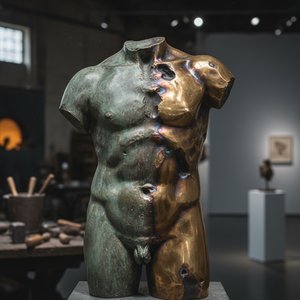
A bronzszobrászat örökös hagyatéka: történelem, technikák és kortárs értelmezések
Fedezze fel a bronzszobrászat gazdag történetét és lenyűgöző alkotásait! Ismerje meg az ősrégi technikákat, kortárs művészeket és szobrok gondozását. Prémium minőségű reprodukciókért látogasson el hozzánk!

The Enduring Form: Sculpture Across History, Technique & Emotional Resonance
Explore the rich history of sculpture with OriginalUniqueArt. Discover key techniques, influential artists & investment potential for discerning collectors. Expert insights into valuing and collecting timeless masterpieces.

A művészettörténet 10 legikonikusabb bronzszobra – OriginalUniqueArt.com
Fedezze fel a művészettörténet 10 legikonikusabb bronzszobrát! Ismerje meg Rodint, Michelangelót és más mestereket. Luxus minőségű nyomatok otthonába – OriginalUniqueArt.com.

A művészettörténet 10 legikonikusabb bronzszobra – OriginalUniqueArt.com
Fedezze fel a művészettörténet 10 legikonikusabb bronzszobrát! Ismerje meg Rodin, Michelangelo és más mesterek alkotásait. Luxus minőségű reprodukciók otthonába – OriginalUniqueArt.com.

The Enduring Form: Exploring Themes & Techniques in Sculpture Across Historical Periods
Explore the rich history of sculpture from ancient masterpieces to contemporary innovations. Discover key techniques, influential artists & investment potential for discerning art collectors.
