Text size

() ·

A painting made for you, by hand

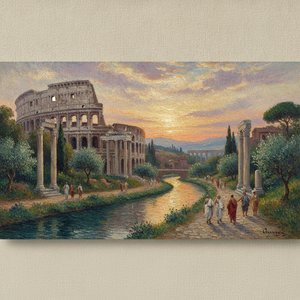
RUINES ROMAINES AVEC LE COLISEE

Kézzel készített olajfestmény reprodukció

Kézzel festett olajvastú vászon, az Ön által választott méretben és keretben, művészeink készítik meglévőre. ( Váltás nyomtatványra Áttérés digitális képre)

A gyűjtemény leírása

Hubert Robert's 'Ruines Romaines avec le Colisée' captures the beauty of Roman ruins reclaimed by nature, showcasing a romantic vision of decay and grandeur. Explore this masterpiece of French landscape painting.

A művész életrajza

Robert Hubert (1733–1808): Franciaország egyik legkiemelkedőbb tájképfestője, aki a rombolás és a látlelet varázslatos keverékével alkotott. Fedezze fel művészetét!

from ·

Chapter 1

How large should it be?

Slide to change the size; the picture on the left shows the frame at its real width. The proportions of the original are kept.

Standard méret
egyedi méretű
CM
INCH

Válasszon előre meghatározott méreteink közül, amelyek megfelelnek a műalkotás eredeti arányainak.

szélesség
magasság

Írja be a kívánt szélességet és magasságot, hogy illeszkedjen a keretéhez vagy a falához. Mivel ez kézzel festett alkotás, egy eltérő formájú méret esetén a művész akár festhet is valamivel többet a kép körül, vagy korolathat is belőle — az Ön döntésének megfelelően. A festés megkezdése előtt küldünk egy digitális tervezetet jóváhagyásra. Az oldalon látható kép nem tartalmazza a végeredményt — csak a tervezet mutatja meg a valódi eredményt.

Chapter 2

How should it arrive?

Choose the edges of the stretched canvas

Choose your frame

Corner sample of the WhiteWrap canvas edge finish, stretched on tömörfa bars
White Ft1
Corner sample of the BlurSideWrap canvas edge finish, stretched on tömörfa bars
Blurside Ft1
Corner sample of the ExtendedWrap canvas edge finish, stretched on tömörfa bars
Extended Ft1
Corner sample of the P118B picture frame: formázott polisztirol, 5 cm wide and 3 cm thick
P118B Ft10
Corner sample of the P118H picture frame: formázott polisztirol, 5 cm wide and 3 cm thick
P118H Ft10
Corner sample of the P118W picture frame: formázott polisztirol, 5 cm wide and 3 cm thick
P118W Ft10
Corner sample of the P438Z picture frame: formázott polisztirol, 5.5 cm wide and 3.5 cm thick
P438Z Ft10
Corner sample of the P508JH picture frame: formázott polisztirol, 7 cm wide and 3.5 cm thick
P508JH Ft12
Corner sample of the P508YH picture frame: formázott polisztirol, 7 cm wide and 3.5 cm thick
P508YH Ft12
Corner sample of the P805H picture frame: formázott polisztirol, 5 cm wide and 3.5 cm thick
P805H Ft10
Corner sample of the P805Z picture frame: formázott polisztirol, 5 cm wide and 3.5 cm thick
P805Z Ft10
Corner sample of the P919BZ picture frame: formázott polisztirol, 7 cm wide and 3.5 cm thick
P919BZ Ft10
Corner sample of the P919G picture frame: formázott polisztirol, 7 cm wide and 3.5 cm thick
P919G Ft10
Corner sample of the P919XJ picture frame: formázott polisztirol, 7 cm wide and 3.5 cm thick
P919XJ Ft10
Corner sample of the P959ZH picture frame: formázott polisztirol, 5 cm wide and 3 cm thick
P959ZH Ft10
Corner sample of the P968JZ picture frame: formázott polisztirol, 6 cm wide and 4 cm thick
P968JZ Ft12
Corner sample of the W106C picture frame: tömörfa, 5 cm wide and 3 cm thick
W106C Ft8
Corner sample of the W218G picture frame: tömörfa, 5 cm wide and 3 cm thick
W218G Ft10
Corner sample of the W218JH picture frame: tömörfa, 5 cm wide and 3 cm thick
W218JH Ft8
Corner sample of the W218Y picture frame: tömörfa, 5 cm wide and 3 cm thick
W218Y Ft10
Corner sample of the W307PJ picture frame: tömörfa, 6 cm wide and 3 cm thick
W307PJ Ft10
Corner sample of the W316G picture frame: tömörfa, 6 cm wide and 3 cm thick
W316G Ft10
Corner sample of the W316PJ picture frame: tömörfa, 6 cm wide and 3 cm thick
W316PJ Ft8
Corner sample of the W316Y picture frame: tömörfa, 6 cm wide and 3 cm thick
W316Y Ft10
Corner sample of the W398PJ picture frame: tömörfa, 5 cm wide and 3 cm thick
W398PJ Ft8
Corner sample of the W4111J picture frame: tömörfa, 6.5 cm wide and 3.5 cm thick
W4111J Ft10
Corner sample of the W500HY picture frame: tömörfa, 7 cm wide and 5 cm thick
W500HY Ft15
Corner sample of the W500JH picture frame: tömörfa, 7 cm wide and 5 cm thick
W500JH Ft15
Corner sample of the W692G picture frame: tömörfa, 8 cm wide and 4 cm thick
W692G Ft12
Corner sample of the W849H picture frame: tömörfa, 5 cm wide and 3 cm thick
W849H Ft8
Corner sample of the W940BG picture frame: tömörfa, 7.5 cm wide and 4.5 cm thick
W940BG Ft15
Corner sample of the W953PJ picture frame: tömörfa, 6 cm wide and 3.5 cm thick
W953PJ Ft8
Corner sample of the H24-GOLD picture frame: faragott fa gesszóval, 10 cm wide and 6 cm thick
H24-GOLD Ft30
Corner sample of the H24-SILVER picture frame: faragott fa gesszóval, 10 cm wide and 6 cm thick
H24-SILVER Ft30
Corner sample of the H36-GOLD picture frame: faragott fa gesszóval, 15 cm wide and 6.5 cm thick
H36-GOLD Ft45
Corner sample of the H36-SILVER picture frame: faragott fa gesszóval, 15 cm wide and 6.5 cm thick
H36-SILVER Ft45

Moulding: . Overall size with the frame: .

Chapter 3

Who paints it, and should anything change?

Examples of what can be changed: Replace face with customer photo; Add pet (e.g., replace cat with dog); Include hidden message in background; Change background landscape or elements.
After order, OriginalUniqueArt.com team will email client for instructions and provide a mockup preview

Világszerte elérhető szállítás () 3-4 hét alatt a szokásos 5 hét helyett. (1 november). A minőség nem kérdőjelezhető.

Chapter 4

The finishing touches

A nameplate, as in a museum?

A gravírozott bronztábla részletei

This elegant plaque features the artist's name and the title of the artwork, finely engraved for a timeless presentation.

It is made from bronze with a refined, elegant finish. The text is precisely laser-engraved for a sharp and permanent result. Measuring 9x2 cm, the plaque is compact yet easy to read. It's built to be durable and scratch-resistant, offering a professional, museum-quality look. Mounting is simple thanks to the included adhesive backing.

Átlátszó akril tábla részletei

The plaque includes essential engraved details such as the artist's name, the title of the artwork, the date it was created, the type of media used-like oil on canvas or watercolor-a brief description of the piece, and a QR code that links to the complete artwork information.

It is crafted from clear acrylic, offering a sleek, modern appearance. The text is UV-engraved in black to ensure strong visual contrast. With a size of 10x15 cm, it ensures optimal readability. It comes equipped with two metal hooks for secure wall mounting. The plaque is designed to be weather-resistant, making it suitable for various environments, and it includes interactive features that work seamlessly with smartphone scanning.

Fekete akril tábla részletei

This elegant plaque includes engraved information such as the artist's name, the title of the artwork, the date it was created, the type of media used (like oil on canvas or watercolor), a short description of the artwork, and a QR code for quick access to more information.

The plaque itself is made from refined black acrylic with a premium finish. The text is laser-engraved in white for high contrast and readability. Its size is 10x15 cm, designed to be easy to read. It comes with two metal hooks for professional mounting. The design is sleek and fits any interior style. It is also weather-resistant and durable, with built-in digital integration for mobile compatibility.

A protective varnish?

When do you need it?

Chapter 5

Your painting, as you ordered it

RUINES ROMAINES AVEC LE COLISEE

Reprodukciós technika

Reprodukció mérete

-

Kiváló mesterművész

Nagyobb részletesség, finomság és bővített gyártási idő

-

Reprodukció keretezése

-

-

A bármely oldalsó méretét túlszálaló 105 cm (kb. 41 hüvelyk) meghaladó műalkotások vagy reprodukciók esetében a keret összeszerelhető készletként, szétszerelve kerül szállításra. Ez a módszer biztosítja a biztonságos szállítást, és megakadályozza a szállítás során fellépő sérüléseket.

Szakmész összeszerelést igényel – ez nem DIY (önösszeszerelhető) termék.
A készletet egy tapasztalt keretező szakembernek kell összeszerelnie és a vásznat feszítenie kell, fa ragasztó (nem tartalmazza a csomag), vásznfeszítő fogó és szorítók használatával, amelyek a ragasztó száradásáig a keretrészeket egymáshoz vuôngjba tartják. A helytelen összeszerelés vagy a nem egyenletes vásznfeszítés maradandó károsíthatja a műalkotást, és ez nem része a garanciánknak.

  • A készlet tartalmazza az összes tömörfa rudat, pontosan méretre vágva.

  • A mellékelt csavarokkal, valamint a sarokszerekhez szükséges faütő ragasztóval kell összeszerelnie (ez nem tartalmazható a csomagban), így a keretrendezőnek külön kell beszereznie.

  • A csomag nem tartalmazza a szükséges professzionális eszközöket: egy vászonfeszítőt és klipseket a rácsok vízszintes tartásához a ragasztó megszáradásáig.

Fontos:
A sarokcsatlakozásokhoz fánylagra van szükség, a keretrudakat szorítókapcsokkal kell rögzíteni, amíg a rag teljesen meg nem szárad, a kész keretre feszített vászonhoz pedig vászonfeszítő fogat szükséges. Ezek egyike sem található meg a készletben. Kérjük, rendelés előtt győződjön meg róla, hogy rendelkezik tapasztalt keretező szakemberrel.

Névtábla

-

-

Védőréteg (Lakk)

Fényes lakk (intenzívabb színek, védelem a fény és a nedvesség hatása ellen)

-

Műalkotásom egyedi igényre szabása

Példák a módosíthatóságra: az arc kicserélése az ügyfél fotójára; háziállat hozzáadása (pl. macska helyett kutya); rejtett üzenet elhelyezése a háttérben; a háttér tájainak vagy elemeinek megváltoztatása.

-

Sürgős

Világszerte szóló szállítás () mindössze 3-4 hét alatt, a szokásos 5 hét helyett. (1 november). A minőség nem kérdőjelezhető.

-

Express szállítás

Világszerte elérhető szállítás területre 5 héten belül. (8 november).

A szállítás díja tartalmazza

Összesített ár

Ft 130989

Összesített ár Ft 130989

Az üvegkeretes opció csak 110 cm alatti méretben érhető el

Included with every order

  • Ingyenes globális expressz szállítás
  • Prémium minőségű len vászon
  • Teljes körű szállítási biztosítás
  • Vámvisszatérítési Garancia
  • Hiteles színarányosság garancia
  • 100 napos visszaküldési lehetőség (csak hibás termékek esetén)
  • 100% pénzvisszatérítési garancia
  • Több darab vásárlásakor kedvezmény

A Glimpse of Lost Grandeur: Hubert Robert’s “RUINES ROMAINES AVEC LE COLISEE”

Hubert Robert's "Ruines Romaines avec le Colisée" isn’t merely a depiction of crumbling stone; it’s an invitation to step back in time, a poignant meditation on the relentless march of history and the enduring allure of vanished civilizations. Painted around 1788, this captivating artwork transports us to a world where the echoes of Roman power resonate through the fragmented remains of its once-magnificent structures. Robert, a master of the "capriccio," skillfully blends meticulous observation with imaginative flourishes, creating an atmosphere thick with nostalgia and a subtle sense of melancholy. The painting’s strength lies not just in its technical brilliance – the masterful use of light, perspective, and texture – but also in its ability to evoke profound emotional responses, prompting us to contemplate our own place within the vast sweep of time.

Composition and Visual Narrative

The composition immediately draws the eye towards a central vista, a carefully orchestrated pathway leading into the distance where the imposing silhouette of the Colosseum dominates the horizon. Robert employs a strong sense of linear perspective, subtly diminishing the scale of the ruins as they recede, reinforcing their age and isolation. The foreground is dominated by colossal, fragmented columns – remnants of temples and public buildings – arranged in a deliberate framework that guides the viewer’s gaze. A circular basin, populated by figures sketching and observing, acts as an intriguing focal point within this ruinous landscape, suggesting a contemporary appreciation for the past amidst its decay. Scattered rubble and architectural fragments are not simply decorative elements; they actively contribute to the painting's narrative of loss and transformation.

Color, Light, and Atmospheric Effects

The color palette is deliberately muted, reflecting the weathered stone and the passage of centuries. Predominantly shades of grey, beige, brown, and pale blue create a tranquil yet somber atmosphere – a testament to time’s relentless work. Subtle touches of green from the foliage in the left foreground offer a delicate contrast, hinting at nature's persistent reclamation of these ancient spaces. Robert masterfully utilizes diffused light, suggesting an overcast day, which softens shadows and enhances the painting’s overall sense of tranquility. The lighting is particularly effective in highlighting the textures of the stone, emphasizing its roughness and age while simultaneously illuminating the figures within the scene, drawing our attention to their contemplative presence.

Romanticism, Antiquarianism, and Robert's Vision

“Ruines Romaines avec le Colisée” firmly resides within the realm of French Romanticism, yet it transcends simple picturesque landscapes. Robert’s work is deeply rooted in antiquarianism – a fascination with the past and a desire to preserve its memory through art. He wasn't simply documenting ruins; he was actively constructing imagined scenes, blending historical accuracy with poetic license. Influenced by artists like Piranesi, Robert created "capricci" that were not merely realistic depictions but rather evocative narratives of lost grandeur. The painting speaks to the Romantic sensibility’s preoccupation with emotion, imagination, and the sublime—the awe-inspiring beauty found in decay and ruin. Robert's own experiences – his time in Rome, his arrest during the Revolution, and his subsequent role as a guardian of Parisian gardens – undoubtedly shaped his artistic vision, imbuing his work with a profound sense of longing for a bygone era.

OriginalUniqueArt offers exquisite hand-painted reproductions of Hubert Robert’s “Ruines Romaines avec le Colisée,” allowing you to bring this evocative masterpiece into your home or office. Each reproduction is created by skilled artists using traditional oil painting techniques, faithfully capturing the original's atmospheric depth and emotional resonance. Explore our collection today and experience the timeless beauty of Robert’s vision.

Kérdések és válaszok

Milyen színtelítettséggel rendelkezik „RUINES ROMAINES AVEC LE COLISEE”, Hubert Robert alkotása?

A "RUINES ROMAINES AVEC LE COLISEE" színeinek telítettsége Subtle Color.

Mik a „RUINES ROMAINES AVEC LE COLISEE” mű másolati jogai a Louvre gyűjteményében?

A Louvre gyűjteményében található „RUINES ROMAINES AVEC LE COLISEE”, Hubert Robert alkotása közösségi tulajdon – a szerzői jog lejártt státuszú. Ez a státusz határozza meg, hogy a kép másolható-e.

Ismertebb műalkotás a „RUINES ROMAINES AVEC LE COLISEE”, Hubert Robert alkotása?

A „RUINES ROMAINES AVEC LE COLISEE”, Hubert Robert alkotása népszerűségi szintje Recognized. Ez a besorolás azt tükrözi, mennyire ismert és elismert ez a mű.

More about this painting

Megtekintés AR előnézet Váltás nyomtatványra Áttérés digitális képre Küldés
Részletek Útmutató Kedvencekhez ad Letöltés Hasonló darabok X-ray felvétel Diavetítés Q&A Statisztika

In numbers

  • 29frames to choose from
  • standard sizes, in its own proportions
  • 5weeks to paint and deliver it
Hubert Robert

Hubert Robert

1733 - 1808, Franciaország

Quick facts about Hubert Robert

  • Artistic Movement Or Style: Római iskola, romantika
  • Artists Or Movements Influenced By This Artist: ['Romantika']
  • Artists Who Influenced This Artist:
    • Giovanni Panini
    • Piranesi
  • Date Of Birth: 1733. május 22.
  • Date Of Death: 1808. április 15.
  • Full Name: Hubert Robert
  • Nationality: Francia
  • Notable Artworks:
    • Római kikötő
    • Galatea repülése
  • Place Of Birth: Párizs, Franciaország

A művész életrajza

A Painter of Ruins and Visions: The World of Hubert Robert

Hubert Robert, a name inextricably linked to evocative landscapes and the romantic allure of ruins, occupies a unique and profoundly influential position in 18th-century French art. Born in Paris in 1733, his life unfolded against a backdrop of dramatic artistic shifts—from the opulent excesses of the Rococo to the burgeoning ideals of Neoclassicism—and was deeply shaped by the tumultuous events of the French Revolution. Robert wasn’t merely documenting decay; he was meticulously crafting visions, skillfully blending astute observation with boundless imagination to create scenes that resonated with a poignant nostalgia for the past and an anticipatory awareness of the future. His artistic journey began within the structured confines of formal training, initially under the tutelage of the sculptor Michel-Ange Slodtz, who recognized Robert’s considerable talent but wisely steered him towards painting, sensing his true calling lay in capturing the ephemeral beauty of light, atmosphere, and the subtle poetry inherent in form.

Roman Reveries: Shaping an Artistic Identity

The defining moment in Robert's artistic development arrived with his extended sojourn to Rome between 1754 and 1765. Accompanying Étienne-François de Choiseul, he immersed himself completely within the ancient city’s captivating world—a realm steeped in history, architectural grandeur, and a palpable sense of timelessness. This wasn't simply about replicating what he observed; it was an intensely transformative experience that fundamentally shaped his artistic sensibilities. For eleven years, Rome became his open-air studio, its crumbling temples, majestic arches, and overgrown gardens relentlessly fueling his imagination. He worked closely with Giovanni Paolo Panini, a master of *capriccio* compositions—fantastical views that juxtaposed classical ruins with contemporary life—but Robert quickly surpassed mere imitation, developing a distinctly personal style characterized by an almost obsessive attention to detail, a masterful command of atmospheric perspective, and a profound sensitivity to the interplay of light and shadow. He wasn’t merely painting ruins; he was capturing time itself, distilling its essence into evocative scenes that hinted at both loss and enduring beauty. His extensive sketchbook collection from this period—filled with meticulously rendered studies of Roman landmarks such as the Villa d'Este and Caprarola—provides invaluable insight into his artistic process and reveals a keen eye for architectural nuance and landscape composition. These sketches weren’t preparatory drawings; they were, in essence, finished paintings in miniature, demonstrating Robert’s ability to capture not just the appearance but also the *feeling* of a place.

Parisian Acclaim and Royal Patronage

Robert's triumphant return to Paris in 1765 marked a significant turning point in his career. He swiftly gained recognition within the established artistic circles, securing admission to the Académie Royale de Peinture et de Sculpture with “The Port of Rome, Ornamented with Different Monuments of Architecture, Ancient and Modern.” This monumental work immediately captivated audiences and critics alike, showcasing Robert’s remarkable ability to synthesize his Roman experiences into a compellingly theatrical composition. His subsequent exhibitions at the Salon—the official art exhibition of the Académie Royale—garnered widespread acclaim, drawing considerable attention to his evocative depictions of ruins, picturesque landscapes, and fantastical *capriccio* scenes. The influential critic Denis Diderot famously lauded Robert’s paintings for their ability to transport viewers to another time and place, recognizing his profound skill in evoking a sense of nostalgia and wonder. This burgeoning success quickly led to royal patronage—a testament to the esteem in which he was held by the French court. He received commissions for decorative projects within the Palace of Versailles and was subsequently appointed “Designer of the King’s Gardens,” a prestigious position that further elevated his status. Later, he became “Keeper of the King's Pictures,” responsible for overseeing the collection and ensuring its proper care—a role that underscored his expertise and dedication to preserving France’s artistic heritage.

Revolution, Resilience, and Lasting Legacy

The French Revolution presented an unprecedented and profoundly challenging period for Robert and the entire artistic community. While many artists struggled to navigate the politically volatile climate, Robert demonstrated remarkable resilience and continued to paint prolifically throughout this tumultuous era. He even endured a harrowing imprisonment during the Reign of Terror—a terrifying experience that nonetheless seemed to fuel his creative spirit, resulting in a series of poignant drawings documenting his confinement. Following the Revolution, Robert was appointed curator of the newly established Muséum Central des Arts—the future Musée du Louvre—a remarkable recognition of his expertise and unwavering commitment to safeguarding France’s cultural treasures for generations to come. He played a crucial role in organizing and cataloging the museum's vast collection, ensuring that its artistic legacy would endure. Hubert Robert died in Paris in 1808, leaving behind an extraordinary body of work—a testament to his exceptional talent, innovative vision, and enduring influence on French art. His legacy extends far beyond mere technical skill; he pioneered a genre of painting that celebrated both the beauty of decay and the timeless power of human creativity, bridging the gap between the Rococo and Neoclassical periods and anticipating many of the key characteristics of Romanticism with his fascination for history, imagination, and the evocative portrayal of lost worlds.
  • Key Influences: Giovanni Paolo Panini, Piranesi, the architectural landscape of Rome.
  • Major Themes: Ruins, landscapes, *capriccio* paintings, historical memory, the passage of time.
  • Artistic Style: Meticulous detail, atmospheric perspective, evocative lighting, blending observation with imagination.

Gyors információk

  • Artistic style: Capriccio, atmospheric
  • Artist: Hubert Robert
  • Medium: Oil on canvas
  • Notable elements: Colosseum, ruins, figures

Művészeti kvíz

Minden kérdésre csak egy helyes válasz létezik.

Kérdés 1:
What is the primary subject matter of this artwork?
Kérdés 2:
The artwork primarily reflects which artistic movement?
Kérdés 3:
What is the dominant color palette used in this painting?
Kérdés 4:
The use of atmospheric perspective in the artwork primarily serves to:
Kérdés 5:
Hubert Robert's fascination with ruins is most closely associated with: