

 Megtekintés
 Küldés
 Megosztás
 Részletek

 Letöltés
 Hasonló darabok
 X-ray felvétel
 Diavetítés
Landscape

 Összes részlet megjelenítése
Vásároljon nagy felbontású, javított digitális képet, amely minőségében messze felülmúlja az online előnézetet.
Minden fájlt szakembereink a legmodernebb eszközök és precíz, kézi retusálás segítségével készítenek el aprólékosan. Gondoskodunk arról, hogy minden kép kivételes tisztasággal, pontos színhelyességgel és részletgazdag finomsággal rendelkezzen.
A végleges fájl 72 órán belül e-mailben megérkezik, professzionális, szerkesztői és nyomtatási környezetbe optimalizálva az azonnali használathoz. Ez ugyanaz a minőség, amelyben a legmeghatározóbb tervezőstúdiók, kiadók és galériák is megbízhatnak.
Digitális kép
Töltsön le nagy felbontású fájlt személyes kiállításokhoz, nyomtatáshoz és kreatív projektekhez. ( Nyomat rendelése Kézzel festett másolat rendelése)
Minden digitális kép rendeléséhez tartozó extrák
Szakértői digitális kézbesítés, garantáltan
Amikor a OriginalUniqueArt.com szolgáltatást választja, nem csupán egy képet kap – professzionálisan felmagasított digitális műalkotást kap, amely precizitással készült, és amelyet megelégsedési gwarancia tesz biztoslássá. Az alábbiakban automatikusan minden benne 】

Gyors e-mail teslimítés
A nagy felbontású digitális képmásolatát a megrendelést követő 72 órán belül e-mailben elküldjük Önnek – azonnal használható formátumban.

MI-alapú digitális fejlesztésű fájl
Műve professzionális módon kerül optimalizálásra fejlett mesterséges intelligencia eszközök és manuális szerkesztés segítségével, biztosítva a maximális részletességet, tisztaságot és színpontosságot.

Örök életű ingyenes újradelivery
Véletlenül törölted vagy elvesztetted a fájlodat? Ne aggódj – bármikor ingyen újra megküldjük neked.

Nincs importköltség – soha
Élvezze műalkotásait azonnal, vám, illeték vagy szállítási költség nélkül – a digitális letöltések mindig adamentesek.

Színpontosság garantálása
Professzionális eszközök és színkezelés segítségével garantáljuk, hogy digitális képe a lehető legpontosabban tükrözze az eredeti színeket.

60 napos elégedettségi garancia
Ha nemມີ elégedett a digitális képpel, 60 napon belül átmunkáljuk azt, vagy 100% visszatérítjük az amountot – kérdés nélkül.

100% Pénzvisszatérítési garancia
Nem érheted el a teljes elégedettséget? 60 napon belül teljes visszatérítést kapsz a digitális fájlod megérkezése után – kérdés nélkül.

Tömegrendelési kedvezmények
Vásároljon 3 képet, spóroljon 10%-et - Vásároljon 5-öt, spóroljon 15%-et - Vásároljon 10+ képet, spóroljon 20%-at. Kiváló kreatív projektekhez, galériákhoz és ügynökségekhez.
A művész életrajza
The Luminous Legacy of Hippolyte Petitjean
In the golden twilight of the nineteenth century, a period defined by radical shifts in perception and the pursuit of pure light, Hippolyte Petitjean emerged as a vital architect of color. Born in the quiet surroundings of Mâcon, France, in 1854, his journey from a provincial student to a central figure in the Neo-Impressionist movement is a testament to the transformative power of artistic vision. His early training began at the age of thirteen in his hometown, but it was the move to Paris and the prestigious École des Beaux-Arts that would fundamentally reshape his destiny. Under the tutelage of academic masters such as Alexandre Cabanel and Pierre Puvis de Chavannes, Petitjean mastered the rigorous foundations of classical technique, yet his spirit yearned for a more modern, scientific exploration of the visible world.
The trajectory of Petitjean’s career underwent a profound metamorphosis in 1884, following a fateful encounter with Georges Seurat. This meeting was not merely a social introduction but an artistic awakening. Inspired by Seurat’s revolutionary theories on optical mixing, Petitjean abandoned the traditional blending of pigments in favor of Pointillism. He embraced the meticulous application of tiny, distinct dots of pure color, a method designed to let the viewer's eye perform the work of synthesis. This transition from the academic traditions of his mentors to the vibrant, shimmering surfaces of Neo-Impressionism allowed him to capture a sense of luminosity that felt almost supernatural, turning landscapes and portraits into vibrating tapestries of light.
A Mastery of Light and Form
Petitjean’s oeuvre is characterized by a remarkable versatility that refused to be confined to a single stylistic prison. While he is most celebrated for his Pointillist precision, his hand was capable of great fluidity. By 1894, he began to move away from the rigid dotting technique, integrating more feathery, expressive strokes into his compositions. This evolution allowed him to bridge the gap between the scientific rigor of Seurat and the more emotive, atmospheric qualities of Impressionism. His landscapes, particularly those capturing the rugged beauty of Normandy and Brittany, serve as profound meditations on the interplay of atmosphere and earth, where the sea and sky seem to dissolve into a haze of pure pigment.
Beyond the landscape, Petitjean’s portraits stand as some of his most intimate achievements. In these works, he utilized his mastery of color theory to imbue skin tones with a subtle psychological depth. He did not merely seek to replicate a likeness; rather, he sought to capture the very essence of his subjects through the careful orchestration of light and shadow. His ability to layer pigment to achieve an unparalleled realism—where a face seems to glow from within—demonstrates a sophisticated understanding of how color affects human perception. This dedication to the emotional resonance of color ensured that even his most technical experiments remained deeply human.
Historical Significance and Artistic Endurance
The significance of Hippolyte Petitjean lies in his role as a bridge between eras. He was an artist who could navigate the strictures of the Salon while simultaneously pushing the boundaries of the avant-garde. His participation in the Salon des Indépendants and exhibitions across Europe—from Brussels to Berlin—cemented his reputation as a significant voice in the international art scene. Even as he experimented with decorative watercolours later in life, returning to widely spaced rounded spots of pure color, he remained faithful to the core principle that light is not merely something that falls upon an object, but something that resides within the very fabric of color itself.
Today, the legacy of Petitjean continues to resonate through the collections of prestigious institutions such as the National Gallery of Art and the Musée d’Art Moderne in Paris. His work serves as a vital chapter in the story of modern art, reminding us of a time when painters dared to deconstruct reality into its most fundamental elements: dots, light, and emotion. To look upon a Petitjean painting is to witness the triumph of scientific observation married to poetic intuition, an enduring testament to the beauty found in the meticulous assembly of a thousand tiny fragments.
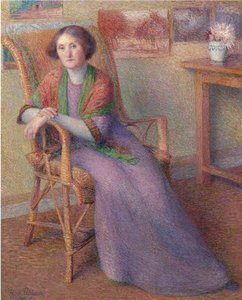
hippolyte petitjean
1854 - 1929 , France
Érdekességek
- Artistic Movement Or Style: Pointillism
- Date Of Birth: 1854
- Full Name: Hippolyte Petitjean
- Nationality: French
- Notable Artworks:
- Pont Neuf
- Woman in a Garden
- In the Park
- Place Of Birth: Mâcon, France

