Megtekintés
 Küldés
 Megosztás
 Részletek
 Útmutató

 Letöltés
 Hasonló darabok
 X-ray felvétel
 Diavetítés
 Statisztika
Dancer Tilting
 Acrylic
- WallArt
- Impressionistic Realism
 1883
1883 69.0 x 51.0 cm
 Összes részlet megjelenítése
Kézzel készített olajfestmény reprodukció
Kézzel festett olajvastú vászon, az Ön által választott méretben és keretben, művészeink készítik meglévőre. ( Váltás nyomtatványra Áttérés digitális képre)




P118B Ft10

P118H Ft10

P118W Ft10

P438Z Ft10

P508JH Ft12

P508YH Ft12

P805H Ft10

P805Z Ft10

P919BZ Ft10

P919G Ft10

P919XJ Ft10

P959ZH Ft10

P968JZ Ft12

W106C Ft8

W218G Ft10

W218JH Ft8

W218Y Ft10

W307PJ Ft10

W316G Ft10

W316PJ Ft8

W316Y Ft10

W398PJ Ft8

W4111J Ft10

W500HY Ft15

W500JH Ft15

W692G Ft12

W849H Ft8

W940BG Ft15

W953PJ Ft8




Válasszon előre meghatározott méreteink közül, amelyek megfelelnek a műalkotás eredeti arányainak.

Írja be a kívánt szélességet és magasságot, hogy illeszkedjen a keretéhez vagy a falához. Mivel ez kézzel festett alkotás, egy eltérő formájú méret esetén a művész akár festhet is valamivel többet a kép körül, vagy korolathat is belőle — az Ön döntésének megfelelően. A festés megkezdése előtt küldünk egy digitális tervezetet jóváhagyásra. Az oldalon látható kép nem tartalmazza a végeredményt — csak a tervezet mutatja meg a valódi eredményt.
A rendelést követően a OriginalUniqueArt.com csapata e-mailt küld az ügyfélnek az instrukciókért, és biztosít egy előnézeti képet (mockup).
Világszerte elérhető szállítás () 3-4 hét alatt a szokásos 5 hét helyett. (26 október). A minőség nem kérdőjelezhető.

Ingyenes globális expressz szállítás

Prémium minőségű len vászon

Teljes körű szállítási biztosítás

Vámvisszatérítési Garancia

Hiteles színarányosság garancia

100 napos visszaküldési lehetőség (csak hibás termékek esetén)

100% pénzvisszatérítési garancia

Több darab vásárlásakor kedvezmény
 Az üvegkeretes opció csak 110 cm alatti méretben érhető el

Dancer Tilting
Reprodukciós technika
Reprodukció mérete
-


Összesített ár
Ft 96304
A Moment Frozen in Motion: Edgar Degas’s Dancer Tilting
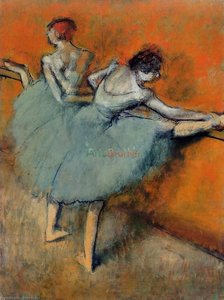
The pastel drawing “Dancer Tilting,” created by Edgar Degas in 1883, stands as a quintessential embodiment of Impressionist artistry—yet simultaneously defies easy categorization. More than just a depiction of ballet; it's an exploration of fleeting beauty and the artist’s unwavering dedication to capturing the essence of movement itself. Located in private collections worldwide, this piece continues to fascinate viewers with its subtle nuances and masterful execution.Subject Matter and Composition
At first glance, “Dancer Tilting” presents a deceptively simple scene: a young woman poised mid-leap, her arms outstretched as if reaching for the heavens. Degas’s focus isn't on grand theatrical gestures but rather on capturing the precise instant of exertion—the subtle tilt of her torso, the delicate curve of her leg muscles straining against gravity. Two additional figures inhabit the background – a pianist and another dancer – subtly reinforcing the ballet studio setting and adding depth to the composition. These elements aren’t merely decorative; they contribute to the overall narrative, hinting at the disciplined environment from which this dancer emerges.Technique: Pastel's Delicate Embrace
Degas’s choice of pastel medium is crucial to understanding the artwork’s aesthetic impact. Unlike oil paints, pastels offer unparalleled luminosity and vibrancy, allowing for incredibly nuanced tonal gradations. Degas skillfully blended shades of yellow, ochre, and gray to recreate the dancer’s dress and skin tone with remarkable accuracy. The artist's technique prioritizes layering thin washes of pastel pigment onto paper, building up texture and capturing the ephemeral quality of light—a hallmark of Impressionism. This method lends itself beautifully to portraying movement, as subtle shifts in color and tone convey a sense of dynamism that would be impossible to achieve with oil paint alone.Historical Context: Challenging Artistic Conventions
Degas’s artistic journey was marked by a constant negotiation between realism and Impressionism. While he admired the grandeur of classical sculpture and painting, he rejected the rigid formalism of academic art, preferring instead to observe life directly—often documenting scenes from Parisian ballet studios. This fascination with dance stemmed not only from aesthetic appreciation but also from an interest in portraying the everyday lives of performers. “Dancer Tilting” reflects this broader artistic impulse: a desire to depict reality as it unfolds, capturing fleeting moments of beauty and emotion without resorting to idealized representations. The painting emerged during a period of significant artistic experimentation, where artists were actively questioning established conventions and embracing new approaches to visual expression.Symbolism and Emotional Resonance
Beyond its technical brilliance, “Dancer Tilting” possesses a profound symbolic resonance. The dancer embodies grace, strength, and aspiration—qualities that transcend the specific context of ballet and speak to universal themes of human endeavor. The pianist’s presence underscores the importance of discipline and focus in achieving artistic excellence. More broadly, Degas's work invites contemplation on the passage of time and the beauty found within transient moments. It captures not just a physical posture but also an inner state—a yearning for movement, balance, and harmony.Conclusion: An Enduring Legacy
“Dancer Tilting” remains a testament to Edgar Degas’s artistic vision and his unwavering commitment to capturing the spirit of Impressionism. Its delicate pastel hues, masterful technique, and evocative composition continue to inspire artists and collectors alike. Reproductions offer an opportunity to experience this iconic artwork firsthand, bringing its beauty and emotional depth into any interior space—a celebration of art's ability to transcend time and connect us to moments of profound grace.Kérdések és válaszok
Hol tekinthető meg a(z) "Dancer Tilting" előnézete?
A „Dancer Tilting”, Hilaire-Germain-Edgar Degas alkotása reprodukciójának megtekintéséhez nyissa meg a mű Előnézet oldalát.
Hogyan tölthetem le a(z) „Dancer Tilting”, Hilaire-Germain-Edgar Degas alkotása képét?
A „Dancer Tilting”, Hilaire-Germain-Edgar Degas alkotása letölthető a mű Letöltés oldaláról, magas felbontású digitális kép letöltése formátumban.
Mekkora a „Dancer Tilting”, Hilaire-Germain-Edgar Degas alkotása valóságos mérete?
A(z) "Dancer Tilting" eredeti mérete 69 x 51 cm. Az eredeti adatok hasznos referenciát nyújtanak a reprodukció méretének kiválasztásakor.
A művész életrajza
A Life Immersed in Movement
Edgar Degas, born Hilaire-Germain-De Gas in Paris on July 19, 1834, remains one of the most intriguing and complex figures in French art history. Often associated with Impressionism, a label he actively resisted, Degas was fundamentally a realist—a meticulous observer of the world around him, dedicated to portraying it with startling honesty and a unique visual language. His early life, comfortably bourgeois thanks to his banker father’s wealth and his mother's Creole background, provided him with access to education and artistic training, though he often felt constrained by academic expectations. Initially enrolled at the Lycée Louis-le-Grand, Degas’s true education began in the Louvre, where he spent countless hours copying works by masters like Raphael and Rembrandt, honing his skills and developing a deep appreciation for classical form. However, this wasn't simply imitation; it was a process of intense study and critical engagement with artistic tradition—a foundation upon which he would later build his own distinctive style. His father’s encouragement, recognizing his son’s innate talent, allowed him to establish a studio within their grand home, providing a space for experimentation and self-discovery.Beyond Impressionism: A Unique Artistic Vision
While many of his contemporaries, including Monet and Renoir, sought to capture the fleeting effects of light outdoors, Degas largely worked within the confines of his Parisian studio. His subject matter was decidedly modern—a departure from the historical or mythological scenes favored by traditional academic painters. He found inspiration in the vibrant, often overlooked details of everyday Parisian life: the bustling activity of laundresses at the Seine, the alluring figures of cabaret singers and dancers, the quiet elegance of milliners crafting their creations. It is this fascination with ballet that defines much of his oeuvre—a world of grueling rehearsals, physical strain, and fleeting moments of grace amidst a demanding profession. Degas didn’t simply paint beautiful ballerinas; he captured the *reality* of their lives, revealing both their beauty and their hardship. His compositions are often unconventional, cropping figures in unexpected ways, utilizing asymmetrical arrangements, and employing a dynamic sense of movement that draws the viewer into the scene. He was particularly adept at capturing the subtle nuances of gesture and expression, conveying not just what he saw but also *how* it felt to be present in those moments. His work is characterized by an intimate, almost voyeuristic perspective, as if he were a silent observer privy to private dramas unfolding before him.Influences and Artistic Development
Degas’s artistic journey was shaped by a remarkably diverse range of influences. His early training emphasized classical principles, particularly the meticulous draftsmanship championed by Jean-Auguste-Dominique Ingres, whose emphasis on precise form and idealized beauty left an indelible mark on his work. However, he also admired the Realist movement, spearheaded by artists like Gustave Courbet, who challenged academic conventions and sought to depict contemporary life with unflinching honesty. A pivotal moment in his development came through his association with Camille Pissarro, a leading Impressionist who encouraged him to experiment with new techniques and broadened his artistic horizons. Degas was deeply captivated by Japanese prints—Ukiyo-e—which exerted a profound influence on his compositions, color palettes, and use of asymmetrical arrangements. He studied the bold lines, flattened perspectives, and decorative patterns of these woodblock prints, incorporating them into his own work to create a sense of dynamism and visual interest. Furthermore, Degas embraced photography as a tool for studying movement and capturing fleeting moments in time—a technique he skillfully integrated into his paintings, particularly his depictions of dancers. He wasn’t simply copying what he saw; he was actively synthesizing diverse influences into something entirely new and uniquely his own.Major Works and Techniques
Degas's artistic output spanned a remarkable range of subjects and media. His paintings of ballet dancers—such as *The Dance Class*, *Little Dancer on the Bar* (bronze sculpture), and *L’Étoile*—are arguably his most famous works, capturing the intensity of rehearsals and the fleeting beauty of performance with unparalleled skill. He also produced a significant body of pastel drawings, often depicting scenes from Parisian life—laundresses at work, milliners displaying their wares, and street vendors hawking their goods. His use of pastels was particularly innovative, employing a loose, expressive technique that captured the immediacy of observation. Beyond painting and sculpture, Degas also experimented with monotypes (unique prints) and drypoint etchings, further expanding his artistic repertoire. His ability to capture movement—not through blurred lines or hazy effects, but through precise observation and careful rendering of form—is a hallmark of his work.Legacy and Lasting Impact
Edgar Degas died in Paris on September 27, 1917, leaving behind a vast and influential body of work that continues to captivate audiences today. He paved the way for future generations of artists who sought to break free from traditional conventions and explore new ways of representing the world around them. His innovative approach to composition, his masterful draftsmanship, and his unflinching portrayal of modern life have had a profound impact on the course of art history. He wasn’t merely a painter of dancers or racehorses; he was a keen observer of human nature, a master of form and movement, and a true innovator who redefined the possibilities of art. His influence can be seen in the work of Pablo Picasso and Henri Matisse, among others, solidifying his place as one of the most important figures in modern art.- Innovative Composition: Degas frequently employed unconventional cropping and asymmetrical arrangements.
- Capturing Movement: He masterfully depicted movement through precise observation and rendering.
- Diverse Subject Matter: His work encompassed ballet, Parisian life, and horse racing.
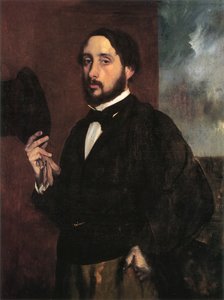
Hilaire-Germain-Edgar Degas
1834 - 1917 , Franciaország
Rövid információk
- Artistic Movement Or Style: Impressionizmus, Realizmus
- Artists Or Movements Influenced By This Artist:
- Picasso
- Matisse
- Artists Who Influenced This Artist:
- Ingres
- Courbet
- Pissarro
- Date Of Birth: 1834. július 19.
- Date Of Death: 1917. szeptember 27.
- Full Name: Hilaire-Germain-Edgar De Gas
- Nationality: Francia
- Notable Artworks:
- Táncosok csoportja
- A táncmester
- Kávéházi jelenet
- Place Of Birth: Párizs, Franciaország
Kapcsolódó cikkek

Edgar Degas: Capturing Modern Life – A Study of Movement, Observation, and the Parisian Belle Époque
Explore the captivating world of Edgar Degas! Discover his innovative techniques, iconic ballet paintings, and unique portrayal of Parisian life in this insightful art history study.
The Subdued Radiance of Pastel Palettes: Exploring Emotional Resonance in Art History
Explore the emotional power of pastel palettes in art history! Discover Impressionism, Post-Impressionism & color psychology insights. Find museum-quality reproductions at OriginalUniqueArt.

The Soft Power of Pastel: A Connoisseur's Guide to History, Technique, and the Art of Texture
Explore the ethereal beauty of pastel art. From Renaissance origins to Impressionist mastery, discover the history, technique, and velvety textures that define this luminous medium in our expert guide for art connoisseurs.

The Subdued Radiance of Pastel: Exploring Nuance & Emotion in Art
Explore the nuanced world of pastel art! Discover its history, techniques & emotional power with expert insights from OriginalUniqueArt.com. Find museum-quality reproductions and learn about collecting this delicate medium.

The Subtleties of Pastel: A Comprehensive Exploration of Technique, History & Emotional Resonance
Explore the captivating world of pastel art! Discover its rich history, Impressionistic masters like Degas, emotional power & unique techniques. Find museum-quality reproductions at OriginalUniqueArt.