- Főoldal

- Vászonra nyomtatás
- Gustáv Moreau
- untitled (3986)

 Előnézet
 Megosztás
 Megosztás
 Részletek

 Letöltés
 Hasonló alkotások
 X-ray felvétel
 Diavetítés
untitled (3986)


 Tovább olvasom
Giclée / Műnyomat
Múzeumi minőségű giclée vagy vászonnyomat, gyors gyártással és rugalmas finomítási lehetőségekkel. ( Áttérés a kézzel festett másolatra Képváltás)




P118B $10

P118H $10

P118W $10

P438Z $10

P508JH $12

P508YH $12

P805H $10

P805Z $10

P919BZ $10

P919G $10

P919XJ $10

P959ZH $10

P968JZ $12

W106C $8

W218G $10

W218JH $8

W218Y $10

W307PJ $10

W316G $10

W316PJ $8

W316Y $10

W398PJ $8

W4111J $10

W500HY $15

W500JH $15

W692G $12

W849H $8

W940BG $15

W953PJ $8




Válasszon előre meghatározott méreteink közül, amelyek megfelelnek a műalkotás eredeti arányainak.

Megadhat saját méreteket is egy konkrét kerethez vagy helyszínhez igazítva. Amennyiben a kiválasztott méret nem egyezik az eredeti kép arányokkal, a műalkotást le fogjuk vágni, vagy kiegészítjük a képet tükrözött vagy egyszínű szélekkel. A gyártás megkezdése előtt egy digitális tervezetet küldünk jóváhagyásra.
Kérjük, vegye figyelembe, hogy a képernyőn látható előnézet nem tükrözi a tényleges levágást vagy kiegészítést. Csak a tervezet mutatja pontosan a végső kompozíciót.
Bár az egyedi méretek is elérhetőek, az eredeti arányok megőrzése érdekében azt javasoljuk, hogy válasszon a előre meghatározott listából származó méretet.
Világszerte történő kiszállítás területére 2 hét alatt, a szokásos 4-5 hét helyett. 3 augusztus

Ingyenes globális expressz szállítás

Prémium minőségű len vászon

Teljes szállítási biztosítás

Vámvisszatérítési Garancia

Tökéletes színpontosság garancia

60 napos visszaküldési lehetőség (csak gyártási hibák esetén)

100%-os pénzvisszatérítési garancia

Kedvezmény több termény esetén
 Az üvegkeretes opció csak 110 cm alatti méretben érhető el

untitled (3986)
Giclée / Műnyomat
A reprodukció mérete
-


Összesített ár
$ 80
Termékinformációk
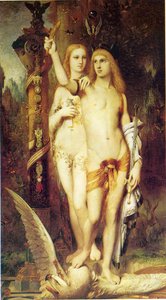
A Dream Within a Forest: Exploring Gustave Moreau’s Untitled Masterpiece (3986)
This captivating oil painting by Gustave Moreau transports viewers to a realm of myth and romance. A reclining nude female figure dominates the composition, nestled within a lush, fantastical forest setting. The scene is imbued with a sense of mystery and ethereal beauty characteristic of the Symbolist movement. In the background, partially obscured by dense foliage, looms an imposing male presence, hinting at hidden narratives and complex relationships.Style & Historical Context
Moreau (1826-1898) was a pivotal figure in the late 19th-century Symbolist movement – a reaction against Realism and Impressionism that sought to express abstract ideas and emotions through evocative imagery. This work exemplifies his signature style: a meticulous attention to detail, rich color palettes, and an embrace of mythological and literary themes. The painting’s aesthetic strongly echoes the Pre-Raphaelites in its romantic idealism and dedication to beauty, yet Moreau infuses it with a distinctly personal and often unsettling psychological depth. He rejected contemporary artistic trends, instead drawing inspiration from historical art, particularly Italian Renaissance masters and Orientalism.Technique & Materials
Executed in oil on canvas, the painting showcases Moreau’s masterful technique. Visible brushstrokes contribute to a tactile quality, especially within the intricate foliage, textured rocks, and delicate skin tones. The artist employed glazing techniques – layering translucent colors – to build luminosity and depth. This meticulous approach creates an immersive experience for the viewer, drawing them into the scene's enchanting atmosphere. The fluid lines and organic shapes further enhance the sense of movement and vitality within the dense vegetation.Symbolism & Interpretation
The symbolism embedded within this work is rich and open to interpretation. The reclining female figure likely represents a nymph or goddess – a personification of nature’s alluring power. The imposing male figure, partially hidden amongst the trees, could be interpreted as a faun, satyr, or other woodland spirit—a guardian or perhaps a threatening presence. The forest itself symbolizes the subconscious mind, a place of both beauty and danger. The contrast between light and shadow adds to this duality, suggesting hidden truths and veiled desires. Moreau’s art consistently explores themes of longing, desire, and the complexities of human emotion.Emotional Impact & Aesthetic Appeal
This painting evokes a powerful emotional response – a blend of dreamy romance, mystery, and perhaps even melancholy. The warm color palette creates intimacy and sensuality, while the cool tones of the forest provide depth and contrast. The intricate details invite close examination, rewarding the viewer with new discoveries upon each viewing. Its immersive quality makes it an ideal piece for creating a captivating focal point in any interior space.Collecting & Reproduction
Gustave Moreau’s works are highly sought after by collectors and art enthusiasts alike. His paintings reside in major museums worldwide, including the Musée Gustave Moreau in Paris – dedicated entirely to his oeuvre. High-quality reproductions of this piece offer an accessible way to experience the beauty and symbolism of Moreau's vision, adding a touch of timeless elegance and intellectual depth to any home or office.- Style: Symbolism, Pre-Raphaelite influences
- Subject: Mythological, Nude, Landscape
- Materials: Oil on Canvas
- Key Themes: Nature, Mythology, Idealized Beauty, Romance, Mystery
A művész életrajza
A Dream Weaver of Symbolism: The Life and Art of Gustave Moreau
Gustave Moreau, a name inextricably linked to the ethereal beauty and profound mysteries of Symbolist painting, emerged from 19th-century Paris as an artist utterly distinct in his vision. Born in 1826 into a comfortable bourgeois family—his father a respected architect and archivist—Moreau’s early life was steeped not just in material comfort, but also in a deep appreciation for art and intellectual curiosity. From a remarkably young age, he displayed a prodigious talent for drawing, nurtured initially through traditional academic training at the École des Beaux-Arts under the guidance of figures like François-Édouard Picot. However, Moreau’s artistic trajectory swiftly diverged from the prevailing Realist and Impressionist currents dominating his time; he possessed little interest in capturing fleeting moments or rendering objective reality. Instead, he was driven by a profound desire to unlock the hidden realms of myth, religion, and the intricate workings of the human psyche – translating these inner landscapes onto canvas through a meticulously detailed and intensely colored visual language. His artistic journey became an inward exploration, a process of distilling subjective emotions and spiritual yearnings into tangible forms, employing an obsessive attention to detail and a palette often rich with opulent hues.The Forge of Imagination: Influences and Artistic Development
Moreau’s artistic development wasn't forged in isolation; rather, it blossomed from a confluence of diverse influences. While consciously rejecting the dominant trends of his era, he drew inspiration from a remarkably broad range of sources. The dramatic use of color and exotic subject matter found in the works of Eugène Delacroix ignited within him a passionate fascination with narrative painting imbued with intense emotional resonance. He held Renaissance masters—Michelangelo and Leonardo da Vinci, in particular—in the highest esteem, deeply admiring their mastery of composition, anatomical precision, and their remarkable ability to penetrate the complexities of human psychology. Yet, Moreau’s genius lay not merely in imitation; he skillfully synthesized these influences – the dynamism of Delacroix, the anatomical rigor of the Renaissance giants – into something entirely new and uniquely his own. His pivotal journey to Italy during the 1850s proved transformative, immersing him completely within the art of antiquity and the Italian Renaissance. This experience provided a veritable treasure trove of motifs, stylistic cues, and artistic precedents that would subsequently populate his future works. Moreau meticulously copied Old Master paintings – not as mere reproductions, but as a deliberate process of absorbing their techniques, understanding their compositional strategies, and unlocking the secrets behind their enduring power. He sought to distill the essence of these masterpieces, translating them into his own distinctive visual vocabulary.A World of Symbols: Themes and Techniques
Moreau’s paintings are not simply illustrations of myths or biblical stories; they are complex allegories designed to provoke contemplation and invite multiple interpretations. He didn't approach narratives like those of Salome, Orpheus, Jupiter and Semele, or countless others, with a desire to retell them literally. Instead, he delved into their underlying psychological and spiritual truths – exploring themes of temptation, loss, redemption, beauty, and the eternal struggle between good and evil. His canvases are often teeming with symbolic imagery: serpents representing deceitful desires, jewels embodying earthly vanities, and figures embodying abstract concepts such as grief, longing, or divine grace. Moreau masterfully created an atmosphere of dreamlike enchantment through intricate detail, rich textures, and a frequently unsettling juxtaposition of light and shadow. His technique was characterized by a painstaking layering of paint—a deliberate process that built up surfaces shimmering with iridescent colors and evoking a profound sense of otherworldliness. The strategic use of gold leaf further amplified this effect, lending his works a Byzantine quality that underscored their spiritual dimension. Crucially, Moreau wasn’t primarily concerned with capturing realistic textures or perspectives; instead, he prioritized the expressive power of color and form to convey mood, emotion, and deeper meaning.Legacy and Influence: The Enduring Power of Symbolism
Though initially met with mixed reactions from the Parisian art establishment, Gustave Moreau gradually gained recognition as a central figure in the burgeoning Symbolist movement during the 1890s. Unlike some of his contemporaries who actively sought public acclaim, he remained largely reclusive, preferring to dedicate himself entirely to his artistic practice within the confines of his studio and home. However, his influence was undeniable. In 1893, he accepted a prestigious professorship at the École des Beaux-Arts, where he profoundly impacted generations of aspiring artists – including Henri Matisse and Georges Rouault – encouraging them to embrace imagination, symbolism, and individual expression, urging them to break free from conventional artistic constraints. Moreau’s legacy extends far beyond his own lifetime. His paintings continue to resonate with audiences today, offering glimpses into the hidden depths of the human soul and reminding us of the transformative power of art to transcend the boundaries of reality. The Musée Gustave Moreau, housed within his former studio and home in Paris, stands as a poignant testament to his enduring artistic vision—a sanctuary where visitors can immerse themselves fully in the captivating world of this extraordinary artist.Notable Works
- Salome Dancing before Herod: Perhaps his most iconic work, this painting exemplifies Moreau’s opulent style and his fascination with biblical narratives, capturing a moment of both beauty and impending doom.
- Jupiter and Semele: A dramatic depiction of the Greek myth, showcasing Moreau's exceptional skill in composition, color orchestration, and conveying a sense of overwhelming power.
- Orpheus: Several paintings by Moreau explore the myth of Orpheus, reflecting themes of loss, grief, artistic inspiration, and the bittersweet nature of beauty.
- The Apparition: Demonstrates his ability to create ethereal and otherworldly scenes, often imbued with a sense of mystery and melancholy.
- Desdemona: A poignant portrayal of Shakespeare’s tragic heroine, capturing her despair and vulnerability with remarkable sensitivity.

Gustáv Moreau
1826 - 1898 , Francia
Rövid tények
- Artistic Movement Or Style: Szimbolizmus
- Artists Or Movements Influenced By This Artist:
- Matisse
- Rouault
- Artists Who Influenced This Artist:
- Delacroix
- Michelangelo
- Da Vinci
- Date Of Birth: 1826. április 6.
- Date Of Death: 1898. április 18.
- Full Name: Gustave Moreau
- Nationality: Francia
- Notable Artworks:
- Salomé táncol
- Jupiter és Semele
- Orfeusz
- A megjelenés
- Desdemona
- Place Of Birth: Párizs, Franciaország
Kapcsolódó cikkek
The Enchanted Canopy: Exploring Forests in Art History – From Romantic Idealization to Ecological Consciousness
Explore the rich history of forests in art! Discover Romantic masterpieces by Friedrich & Monet, Symbolist depths, and contemporary visions. Find inspiration & quality reproductions at OriginalUniqueArt.
The Eloquent Body: A Historical Survey of Figure Painting & Representation
Explore the rich history of figure painting from antiquity to the Renaissance! Discover iconic artworks, masterful techniques & enduring symbolism. Find museum-quality reproductions at OriginalUniqueArt.

A Romantikus Tájképfestészet 10 Legikonikusabb Műalkotása – OriginalUniqueArt.com
Fedezze fel a romantikus tájképfestészet 10 legikonikusabb műalkotását! Caspar David Friedrich, J.M.W. Turner és más mesterek festményeinek története – inspiráló olajfestmények otthonába. OriginalUniqueArt.com: múzeumi minőségű reprodukciók és egyedi dekorációk online.
Gustave Moreau: Symbolism's Enigmatic Visionary & Precursors of Modern Fantasy Art
Explore the captivating world of Gustave Moreau, the leading Symbolist painter. Discover his iconic masterpieces, influences, and lasting legacy. Expert analysis for collectors & art enthusiasts.

A 10 legikonikus impresszionista tájkép: művészeti remekművek otthonába | OriginalUniqueArt.com
Fedezze fel a 10 legikonikus impresszionista tájkép festményt! Monet, Renoir, Degas és más művészek remekművei. Vászonképek, faliképek otthonába – inspirálódjon OriginalUniqueArt.com-on! Explore the full collection online.