Váltás nyomtatványra
 Összes részlet megjelenítése







































 A bármely oldalsó méretét túlszálaló 105 cm (kb. 41 hüvelyk) meghaladó műalkotások vagy reprodukciók esetében a keret összeszerelhető készletként, szétszerelve kerül szállításra. Ez a módszer biztosítja a biztonságos szállítást, és megakadályozza a szállítás során fellépő sérüléseket.


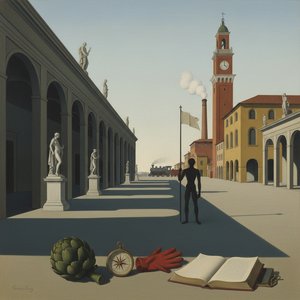
A Still Life Echoing the Masters
This captivating still life by Giorgio de Chirico transports viewers to a realm of rustic beauty and quiet contemplation. Executed in 1992, the painting showcases a carefully arranged collection of apples resting on rough, earthen ground, set against the subtle backdrop of a distant landscape. While created late in his career, this work demonstrates De Chirico’s enduring fascination with classical composition and technique, particularly those of the Spanish Golden Age – notably Velázquez.Style & Technique: A Metaphysical Resonance
De Chirico's approach here is characterized by a loose, expressive style. Bold brushstrokes define the forms of the apples and the texture of the ground, prioritizing the capture of light and atmosphere over meticulous detail. This technique echoes the *alla prima* painting favored by Velázquez, creating a sense of immediacy and vibrancy. The perspective is deliberately flattened, drawing attention to the objects themselves rather than striving for strict realism – a hallmark of his earlier Metaphysical period, though subtly applied here. Oil paint is employed with confidence, building up layers of color and texture that invite close inspection.Subject & Symbolism: Simplicity and Depth
The subject matter—a simple arrangement of fruit—belies a deeper resonance. Still life painting has long been imbued with symbolic meaning. Apples, in particular, carry connotations of abundance, temptation, knowledge, and even mortality. De Chirico doesn’t explicitly dictate a single interpretation; instead, he presents the apples as objects of beauty that invite personal reflection. The rural landscape glimpsed in the background further reinforces themes of nature, transience, and the passage of time.Historical Context: A Legacy of Innovation
Giorgio de Chirico (1888-1978) was a pivotal figure in 20th-century art. Born in Greece to Italian parents, he is best known as the founder of Pittura Metafisica (Metaphysical Painting). This movement, emerging in the early 20th century, profoundly influenced Surrealism with its dreamlike imagery and unsettling juxtapositions. While this later work doesn’t possess the stark strangeness of his Metaphysical paintings, it demonstrates a continued engagement with classical principles and a masterful handling of light and shadow – qualities that made him such an influential artist. His ability to evoke mood and atmosphere remains central to his artistic vision throughout his career.Emotional Impact & Interior Design
The painting evokes a sense of peaceful melancholy, grounded in the earthy tones and tactile brushwork. The warm color palette—dominated by reds, yellows, and greens—creates an inviting ambiance. This artwork would be a stunning addition to a variety of interior spaces.- Its rustic charm complements farmhouse or country-style décor.
- The subdued tones work well in traditional settings, adding depth and sophistication.
- For modern interiors, the painting provides a touch of classic elegance and artistic intrigue.
Kérdések és válaszok
Honnan érkeznek a „untitled (1992)”, De Chirico alkotása látogatói?
A „untitled (1992)”, De Chirico alkotása statisztikái a mű Statisztikák oldalán érhetőek el: a mű havi látogatottsága, a művész alkotásainak megtekintése, valamint a legutóbbi látogatók országos és nyelvi lebontása.
Ki a "untitled (1992)" mögött álló művész?
A "untitled (1992)" alkotója De Chirico. A mű De Chirico nevére van katalógusozva.
Mi a(z) domináns színe a(z) „untitled (1992)”, De Chirico alkotása alkotásnak?
A(z) "untitled (1992)" alkotásban leginkább a Phthalo Green (#2b2222) szín tűnik ki. A domináns szín hasznos, amikor egy műalkotást össze kell egyeztetni egy belső térrel.
 Megtekintés
 Küldés
 Megosztás
 Részletek
 Útmutató

 Letöltés
 Hasonló darabok
 X-ray felvétel
 Diavetítés
 Q&A
Q&A Statisztika