

 Előnézet
 Megosztás
 Megosztás
 Részletek
 Útmutató

 Letöltés
 Hasonló darabok
 X-ray felvétel
 Diavetítés
 Statisztika
The Young Mother
 Acrylic On Canvas
- WallArt
- Dutch Golden Age
 1655
1655 49.0 x 37.0 cm
 Staatliche Museen zu Berlin
 Tovább olvasom
Giclée / Műnyomat
Múzeumi minőségű giclée vagy vászonnyomat, gyors gyártással és rugalmas finomítási lehetőségekkel. ( Kézzel festett másolat vásárlása Áttérés digitális képre)




P118B Ft10

P118H Ft10

P118W Ft10

P438Z Ft10

P508JH Ft12

P508YH Ft12

P805H Ft10

P805Z Ft10

P919BZ Ft10

P919G Ft10

P919XJ Ft10

P959ZH Ft10

P968JZ Ft12

W106C Ft8

W218G Ft10

W218JH Ft8

W218Y Ft10

W307PJ Ft10

W316G Ft10

W316PJ Ft8

W316Y Ft10

W398PJ Ft8

W4111J Ft10

W500HY Ft15

W500JH Ft15

W692G Ft12

W849H Ft8

W940BG Ft15

W953PJ Ft8




Válasszon előre meghatározott méreteink közül, amelyek megfelelnek a műalkotás eredeti arányainak.

Írja be a keretének vagy a falának megfelelő szélességet és magasságot. A nyomatot csak le lehet vágni, soha nem tehető nagyobbá, mint az eredeti kép, így egy eltérő alakú méretnél a kép egy része elveszik. Mielőtt bármit kinyatintanánk, küldünk egy digitális próbamodellt jóváhagyásra. Az oldalon látható kép nem tartalmazza a valós levágást — ezt csak a próbamodell mutatja meg.
Világszerte történő kiszállítás területére mindössze 2 hét alatt, a szokásos 4-5 hét helyett. (22 október)

Ingyenes globális expressz szállítás

Prémium minőségű len vászon

Teljes körű szállítási biztosítás

Vámvisszatérítési Garancia

Tökéletes színarányosság garancia

100 napos visszaküldési garancia (csak gyártási hibás termékek esetén)

100% pénzvisszatérítési garancia

Több darab vásárlásakor kedvezmény
 Az üvegkeretes opció csak 110 cm alatti méretben érhető el

The Young Mother
Giclée / Műnyomat
Reprodukció méretei
-


Összesített ár
Ft 25565
A Moment of Quiet Devotion: Gerrit Dou’s “The Young Mother”
Gerrit Dou's "The Young Mother," painted in 1655, is more than just a portrait; it’s a carefully constructed tableau of domesticity and maternal tenderness, rendered with the exquisite precision that defined his unique ‘fijnschilder’ style. This intimate scene, measuring a modest 49 x 37 cm, offers a glimpse into the heart of 17th-century Dutch life – a world where piety, family values, and an appreciation for subtle detail were paramount. The painting depicts a young woman seated in a chair, gently feeding her infant child nestled within a woven basket. Around her, hints of a larger room unfold: a dining table laden with simple tableware, a couch suggesting a comfortable domestic space, and a clock on the wall subtly anchoring the scene to time’s relentless flow.
Dou's mastery lies in his ability to capture fleeting moments of everyday life with remarkable realism and psychological depth. He was a student of Rembrandt, inheriting from him an understanding of light and shadow, but he developed a distinctly more polished and controlled technique. Unlike Rembrandt’s dramatic contrasts, Dou favored a ‘subtle chiaroscuro,’ meticulously layering thin glazes of paint to create a luminous quality, particularly evident in the soft glow illuminating the mother's face and the baby’s features. This delicate manipulation of light not only enhances the realism but also imbues the scene with an almost ethereal serenity.
The Leiden Fijnschilder and the Art of Nuance
Dou was a key figure in the Leiden ‘fijnschilders’ group – a collective of Dutch painters renowned for their painstaking attention to detail, refined brushwork, and mastery of illusionistic techniques. They specialized in genre scenes, often depicting domestic interiors and everyday activities with an unparalleled level of realism. Dou's work frequently incorporated 'niche' paintings—small, self-contained scenes designed to resemble miniature rooms or architectural details, creating a sense of depth and intrigue. This technique is subtly present here, drawing the viewer into the intimate space and encouraging careful observation.
The painting’s composition is deliberately restrained, focusing on the immediate interaction between mother and child. The presence of the other two figures – one standing near the left side and another to the right – adds a layer of narrative complexity without disrupting the central focus. They are not overtly engaged; rather, they seem to be part of the domestic setting, contributing to the overall sense of quiet normalcy. The bowl on the table further reinforces this impression of everyday life, suggesting a simple meal or preparation for the child.
Symbolism and Emotional Resonance
“The Young Mother” is rich in symbolic meaning, reflecting the prevailing values of 17th-century Dutch society. Motherhood was highly esteemed, representing piety, domestic virtue, and the continuation of the family line. The act of feeding the child symbolizes nurturing, protection, and the transmission of faith. The carefully arranged interior – the table, the couch, the clock – speaks to a desire for order, stability, and a connection to both earthly and spiritual realms.
Beyond its historical context, the painting possesses a profound emotional resonance. The mother’s gentle gaze, the baby's trusting expression, and the overall atmosphere of quiet intimacy evoke feelings of warmth, tenderness, and a deep appreciation for the simple joys of family life. Gerrit Dou masterfully captures a fleeting moment of grace—a testament to the enduring power of maternal love and the beauty of everyday domesticity. A reproduction of this work offers a captivating window into a bygone era, inviting viewers to contemplate the timeless values it represents.
Collecting a Masterpiece: A Reproduction for Your Home
OriginalUniqueArt is proud to offer meticulously crafted hand-painted reproductions of Gerrit Dou’s “The Young Mother.” Our artists replicate Dou's signature style with exceptional accuracy, capturing the subtle nuances of light, color, and brushwork. Whether you are a seasoned art collector or simply seeking to add a touch of Dutch Golden Age elegance to your home, our reproduction provides an authentic representation of this iconic masterpiece. Each reproduction is created on high-quality canvas using archival pigments, ensuring its longevity and beauty for generations to come. Explore the available sizes and options today – bringing a piece of Dutch art history into your personal space.
Gyakran Ismételt Kérdések
Van-e útmutató a(z) „The Young Mother”, Gerrit Dou alkotása alkotáshoz?
A „The Young Mother”, Gerrit Dou alkotása alkotáshoz elérhető egy Útmutató oldal: egy kinyomtatható információs lap a műről, amelyet diákok és tantervhez készült használatra terveztek.
Hogyan ötvölik a kontraszt és a harmónia a(z) "The Young Mother" alkotásban?
A "The Young Mother" alkotásban egy Gentle kontraszt párosul egy Strong Color Unity harmóniával.
Milyen tónus felé hajlik a "The Young Mother"?
A Amber to Saffron árnyalat áthatárolja a „The Young Mother”, Gerrit Dou alkotása alkotást.
A művész életrajza
Gerrit Dou (1613 - 1675)
Gerrit Dou was one of the most famous of all dutch painters until the beginning of the 19th century. He trained with Rembrandt, whose influence shows in his early works. His fame depended on his minutely painted scenes of everyday life, often represented in arched stone openings, like 'A Poulterer's Shop'; these are sometimes called 'niche' paintings. Trompe l’œil techniques were a hallmark of his style, creating illusions that blurred the boundaries between reality and artifice.Life
Gerrit Dou was born in Leiden on April 7, 1613, the son of Marytje Jansdr van Rosenburg and the glassmaker and engraver Douwe Jansz. According to Jan Jansz. Orlers (1570–1646), burgomaster of Leiden and author of a city chronicle in 1641, Dou evinced “a pleasure and desire toward painting” at a young age. He studied drawing under Bartholomeus Dolendo, and then trained in the stained-glass workshop of Pieter Couwenhorn. In February 1628, at the age of fourteen, his father sent him to study painting in the studio of Rembrandt (then aged about 21) who lived nearby. From Rembrandt, with whom he remained for about three years, he acquired his skill in colouring and in the more subtle effects of chiaroscuro, and his master's style is reflected in several of his earlier pictures, notably a self-portrait at the age of 22, around 1635–1638, in the Bridgewater Collection, and in the *Blind Tobit going to meet his Son*, at Wardour Castle. Dou’s workshop was initially located on Kort Rapenburg, where he resided until his death in 1675. He married Anna Maria van der Meer in 1649, and they had several children.Artistic Style and Specialization
Gerrit Dou's artistic style is characterized by its minute and elaborate treatment, often featuring genre scenes and trompe l’œil ‘niche’ paintings. His mastery of chiaroscuro—the dramatic interplay of light and shadow—is particularly notable, as seen in his candlelit night-scenes. He achieved this remarkable effect through a combination of techniques, including the use of concave lenses and convex mirrors to accurately reproduce the illumination of real objects. Dou's meticulous attention to detail extended beyond mere visual representation; he painstakingly crafted every brushstroke, striving for an unparalleled level of realism and expressive nuance. His work was admired by contemporaries and continues to captivate viewers today.Notable Works
Gerrit Dou produced over 200 paintings during his lifetime, many of which are housed in prominent museums across Europe. Among his most celebrated works include *The Astronomer by Candlelight*, a masterful depiction of scientific observation bathed in soft light; *A Poulterer’s Shop*, a stunning example of trompe l'œil that creates the illusion of depth and architectural grandeur; and *The Leiden Collection*, new york, which showcases Dou’s contribution to European art history. His influence extended beyond his own generation, inspiring subsequent artists and shaping the aesthetic sensibilities of the eighteenth century.Legacy
Gerrit Dou is considered one of the founders of the Leiden fijnschilderij—a movement that emphasized precision, subtlety, and polished realism in painting. He was a student of Rembrandt, whose artistic vision profoundly impacted Dou’s own approach to artmaking. His pupils included Frans van Mieris the Elder and Gabriel Metsu, who carried forward Dou's legacy into the next generation of Dutch painters. Gerrit Dou remains an enduring symbol of artistic excellence and innovation—a testament to the transformative power of observation and meticulous craftsmanship.
Gerrit Dou
1613 - 1675 , Holland
Gyors információk
- Artistic Movement Or Style: Fijnschilder
- Artists Or Movements Influenced By This Artist: ['Frans van Mieris öreg']
- Artists Who Influenced This Artist: ['Rembrandt van Rijn']
- Date Of Birth: Április 7., 1613.
- Date Of Death: Február 9., 1675.
- Full Name: Gerrit Dou
- Nationality: Hollandi
- Notable Artworks:
- Az astronomerák kandillal
- A Leiden gyűjteménye
- Place Of Birth: Leiden, Hollandia
Kapcsolódó cikkek

Golden Age Reflections: Dutch Baroque Painting & Cultural Innovation
Explore the Dutch Golden Age of painting! Discover key artists like Vermeer & ter Borch, their innovative techniques, and the rich cultural context behind these Baroque masterpieces. Learn about collecting & appreciating this iconic art period.

A Hollandi Aranykor 10 Mesterműve: Festmények, Amelyek Megváltoztatták a Világot | OriginalUniqueArt.com
Fedezze fel a Hollandi Aranykor 10 legikonikusabb műalkotását! Rembrandt, Vermeer és más mesterek festményeinek történeteit olvassa el. Barokk stílus, klasszikus művészet – inspirálódjon otthon dekorációjához a OriginalUniqueArt.com-on! Fedezze fel a teljes gyűjteményt online.

Golden Light & Dutch Skies: The Timeless Magic of Dutch Golden Age Landscapes
Discover the breathtaking beauty of Dutch Golden Age landscapes. Explore the mastery of light, chiaroscuro, and 17th-century realism through an expert art history lens, celebrating the enduring legacy of the Dutch Masters for discerning collectors and art lovers.
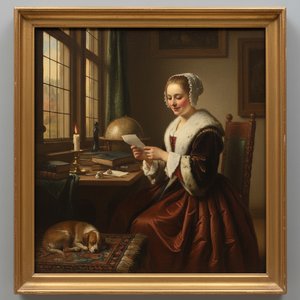
Gerrit Dou: Intimacy & Light in the Dutch Golden Age
Explore the exquisite world of Gerrit Dou, a master of Dutch Golden Age painting. Discover his intimate genre scenes, signature use of light, and lasting legacy. Learn about collecting Dou's works & their value.
Illuminating Realism: Exploring the Dutch Golden Age of Painting (1600-1700)
Explore the Dutch Golden Age of painting (1600-1700) with OriginalUniqueArt. Discover Rembrandt, Vermeer & other masters. Learn about techniques, history & find museum-quality reproductions.


