Váltás nyomtatványra
 Összes részlet megjelenítése







































 A bármely oldalsó méretét túlszálaló 105 cm (kb. 41 hüvelyk) meghaladó műalkotások vagy reprodukciók esetében a keret összeszerelhető készletként, szétszerelve kerül szállításra. Ez a módszer biztosítja a biztonságos szállítást, és megakadályozza a szállítás során fellépő sérüléseket.


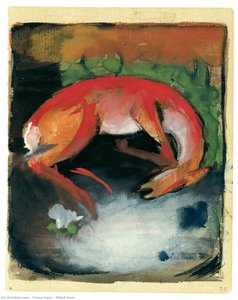
A Glimpse into a Primal World: Decoding Franz Marc’s *Fabulous Beast II*
Franz Marc's *Fabulous Beast II*, painted in 1913, is more than just an image of an animal; it’s a vibrant exploration of the spiritual connection between humanity and nature, rendered through the lens of early modernism. This small but powerfully evocative work—measuring only 26 x 30 cm—packs a significant punch, embodying Marc's unique artistic vision and his pivotal role in the development of Expressionism.Subject & Style: Beyond Representation
At first glance, *Fabulous Beast II* presents a fragmented depiction of a horse, its form broken down into geometric shapes and bathed in fiery hues of red and orange. However, to call it simply a “horse” feels inadequate. Marc wasn’t interested in realistic representation; he sought to capture the *essence* of the animal – its inner life, its energy, and its place within the cosmos. This approach aligns with his broader philosophical beliefs about animals as possessing a purity and spiritual depth lacking in human society. The style is undeniably influenced by Cubism, evident in the fractured planes and multiple perspectives, but Marc infuses it with an emotional intensity that sets his work apart.Technique & Materials: A Textured Vision
Executed in tempera on board, the painting’s surface exhibits a noticeable texture, achieved through visible brushstrokes. This impasto technique adds depth and physicality to the composition, enhancing the sense of movement and vitality. The deliberate application of paint isn't merely decorative; it contributes to the overall expressive power of the work, conveying a raw, almost primal energy.Historical Context: Der Blaue Reiter & Spiritual Expression
*Fabulous Beast II* emerged during a period of intense artistic experimentation and societal upheaval. Marc was a founding member of *Der Blaue Reiter* (The Blue Rider), a group of artists who rejected traditional academic art in favor of subjective expression and spiritual exploration. Influenced by Fauvism’s bold color palettes and Cubism's formal innovations, the group sought to create an art that resonated with inner experience rather than external reality. Marc believed animals were closer to this primal state of being, making them ideal subjects for his artistic investigations.Symbolism & Interpretation: Color as Emotion
The dominant use of red and orange is crucial to understanding the painting’s symbolism. For Marc, colors weren't arbitrary choices; they held specific emotional and spiritual significance. Red represented violence, energy, and life force, while orange evoked a sense of warmth and optimism. The horse itself, often associated with freedom and power, becomes a vessel for these intense emotions. The fragmented forms can be interpreted as representing the breakdown of traditional structures and beliefs, mirroring the anxieties of the pre-war era.Emotional Impact & Legacy: A Lasting Resonance
*Fabulous Beast II* is not a passive viewing experience. It’s a work that demands attention, inviting viewers to contemplate their own relationship with nature and the spiritual realm. The painting's dynamic composition and vibrant colors evoke a sense of both excitement and unease, reflecting the complex emotions of its time. Marc’s tragically short life – he died in action during World War I in 1916 – adds another layer of poignancy to his work. Today, *Fabulous Beast II* remains a powerful testament to Marc's artistic genius and continues to inspire artists and art lovers alike.- Perfect for: Collectors of Expressionist art, those seeking unique statement pieces, and interior designers aiming to create spaces that evoke emotion and contemplation.
- Consider pairing this piece with: Works by other *Der Blaue Reiter* artists like Wassily Kandinsky or August Macke, or contemporary abstract paintings that explore similar themes of spirituality and nature.
- A reproduction of *Fabulous Beast II* will bring: A touch of early 20th-century modernism, a vibrant color palette, and a sense of intellectual depth to any room.
Kérdések és válaszok
Milyen technika és stílus jellemzi a(z) „Fabulous Beast II”, Franz Marc alkotása alkotást?
A „Fabulous Beast II”, Franz Marc alkotása egyesíti a Acrylic On Canvas technikát a Cubism stílussal. A technika és a művészeti irány a mű elkészítésének módját és stílusát jellemzi.
A dátum alapján Fabulous Beast II Franz Marc pályájának melyik szakaszába tartozik?
A 1913 évszám a "Fabulous Beast II" alkotást Franz Marc fejlődésének Early Period szakaszába helyezi.
Mely művészhez köthető a "Fabulous Beast II"?
A "Fabulous Beast II" alkotását Franz Marc készítette. Az ezen az oldalon található információk Franz Marc eredeti művészetét mutatják be.
Több információ erről a festményről
 Megtekintés
 Küldés
 Megosztás
 Részletek
 Útmutató

 Letöltés
 Hasonló darabok
 X-ray felvétel
 Diavetítés
 Kérdések és válaszok
 Statisztika