- Főoldal

- Vászonra nyomtatás
- Ernest Lawson
- Harlem River
 Előnézet
 Megosztás
 Megosztás
 Részletek

 Letöltés
 Hasonló alkotások
 X-ray felvétel
 Diavetítés
Harlem River


 Tovább olvasom
Giclée / Műnyomat
Múzeumi minőségű giclée vagy vászonnyomat, gyors gyártással és rugalmas finomítási lehetőségekkel. ( Áttérés a kézzel festett másolatra Képváltás)




P118B $10

P118H $10

P118W $10

P438Z $10

P508JH $12

P508YH $12

P805H $10

P805Z $10

P919BZ $10

P919G $10

P919XJ $10

P959ZH $10

P968JZ $12

W106C $8

W218G $10

W218JH $8

W218Y $10

W307PJ $10

W316G $10

W316PJ $8

W316Y $10

W398PJ $8

W4111J $10

W500HY $15

W500JH $15

W692G $12

W849H $8

W940BG $15

W953PJ $8




Válasszon előre meghatározott méreteink közül, amelyek megfelelnek a műalkotás eredeti arányainak.

Megadhat saját méreteket is egy konkrét kerethez vagy helyszínhez igazítva. Amennyiben a kiválasztott méret nem egyezik az eredeti kép arányokkal, a műalkotást le fogjuk vágni, vagy kiegészítjük a képet tükrözött vagy egyszínű szélekkel. A gyártás megkezdése előtt egy digitális tervezetet küldünk jóváhagyásra.
Kérjük, vegye figyelembe, hogy a képernyőn látható előnézet nem tükrözi a tényleges levágást vagy kiegészítést. Csak a tervezet mutatja pontosan a végső kompozíciót.
Bár az egyedi méretek is elérhetőek, az eredeti arányok megőrzése érdekében azt javasoljuk, hogy válasszon a előre meghatározott listából származó méretet.
Világszerte történő kiszállítás területére 2 hét alatt, a szokásos 4-5 hét helyett. 4 augusztus

Ingyenes globális expressz szállítás

Prémium minőségű len vászon

Teljes szállítási biztosítás

Vámvisszatérítési Garancia

Tökéletes színpontosság garancia

60 napos visszaküldési lehetőség (csak gyártási hibák esetén)

100%-os pénzvisszatérítési garancia

Kedvezmény több termény esetén
 Az üvegkeretes opció csak 110 cm alatti méretben érhető el

Harlem River
Giclée / Műnyomat
A reprodukció mérete
-


Összesített ár
$ 80
Termékinformációk
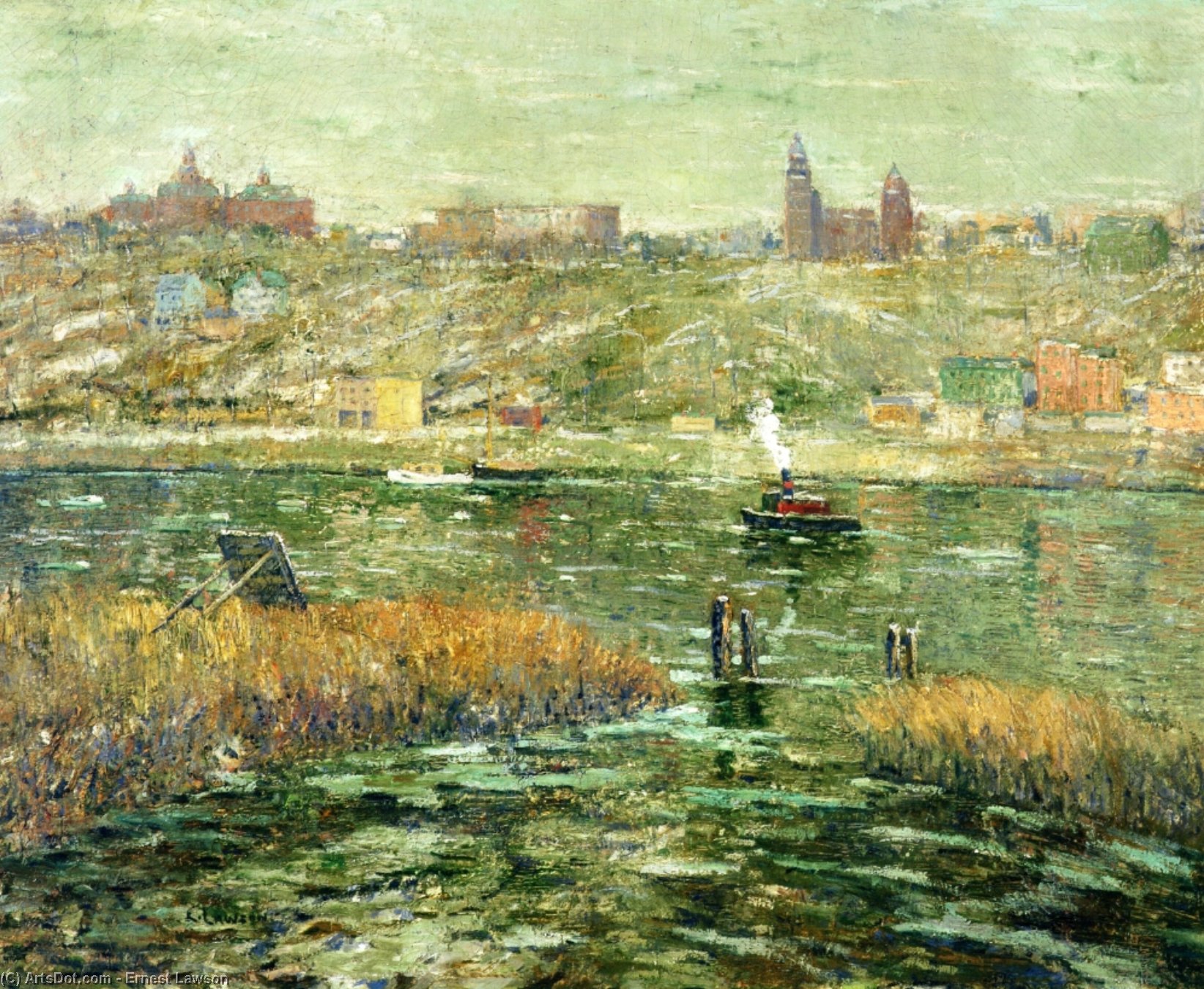
A Symphony of Light on the Harlem River
In his 1911 masterpiece, Harlem River, Ernest Lawson invites the viewer to step into a world where the boundaries between water, sky, and shore dissolve into a vibrant dance of light. This exquisite oil on canvas is far more than a mere landscape; it is an Impressionist poem captured in pigment. The scene unfolds along the rhythmic pulse of the river, where several boats drift through the shimmering currents, their forms softened by the atmospheric haze. A solitary figure stands near the water's edge, a quiet observer lost in the grandeur of the scene, serving as a poignant anchor for the viewer’s own contemplation. Through Lawson's eyes, the Harlem River becomes a stage for the interplay of movement and stillness, capturing a fleeting moment of New York's natural beauty before the encroaching rush of modernity.
The technical brilliance of this work lies in Lawson's mastery of the Impressionist technique, specifically his ability to manipulate color and brushwork to evoke texture and temperature. Rather than relying on harsh outlines, he utilizes broken brushstrokes that allow colors to blend optically, creating a sense of shimmering energy. The palette is a sophisticated arrangement of tones that capture the essence of a living ecosystem; the cool blues and greens of the water contrast beautifully with the warmer, sun-drenched highlights reflecting off the boats and the shoreline. This meticulous application of paint gives the canvas a tactile quality, making the ripples of the river feel almost palpable to the touch.
Historical Resonance and Artistic Legacy
To understand Harlem River, one must look to Lawson’s place within the American art canon. As a prominent member of The Eight, Lawson brought a unique Canadian sensibility—honed by his early years in Halifax—to the gritty yet beautiful landscapes of New York. His training at the Art Students League under John Twachtman and his encounters with the French masters in Paris allowed him to bridge the gap between European Impressionism and American Realism. This painting stands as a testament to that fusion, capturing a specific historical era where the industrial spirit of the city met the untamed beauty of its waterways.
For the discerning collector or interior designer, this reproduction offers more than just aesthetic appeal; it provides an emotional centerpiece for any curated space. The painting’s ability to evoke tranquility while maintaining a sense of vitality makes it an ideal choice for creating a sophisticated atmosphere in a study, a grand living room, or a serene gallery setting. Owning a piece that reflects Lawson's profound connection to the light and life of the Harlem River is an opportunity to bring a fragment of art history into the modern home, offering a timeless window into a world of enduring grace and luminous beauty.
A művész életrajza
early life and training
Ernest Lawson, a luminary of American Impressionism, was born on March 22nd, 1873, in the vibrant coastal city of Halifax, Nova Scotia, Canada. His early years were shaped by his family’s move to Kansas City, Missouri, in 1888, where his father established a successful medical practice. This relocation marked the beginning of Lawson's artistic journey, as he began formal training at the Kansas City Art Institute between 1888 and 1889. However, it was his subsequent enrollment at the prestigious Art Students League in New York City in 1891 that truly ignited his passion and set him on a path toward mastering the techniques of European art movements. Under the guidance of John Twachtman, a pivotal figure in American Impressionism, Lawson was introduced to the principles of this revolutionary style – an approach characterized by capturing fleeting moments of light and color with loose brushstrokes and an emphasis on subjective perception. This early mentorship proved instrumental in shaping his artistic sensibilities. Further enriching his understanding, Lawson traveled to Paris in 1893, where he immersed himself in the academic rigor of the Académie Julian. There, he studied under renowned artists like Jean-Joseph Benjamin-Constant and Jean-Paul Laurens, absorbing their knowledge of classical techniques while simultaneously embracing the innovative spirit of Impressionism. Crucially, Lawson’s time in France also involved extensive plein air painting experiences – working directly from nature – which proved invaluable in developing his observational skills and ability to translate the beauty of the landscape onto canvas.artistic development and influences
Lawson's artistic style evolved into a distinctive blend of Impressionism and Realism, reflecting a deep engagement with both approaches. He was profoundly influenced by the works of John Henry Twachtman, whose meticulous attention to detail and ability to capture atmospheric effects served as a cornerstone of Lawson’s technique. Furthermore, he drew inspiration from the evocative landscapes of Alfred Sisley, an English Impressionist known for his serene depictions of French countryside, and J. Alden Weir, who focused on capturing the subtle nuances of light and color in urban scenes. Lawson's travels to southern France and Moret-sur-Loing provided him with invaluable opportunities to study alongside Alfred Sisley, deepening his understanding of plein air painting and the Impressionist philosophy. The eight artists, a group of progressive painters who challenged the conservative norms of the National Academy of Design, played a significant role in Lawson’s artistic development. He joined their ranks in 1908, participating in the landmark exhibition at the Macbeth Galleries that brought attention to the diversity of styles and subject matter within American art. This association exposed him to new ideas and encouraged him to push beyond traditional boundaries.the eight and notable exhibitions
In 1908, Ernest Lawson became a founding member of “The Eight,” a group of artists who sought to break away from the restrictive policies of the National Academy of Design. This bold move was driven by their desire to champion more diverse artistic styles and subject matter – moving beyond idealized historical scenes and portraits towards depictions of everyday life and urban landscapes. The exhibition organized by The Eight at the Macbeth Galleries in New York City generated considerable media attention, sparking a lively debate about the future of American art. Lawson’s paintings, particularly “City Suburbs,” were prominently featured and garnered critical acclaim for their evocative portrayal of urban life. Throughout his career, Lawson continued to exhibit his work in prestigious venues across America, including the Pennsylvania Academy of Fine Art, the National Gallery, and the Corcoran Gallery in Washington, D.C., as well as the Metropolitan Museum of Art. His participation in the 1913 Armory Show further solidified his position as a leading figure in the American art scene.legacy and impact
Ernest Lawson’s artistic legacy is characterized by an understated yet profoundly vibrant style. Art critic James Gibbons Huneker famously described Lawson's palette as “a crushed jewel,” capturing the shimmering, iridescent quality of his paintings – achieved through meticulous layering of paint and a masterful use of impasto technique. His work resonated with a deep appreciation for the American landscape, reflecting both its natural beauty and its evolving urban environment. Lawson’s contributions to American Impressionism are significant, demonstrating a unique ability to synthesize European influences with a distinctly American sensibility. He remains an important figure in the history of art, celebrated for his evocative depictions of light, color, and place. His paintings continue to captivate viewers with their beauty and emotional depth.
Ernest Lawson
1873 - 1939 , Kanada
Rövid tények
- Artistic Movement Or Style: Amerikai impresszionizmus
- Artists Or Movements Influenced By This Artist: ['A nyolcas']
- Artists Who Influenced This Artist:
- John Twachtman
- Jean-Joseph Benjamin-Constant
- Alfred Sisley
- Date Of Birth: March 22, 1873
- Full Name: Ernest Lawson
- Nationality: Kanadai
- Notable Artworks:
- City Szuburbs
- Approaching Storm
- Place Of Birth: Halifax, Kanada
Kapcsolódó cikkek

A művészet vitorlái: 10 ikonikus hajóábrázolás a festészetben | OriginalUniqueArt
Fedezze fel a művészet vitorláit! 10 ikonikus hajóábrázolás Monet-tól Manet-ig. Ismerje meg a festmények történetét, technikáját és inspirációját. Luxus reprodukciók otthonra – OriginalUniqueArt.com
Ernest Lawson: A Pioneer of American Impressionism & His Vision of the Rural Landscape
Explore the life & art of Ernest Lawson, a pivotal figure in American Impressionism. Discover his evocative landscapes, influences, and lasting legacy with OriginalUniqueArt.
Renoir Mesterek: A 25 Leglenyűgözőbb Kép a Francia Impresszionizmus Gyöngyszemeiből | OriginalUniqueArt
Fedezze fel Pierre-Auguste Renoir 25 legszebb művét! Ismerje meg az impresszionizmus gyöngyszemeit, a színek és fény játékát. Vásároljon exkluzív Renoir reprodukciókat otthonába a OriginalUniqueArt.com kínálatából – minőségi faliképek és inspiráló dekoráció.

A 10 legikonikus impresszionista tájkép: Művészeti remekművek otthonába – OriginalUniqueArt.com
Fedezze fel a 10 legikonikus impresszionista tájkép festményt! Monet, Renoir és más mesterek alkotásainak története. Olajfestmények, vászonképek otthonába – OriginalUniqueArt.com kínálatából. Explore the full collection online!
Claude Monet 25 Mesterműve: A Fény és a Szín Zsenialitása – OriginalUniqueArt.com
Fedezze fel Claude Monet 25 legikonikusabb mesterművét! Ismerje meg az impresszionizmus zseniális festőjének történetét, a fény és szín varázsát. Vásároljon exkluzív reprodukciókat otthona dekorációjához a OriginalUniqueArt.com-on!

