Küldés
 Megosztás
 Részletek
 Útmutató

 Letöltés
 Hasonló darabok
 Diavetítés
 Statisztika
Guarding his Gift


 Összes részlet megjelenítése
Az ezen az oldalon megjelenített műalkotások szerzői jogi védelem alatt állnak, ami azt jelenti, hogy törvényileg nem készíthetünk és nem adhatunk el belőlük pontos másolatokat. Ez a védelem olyan nemzetközi megállapodások alapján érvényesül, mint például a Berni Egyezmény és a nemzeti jogszabályok által, beleértve azokat is, amelyeket meghatározott Az USA szerzői jogi törvénye – 17. cím.
Ez a módszer teljes mértékben megfelel a szerzői jogi szabályozásnak, mivel nem tartalmazza a védett műalkotás másolását vagy duplikálását. Ehelyett ez egy kreatív újinterpretáció – egy új festmény, amely az eredetivel való összefüggései miatt hatással van rá, de nem az az.
Giclée / Műnyomat
Múzeumi minőségű giclée vagy vászonnyomat, gyors gyártással és rugalmas finomítási lehetőségekkel. ( Kézzel festett másolat rendelése Áttérés digitális képre)




































Válasszon előre meghatározott méreteink közül, amelyek megfelelnek a műalkotás eredeti arányainak.

Írja be a keretének vagy a falának megfelelő szélességet és magasságot. A nyomatot csak le lehet vágni, soha nem tehető nagyobbá, mint az eredeti kép, így egy eltérő alakú méretnél a kép egy része elveszik. Mielőtt bármit kinyatintanánk, küldünk egy digitális próbamodellt jóváhagyásra. Az oldalon látható kép nem tartalmazza a valós levágást — ezt csak a próbamodell mutatja meg.
Világszerte történő kiszállítás területére mindössze 2 hét alatt, a szokásos 4-5 hét helyett. (25 október)

Ingyenes globális expressz szállítás

Prémium minőségű len vászon

Teljes körű szállítási biztosítás

Vámvisszatérítési Garancia

Hiteles színarányosság garancia

100 napos visszaküldési lehetőség (csak hibás termékek esetén)

100% pénzvisszatérítési garancia

Több darab vásárlásakor kedvezmény
 Az üvegkeretes opció csak 110 cm alatti méretben érhető el

Guarding his Gift
Giclée / Műnyomat
Reprodukció mérete
-


Összesített ár
Ft 25642
A Guardian’s Echoes: Dia al-Azzawi's "Guarding His Gift"
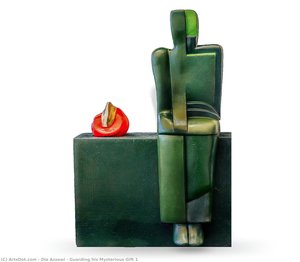
Dia al-Azzawi’s “Guarding His Gift,” created in 2018, isn’t merely a sculpture; it’s a distilled meditation on heritage, responsibility, and the enduring power of symbolic protection. Born in Baghdad amidst a landscape scarred by political upheaval and steeped in the echoes of ancient Mesopotamia, al-Azzawi's work consistently grapples with themes of identity, memory, and the preservation of cultural narratives – a lineage deeply rooted in his Iraqi experience. This particular piece, rendered in glazed ceramic and meticulously photographed to capture its textural richness, presents a strikingly geometric figure safeguarding an abstract form reminiscent of a seed pod or nascent growth. The composition immediately draws the eye, establishing a clear hierarchy where the figure dominates the frame, radiating a sense of watchful guardianship.
The artwork’s style leans decisively towards cubism, albeit with a subtly expressive core. Al-Azzawi masterfully employs fragmented planes and sharp angles to define the figure's form – its rigid structure contrasting sharply with the organic curves of the object it protects. This deliberate juxtaposition speaks volumes about the tension inherent in preserving tradition amidst rapid change; the geometric solidity represents established structures, while the flowing lines suggest the fluidity and potential of the future. The color palette further amplifies this duality: bold blocks of primary colors – reds, blues, yellows – are juxtaposed against stark whites and blacks, creating a visually arresting dynamism that avoids any sense of harmony or complacency.
Materiality and Technique: A Sculptor’s Dialogue
“Guarding His Gift” is not simply a photograph; it's an astute representation of a ceramic sculpture. The choice of material – glazed ceramic – immediately evokes a sense of permanence, reflecting the artist’s desire to safeguard something precious. The smooth, glossy surface suggests meticulous craftsmanship and careful attention to detail, while also hinting at a connection to Mesopotamian pottery traditions. The technique employed is one of deliberate fragmentation and reassembly, mirroring the cubist aesthetic. Al-Azzawi doesn't aim for seamless integration; instead, he strategically exposes the seams and joins between the ceramic pieces, inviting the viewer to contemplate the process of creation itself – a visual metaphor for the ongoing act of rebuilding and redefining cultural identity.
The photograph’s lighting is deliberately diffused, minimizing harsh shadows and allowing the colors and textures to emerge with clarity. This careful attention to detail ensures that every facet of the sculpture—from the subtle variations in glaze color to the precise angles of its geometric forms—is fully visible. The overall effect is one of quiet contemplation, encouraging viewers to linger and decipher the layers of meaning embedded within the artwork.
Symbolism and Emotional Resonance
At its core, “Guarding His Gift” operates as a potent symbol of responsibility and preservation. The act of guarding suggests a commitment to protecting something vulnerable – whether it be knowledge, creativity, or perhaps even the very essence of Iraqi heritage. The abstract object being shielded could be interpreted as representing the intangible values that underpin a culture’s identity: its stories, traditions, and artistic expressions. The figure's tilted head and focused gaze convey an intense sense of vigilance, suggesting a constant awareness of potential threats to these cherished elements.
Furthermore, the artwork subtly explores themes of complexity and fragmentation. The fractured form of the guardian figure might be seen as reflecting the challenges inherent in navigating a rapidly changing world – a world where traditional values are often confronted by new ideologies and global influences. The contrast between geometric and organic shapes reinforces this idea, suggesting a tension between structure and freedom, order and chaos. Ultimately, “Guarding His Gift” is not simply a depiction of protection; it’s an invitation to consider the ongoing struggle to maintain cultural continuity in the face of adversity.
A Legacy of Vision: Dia al-Azzawi's Artistic Voice
Dia al-Azzawi, born in Baghdad in 1939 and continuing his artistic practice today, stands as a pivotal figure in contemporary Arab art. His work is deeply informed by the turbulent history of Iraq, yet it transcends mere documentation, instead offering profound meditations on identity, memory, and cultural resilience. His signature style—characterized by bold colors, intricate symbolism, and a masterful command of form—has earned him international recognition as a visionary artist who consistently challenges viewers to confront complex social and political realities. “Guarding His Gift” is a prime example of al-Azzawi’s artistic prowess, embodying his enduring commitment to exploring the heart of Arab culture through a uniquely powerful and evocative lens.
Kérdések és válaszok
Dia al-Azzawi pályájának mely időszakához tartozik a „Guarding his Gift”?
Dia al-Azzawi pályaművében a „Guarding his Gift” a Mature Period korszakba tartozik. Ez az időszak segít összehasonlíthatóvá tenni a művet a művész többi alkotásával.
Melyik szobához ajánlott a „Guarding his Gift”, Dia al-Azzawi alkotása?
A „Guarding his Gift”, Dia al-Azzawi alkotása számára a javasolt helyszín egy Living Room. Természetesen ez az ajánlás az Ön belső terehez is igazítható.
Hol javasolt a(z) "Guarding his Gift" Square formátumú alkotás kihelyezését?
A „Guarding his Gift”, Dia al-Azzawi alkotása Square formátumú alkotása egy Living Room számára ajánlott. A formátum és a tér együtt segítik a reprodukció elhelyezését.
A művész életrajza
A Life Forged in Mesopotamian Echoes
Dia al-Azzawi, born in Baghdad in 1939, is more than just a painter; he’s a visual poet of the Arab world, an artist whose life and work are inextricably linked to the turbulent history and enduring cultural heritage of Iraq. His formative years unfolded amidst a period of profound political and social change – a backdrop that would deeply inform his artistic vision. From early childhood experiences steeped in Iraqi folklore and the majestic remnants of Mesopotamia’s ancient civilizations, al-Azzawi developed an acute sensitivity to the power of symbolism and narrative. This foundation led him to the Institute of Fine Arts in Baghdad, where he received formal training, mastering technical skills while simultaneously absorbing the currents of art history – a knowledge base he would later brilliantly synthesize with his own unique aesthetic language. Even then, it was clear that al-Azzawi wasn’t simply aiming to replicate existing styles; he sought to excavate and revitalize the visual culture of his ancestors.The Birth of a Distinctive Vision
Al-Azzawi's artistic journey began with explorations in abstract expressionism, but this phase proved merely a stepping stone towards something far more distinctive. He quickly gravitated toward an innovative style that boldly integrated Arabic calligraphy into his compositions. This wasn’t mere ornamentation; it was a deliberate act of reclamation, a powerful assertion of Arab identity within the global art landscape. Al-Azzawi became a central figure in the *Hurufiyya* movement – a collective endeavor to liberate Arabic letters from their traditional linguistic function and explore their inherent aesthetic potential as abstract forms. His canvases began to pulse with the energy of ancient scripts, transformed into dynamic shapes and patterns that resonated with both historical weight and contemporary relevance. The palette he employed was often vibrant and emotionally charged, reflecting not only his personal intensity but also a deep engagement with the political realities surrounding him. He didn’t shy away from confronting difficult themes; instead, he channeled them into works of profound beauty and unsettling power. The influence of Mesopotamian art, particularly its intricate geometric patterns and symbolic representations, is clearly visible in this early work, suggesting a deliberate return to ancient roots.Forging New Paths: The New Vision Group
In 1963, recognizing the need for a more progressive artistic voice in Iraq, al-Azzawi co-founded the New Vision group (Jama’at al-Ru’ya al-Jadida). This collective of Iraqi artists aimed to break free from conventional norms and modernize Arab art. It was a bold undertaking, challenging established institutions and advocating for experimentation. Al-Azzawi’s leadership within the group proved instrumental in fostering a vibrant artistic community and inspiring a new generation of creatives. The New Vision group wasn’t simply about stylistic innovation; it was about redefining what it meant to be an Arab artist in a rapidly changing world, forging a path toward greater cultural autonomy and self-expression. Through exhibitions, publications, and collaborative projects, they sought to elevate the profile of modern Iraqi art both domestically and internationally. The group's activities extended beyond purely artistic endeavors, encompassing discussions on social issues and advocating for a more critical engagement with history and politics – a testament to al-Azzawi’s commitment to using art as a tool for social change.Themes of Heritage, Conflict, and Exile
Throughout his prolific career, Dia al-Azzawi has consistently addressed themes of heritage, identity, conflict, and exile – subjects deeply resonant with the experiences of the Arab world. His work serves as a poignant reflection of the political turmoil and social upheaval that have marked Iraq’s history and continue to shape its present. He masterfully navigates diverse media – painting, sculpture, printmaking, and digital art – demonstrating an unwavering commitment to artistic innovation. Notable works like “Amin Hasanain Al-Ibrahimy,” a moving tribute to the renowned Iraqi poet, and the harrowing “Nasheed Al Jassad (Bodily Anthem) Tel el Zaatar” series, commemorating the victims of the Tel al-Zaatar refugee camp massacre in Lebanon, stand as powerful testaments to his artistic conscience. Al-Azzawi’s art often grapples with the complexities of displacement and loss, exploring themes of memory, trauma, and resilience. His use of symbolism – particularly references to ancient Mesopotamian myths and legends – adds layers of meaning to these works, inviting viewers to contemplate the enduring legacy of the past. The series *Ruins of Two Cities: Mosul and Aleppo* powerfully documents the devastation caused by recent conflicts, highlighting the human cost of political instability.A Legacy Etched in Calligraphy and Courage
Today, Dia al-Azzawi is rightfully regarded as one of the most important and influential artists of the modern Arab world. His pioneering use of Arabic calligraphy, coupled with his unflinching exploration of complex socio-political themes, has left an indelible mark on subsequent generations of artists. Though he now resides in London, he remains a vital voice in contemporary art, continuing to advocate for Arab artistic expression on a global stage. His work is exhibited internationally and held in numerous prestigious collections, solidifying his place as a significant figure not only within the context of Middle Eastern art but also within the broader narrative of global art history. Dia al-Azzawi’s legacy isn't just about aesthetic innovation; it’s about courage – the courage to confront difficult truths, to reclaim cultural identity, and to use art as a powerful tool for social change.
Dia al-Azzawi
1939 - , Irak
Rövid információk
- Artistic Movement Or Style: Hurufiyya, Abst. ekspr.
- Artists Or Movements Influenced By This Artist: ['Modern arab művészek']
- Date Of Birth: 1939
- Full Name: Dia al-Azzawi
- Nationality: Irak
- Notable Artworks:
- Amin Hasanain Al-Ibrahimy
- Nasheed Al Jassad
- Szép Szív
- Gilgamesh
- Place Of Birth: Bagdad, Irak
Kapcsolódó cikkek

A művészettörténet 10 legikonikusabb bronzszobra – OriginalUniqueArt.com
Fedezze fel a művészettörténet 10 legikonikusabb bronzszobrát! Ismerje meg Rodin, Michelangelo és más mesterek alkotásait. Luxus minőségű reprodukciók otthonába – OriginalUniqueArt.com.

Geometrikus Absztrakció Mesterei: 10 Alapvető Műalkotás a Lakberendezéshez
Fedezze fel a geometrikus absztrakció 10 legikonikusabb műalkotását! Kandinsky, Mondrian és más mesterek festményeinek története inspirálja otthona dekorációját. Múzeumi minőségű reprodukciók a OriginalUniqueArt.com-on – fedezze fel online!

The Enduring Form: Exploring Themes & Techniques in Sculpture Across Historical Periods
Explore the rich history of sculpture from ancient masterpieces to contemporary innovations. Discover key techniques, influential artists & investment potential for discerning art collectors.

A művészettörténet 10 legikonikusabb bronzszobra – OriginalUniqueArt.com
Fedezze fel a művészettörténet 10 legikonikusabb bronzszobrát! Ismerje meg Rodint, Michelangelót és más mestereket. Luxus minőségű nyomatok otthonába – OriginalUniqueArt.com.

The Enduring Form: Sculpture Across History, Technique & Emotional Resonance
Explore the rich history of sculpture with OriginalUniqueArt. Discover key techniques, influential artists & investment potential for discerning collectors. Expert insights into valuing and collecting timeless masterpieces.