
 Küldés
 Megosztás
 Részletek
 Útmutató

 Letöltés
 Hasonló darabok
 Diavetítés
 Statisztika
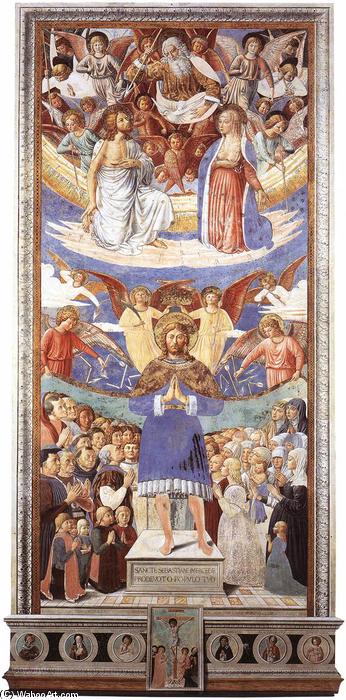
St Sebastian Intercessor
 Fresco
- Early Renaissance
 1464
1464- Renaissance
 527.0 x 248.0 cm
 Nave of Sant'Agostino
 Összes részlet megjelenítése
Get a print-ready file that goes far beyond the web preview. Every digital image we sell comes from a high-resolution master in our stock database — usually 5,000 to 15,000 pixels wide — so you can print large, crop tightly, or reproduce fine detail with confidence.
No file leaves our studio untouched. A digital expert checks the colors against the original painting and corrects them if needed, then improves clarity and detail with professional retouching tools — always staying faithful to the artist's brushwork and style. The result is an image that looks like the painting, not like a filtered scan.
You approve before you're done: our expert sends the image by e-mail within 72 hours for your review. Not satisfied? Ask for improvements or corrections, or request a refund if the quality falls short.
This is the quality relied on by publishers, design studios, galleries and print shops.
Digitális kép
Töltsön le nagy felbontású fájlt személyes kiállításokhoz, nyomtatáshoz és kreatív projektekhez. ( Váltás nyomtatványra Kézzel festett másolat rendelése)
Minden digitális kép rendeléséhez tartozó extrák
Szakértői digitális kézbesítés, garantáltan
Amikor a OriginalUniqueArt.com szolgáltatást választja, nem csupán egy képet kap – professzionálisan felmagasított digitális műalkotást kap, amely precizitással készült, és amelyet megelégsedési gwarancia tesz biztoslássá. Az alábbiakban automatikusan minden benne 】

Gyors e-mail teslimítés
A nagy felbontású digitális képmásolatát a megrendelést követő 72 órán belül e-mailben elküldjük Önnek – azonnal használható formátumban.

MI-alapú digitális fájljavítás
Műve professzionális módon kerül optimalizálásra fejlett mesterséges intelligencia eszközök és manuális szerkesztés segítségével, biztosítva a maximális részletességet, tisztaságot és színpontosságot.

Örök életű ingyenes újradelivery
Véletlenül törölted vagy elvesztetted a fájlodat? Ne aggódj – bármikor ingyen újra megküldjük neked.

Nincs importköltség – soha
Élvezze műalkotásait azonnal, vám, illeték vagy szállítási költség nélkül – a digitális letöltések mindig adamentesek.

Színpontosság garantálása
Professzionális eszközök és színkezelés segítségével garantáljuk, hogy digitális képe a lehető legpontosabban tükrözze az eredeti színeket.

100 napos elégedettségi garancia
Ha nemມີ elégedett a digitális képével, 100 napon belül felülvizsgáljuk vagy 100% visszatérítjük az amountot – kérdés बिना.

100% Pénzvisszatérítési garancia
Nem tetszett a vásárlás? 100 napon belül teljes visszatérítést garantálunk a digitális fájl megvételétől számítva – kérdés nélkül.

Tömegrendelési kedvezmények
Vásároljon 3 képet, spóroljon 10%-et - Vásároljon 5-öt, spóroljon 15%-et - Vásároljon 10+ képet, spóroljon 20%-at. Kiváló kreatív projektekhez, galériákhoz és ügynökségekhez.
St Sebastian Intercessor: A Renaissance Masterpiece by Benozzo Gozzoli
- Title: St Sebastian Intercessor
- Artist: Benozzo Gozzoli
- Date: 1464
- Size: 527 x 248 cm
- Location: Nave of Sant'Agostino (San Gimignano, Italy)
Artistic Style and Technique
“St Sebastian Intercessor” is a remarkable fresco created by the renowned Italian artist Benozzo Gozzoli in 1464. This large-scale work showcases his mastery of the fresco technique, a method involving painting directly onto wet plaster. The vibrant colors and intricate details characteristic of Gozzoli’s style are evident throughout the scene. His approach blends realism with an International Gothic influence, resulting in figures that possess both detailed rendering and a sense of stylized elegance.
The composition depicts a gathering of people, including angels, Roman soldiers, and numerous onlookers, all centered around the martyrdom of St Sebastian. The use of perspective guides the viewer's eye upwards towards Christ, creating a hierarchical structure that emphasizes the spiritual significance of the event. Gozzoli’s skillful application of fresco allows for rich color saturation and textural depth, bringing the narrative to life.
Historical Context and Symbolism
Painted during a period of plague in 1464, “St Sebastian Intercessor” served as a votive offering – a prayer for divine intervention. The depiction of St Sebastian, fully clothed and shielding people from arrows, deviates from the traditional portrayal of him riddled with wounds. This symbolizes his role not just as a martyr but also as an intercessor, protecting humanity from suffering.
The scene is rich in symbolism: God the Father surrounded by angels prepares to hurl arrows representing divine wrath, while Mary and Christ kneel as intercessors, appealing for mercy. Christ’s display of his wounds and Mary's baring of her breast are poignant reminders of sacrifice and redemption. The crowd at St Sebastian’s feet represents humanity seeking solace and protection.
Emotional Impact and Legacy
“St Sebastian Intercessor” evokes a powerful sense of awe, reverence, and spiritual significance. The vibrant colors, detailed figures, and dramatic lighting create an emotionally charged atmosphere that draws the viewer into the scene. The painting’s enduring appeal lies in its ability to convey both the suffering of humanity and the promise of divine grace.
Benozzo Gozzoli's work remains a testament to the artistic achievements of the Early Renaissance, celebrated for its beauty, technical skill, and profound spiritual message. The fresco’s location within the Nave of Sant'Agostino continues to inspire visitors and art enthusiasts alike.
Kérdések és válaszok
St Sebastian Intercessor színei erőteljesnek vagy lágynak tűnnek?
A "St Sebastian Intercessor" színtelítettsége Balanced. Az intenzitás azt mutatja meg, mennyire erőteljesnek tűnnek a színek.
Hová sorolható a "St Sebastian Intercessor" Benozzo Gozzoli ismétlődő témái közé?
Benozzo Gozzoli dokumentált témái – international gothic style, fra angelico training, early work showcasing developing skill, demonstrates fresco mastery., religious devotion, plague intercession, divine mercy – között a „St Sebastian Intercessor” különös hangsúlyt fektet martyrdom, saint sebastian, fresco, religious, intercessor, angels, gozzoli, san gimignano-ra.
Hogyan írható le „St Sebastian Intercessor”, Benozzo Gozzoli alkotása hangulata?
„St Sebastian Intercessor”, Benozzo Gozzoli alkotása művészeti alkotásának összhangulata Classic. Ez az érzet foglalja össze a mű általános atmoszféráját.
Művész életrajza
Early Life and Artistic Foundations
Benozzo Gozzoli, a name synonymous with the vibrant heart of the Italian Renaissance, was born in Florence around 1420 – a time of burgeoning artistic innovation and political intrigue. His origins were humble; he hailed from a family rooted in the Florentine countryside, specifically Sant’Ilario a Colombaia, yet his early life was inextricably linked to the city's artistic epicenter. While details about his precise upbringing remain somewhat elusive, it is known that his father, Lese di Sandro, worked as a tailor – an occupation that perhaps subtly nurtured Gozzoli’s keen eye for detail and appreciation of intricate craftsmanship. Interestingly, the family name itself, “Gozzoli,” evolved over time, tracing its roots back to another branch of the lineage, suggesting a complex familial history. Crucially, Gozzoli's artistic journey didn't begin with formal training in a traditional workshop. Instead, he seems to have embarked on his career as an assistant, initially honing his skills under the tutelage of Fra Angelico – one of the most revered artists of his era. This formative period within the serene confines of the San Marco convent in Florence proved invaluable, exposing him to Angelico’s meticulous technique and profound understanding of religious iconography. Furthermore, Gozzoli's early collaborations with Lorenzo and Vittorio Ghiberti on the magnificent bronze doors of the Florence Baptistery provided him with an unparalleled opportunity to learn from one of the greatest sculptors of the Renaissance. These experiences laid a solid foundation for his future development, imbuing him with a deep appreciation for both painting and sculpture – skills that would later inform his distinctive artistic style.A Flourishing Career Across Tuscany and Rome
Following his apprenticeship, Benozzo Gozzoli embarked on a prolific career spanning across Tuscany, Umbria, and ultimately, the heart of the Renaissance itself: Rome. He wasn’t merely a journeyman artist; he was a dynamic figure who actively sought commissions and embraced diverse artistic challenges. His early works in Montefalco showcased his burgeoning talent, particularly evident in the cycle of frescoes depicting scenes from the life of Saint Francis – a testament to his ability to blend narrative storytelling with vibrant color palettes. Rome became a crucial stage in Gozzoli’s career. He worked under the patronage of Pope Eugenius IV, contributing to the decoration of the Vatican library and undertaking significant projects within the Santa Maria in Aracoeli church. His frescoes there – depicting Saint Anthony and two angels – stand as powerful examples of his evolving style, demonstrating a growing confidence and mastery of composition. This period also saw him collaborating with Fra Angelico on the magnificent Chapel of San Brizio in Orvieto, further solidifying his reputation as a leading artist of his time. Throughout these travels, Gozzoli consistently demonstrated an adaptability to different artistic traditions, absorbing influences from various masters while simultaneously forging his own unique and recognizable style.The Masterpiece: The Journey of the Magi
Perhaps the most celebrated achievement in Benozzo Gozzoli’s illustrious career is undoubtedly the fresco cycle he executed in the chapel of the Medici-Riccardi Palace in Florence – known as *La Processione dei Tre Re* (The Procession of the Three Kings). Commissioned by Piero de' Medici, this monumental work represents a culmination of Gozzoli’s artistic vision and a masterful synthesis of his diverse influences. The scene depicts the biblical journey of the Magi to Bethlehem, but it transcends mere religious narrative; it becomes a vibrant tableau of Florentine society, replete with portraits of prominent figures – including young Lorenzo de' Medici himself. What distinguishes this fresco is its remarkable dynamism and intricate detail. Gozzoli masterfully employs perspective and spatial relationships to create a sense of movement and depth, drawing the viewer into the heart of the procession. The rich color palette, dominated by scarlet, gold, and blue, contributes significantly to the work’s overall impact, evoking a sense of opulence and grandeur. The fresco is not simply a depiction of a biblical event; it's an elaborate celebration of Florentine power, wealth, and artistic prowess – a testament to Gozzoli’s ability to seamlessly integrate religious symbolism with secular themes.Artistic Style and Legacy
Benozzo Gozzoli’s artistic style is characterized by a unique blend of elegance, sophistication, and a distinctly international gothic influence. He skillfully combined the meticulous detail and refined aesthetics of the International Gothic tradition with the emerging naturalism and dynamism of the early Renaissance. His works are renowned for their vibrant color palettes, intricate compositions, and a remarkable attention to human anatomy and expression. Gozzoli’s prolific output – encompassing numerous frescoes, panel paintings, and tempera works – has ensured his place as one of the most important figures in Italian Renaissance art. His legacy extends beyond individual masterpieces; he served as an influential teacher and mentor, shaping the artistic sensibilities of subsequent generations of painters. His work continues to inspire admiration for its beauty, complexity, and profound engagement with both religious and secular themes.- View Gozzoli’s artworks on OriginalUniqueArt: https://OriginalUniqueArt.com/@/benozzo-gozzoli
- Explore the Italian Renaissance art movement on OriginalUniqueArt: /hu/art/list/
- Discover more about Gozzoli’s life and works on Wikipedia: https://en.wikipedia.org/wiki/benozzo_gozzoli

Benozzo Gozzoli
1420 - 1497 , Olaszország
Érmeradatok
- Artistic Movement Or Style: Internacionális Gótika
- Artists Or Movements Influenced By This Artist: ['Korai Reneszánsz']
- Artists Who Influenced This Artist:
- Fra Angelico
- Lorenzo Ghiberti
- Date Of Birth: 1420 körül
- Date Of Death: 1497 október 4.
- Full Name: Benozzo di Lese
- Nationality: Florentine
- Notable Artworks:
- Háromkirályok meneté
- St Francis életkéje
- Place Of Birth: Firenze, Itália