

 Előnézet
 Megosztás
 Megosztás
 Részletek
 Útmutató

 Letöltés
 Hasonló darabok
 X-ray felvétel
 Diavetítés
 Statisztika
Dematerialization
 1957
1957 71.0 x 66.0 cm
 Tovább olvasom
Kézzel készített olajfestmény reprodukció
Kézzel festett olajvastú vászon, az Ön által választott méretben és keretben, művészeink készítik meglévőre. ( Váltás nyomtatványra Áttérés digitális képre)




































Válasszon előre meghatározott méreteink közül, amelyek megfelelnek a műalkotás eredeti arányainak.

Ön megadhat saját méreteket egy adott kerethez vagy térhez igazításhoz. Ha a kiválasztott méret nem egyezik az eredeti kép arányával, akkor a műalkotást levágjuk, vagy további kézzel festett elemekkel meghosszabbítjuk a festményt. A gyártás megkezdése előtt küldünk Önnek egy digitális előnézetet jóváhagyásra.
Kérjük, vegye figyelembe, hogy a képernyőn megjelenő előnézet nem tükrözi a tényleges vágást vagy kiterjesztést. Csak az előnézet fog pontosan mutatni a végső kompozíciót.
Bár egyedi méretek állnak rendelkezésre, javasoljuk, hogy válasszon egy méretet az előre meghatározott listából az eredeti arányok megőrzése érdekében.
A rendelést követően a OriginalUniqueArt.com csapata e-mailt küld az ügyfélnek az instrukciókért, és biztosít egy előnézeti képet (mockup).
Világszerte elérhető szállítás () 3-4 hét alatt a szokásos 5 hét helyett. (25 szeptember). A minőség nem kérdőjelezhető.

Ingyenes globális expressz szállítás

Prémium minőségű len vászon

Teljes körű szállítási biztosítás

Vámvisszatérítési Garancia

Tökéletes színarányosság garancia

100 napos visszaküldési garancia (csak gyártási hibás termékek esetén)

100% pénzvisszatérítési garancia

Több darab vásárlásakor kedvezmény
 Az üvegkeretes opció csak 110 cm alatti méretben érhető el

Dematerialization
Reprodukciós technika
Reprodukció méretei
-


Összesített ár
$ 300
A művész életrajza
The Architect of Perception: The Life and Vision of Ben Cunningham
To step into the world of Ben Cunningham is to enter a realm where color ceases to be merely a pigment and begins to function as a living, breathing force. Born in 1904, this American pioneer did not simply paint; he orchestrated visual experiences that challenged the very boundaries of human sight. His journey, which began amidst the rugged landscapes of his youth and moved through the vibrant artistic hubs of San Francisco and New York, was a lifelong quest to bridge the gap between the physical world and the abstract sensations of the mind. Cunningham possessed a rare ability to translate the complexities of natural forms into simplified, intellectually stimulating compositions that resonated with the spiritual and the scientific alike.
Cunningham’s early years were marked by a nomadic spirit and a deep connection to the American West. Though his roots trace back to Colorado and Nevada, it was in the studios of San Francisco that his artistic identity truly began to crystallamos. Studying at the Mark Hopkins Art Institute, he immersed himself in the technical rigors of painting, weaving, and tapestry design—disciplines that would later inform his profound understanding of texture and structural harmony. His early exposure to the radical currents of European avant-garde movements, such as Cubism and Futurism, acted as a catalyst for his development. The works of Piet Mondrian and Kazimir Malevich provided him with a blueprint for radical simplification, teaching him that art could transcend mere representation to engage directly with the fundamental truths of geometry and color.
From Monumental Murals to the Science of Sight
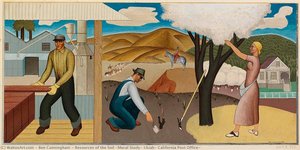
In the middle years of his career, Cunningham achieved widespread recognition through his monumental contributions to public art. During the era of the Works Progress Administration (WPA), he became a vital voice in the American mural movement. His hands shaped the walls of iconic landmarks, most notably at Coit Tower in San Francisco, where his work captured the essence of outdoor life with a sophisticated, rhythmic grace. His involvement in projects like the “Resources of the Soil” for the Ukiah, California Post Office demonstrated his ability to marry large-scale narrative with a modern, streamlined aesthetic. These murals were more than mere decorations; they were bold statements of vision that integrated art into the very fabric of civic life.
However, as his career progressed, Cunningham’s focus shifted from the representational toward the experimental. Influenced by the visionary Hilaire Hiler, he began to explore the intersection of science and art, seeking a way to use color to transmit forms and sensations in space without the burden of political or ideological content. This period saw him delving into what would later be recognized as Op Art. He became obsessed with the mechanics of perception, creating works that utilized color field techniques and geometric precision to trigger extra-optical perceptions. In these later compositions, the viewer is no longer a passive observer but an active participant in a dance of light and movement, where the eye must constantly recalibrate itself against shifting planes of pigment.
A Lasting Legacy in Modern Abstraction
The historical significance of Ben Cunningham lies in his refusal to remain static. He successfully navigated the transition from the social realism of the muralist era to the cerebral complexities of mid-century abstraction. His ability to synthesize the heavy, grounded nature of public murals with the ethereal, weightless qualities of geometric abstraction marks him as a singular figure in American modernism. Today, his legacy is preserved within the hallowed halls of the world's most prestigious institutions, ensuring that his explorations of color and form continue to inspire:
- The Museum of Modern Art (MoMA), where his contributions to abstraction are celebrated.
- The National Gallery of Art, recognizing his role in the evolution of American painting.
- The Smithsonian American Art Museum, housing works that reflect his profound impact on the national artistic landscape.
Ultimately, Cunningham’s life work serves as a testament to the power of visual inquiry. He left behind a body of work that does not merely ask us to look, but demands that we see—reminding us that beneath the surface of the visible world lies a structured, vibrant universe of pure form and infinite sensation.
Ben Cunningham
1883 - 1976 , United States of America
Gyors információk
- Artistic Movement Or Style: Op Art
- Artists Or Movements Influenced By This Artist: ['']
- Artists Who Influenced This Artist: ['']
- Date Of Birth: February 10, 1904
- Date Of Death: April 5, 1975
- Full Name: Ben Frazier Cunningham
- Nationality: American
- Notable Artworks:
- Dematerialization
- Nevada, from the United States Series
- Resources of the Soil
- Place Of Birth: Portland, United States