Olajfestmény vásárlása
 Minden, ami a Therese kapcsán







































 A bármely oldalsó méretét túlszálaló 105 cm (kb. 41 hüvelyk) meghaladó műalkotások vagy reprodukciók esetében a keret összeszerelhető készletként, szétszerelve kerül szállításra. Ez a módszer biztosítja a biztonságos szállítást, és megakadályozza a szállítás során fellépő sérüléseket.


Identification of the Portrait by Balthus
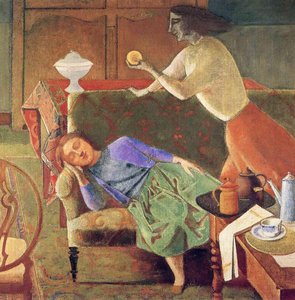
Therese Dreaming is a work by the artist Balthus, also known as Balthasar Klossowski. Created in 1938, the painting focuses on a young girl positioned within a murky, interior setting. The subject is characterized by a puckered expression, appearing both dreamy and absent as she sits in a state of quiet contemplation.
The portrait captures a specific moment of introspection. The girl's posture and facial expression suggest a sense of detachment from her immediate surroundings. This psychological depth defines the subject's presence within the composition.
Composition and Visual Elements
The figure is positioned with hands clasped behind the head and elbows thrust outward, creating a taut, angular silhouette. A red skirt is gathered around the hips, revealing white underpants. This central arrangement is set within a murky room characterized by red-striped wallpaper and the presence of a crumpled sheet. The lighting and color palette emphasize a sense of stillness and isolation.
At the subject's feet, a cat licks from a shallow dish. The composition relies on a balance of stark, geometric lines and soft, organic forms. The use of red appears as a recurring motif, appearing in the wallpaper and the subject's clothing to anchor the viewer's eye within the shadowed interior. The spatial arrangement focuses on the tension between the girl's posture and the cluttered, dim environment.
Documented Interpretations and Debates
The work has been a focal point for intense debate regarding the representation of childhood. In 2017, a public petition was circulated requesting that the Metropolitan Museum of Art in New York remove the painting from its collection. This protest, which gathered nearly 12,000 signatures, argued that the imagery romanticizes the sexualization of a child. Critics raised concerns regarding the suggestive nature of the portrayal and its implications for contemporary audiences.
The Metropolitan Museum of Art refused to remove the work from display, maintaining its position despite the public outcry. Within the artist's broader oeuvre, the subject functions as a leitmotif, appearing repeatedly to explore the tension between innocence and impropriety. The painting remains a central example of the artist's interest in the psychological complexities of adolescence and the boundaries of social decorum.
Scientific Studies and Conservation
During a two-year restoration of the work, technical analysis provided significant insight into the artist's compositional evolution. The application of infrared reflectography allowed for a detailed examination of the underlying layers, revealing a drastic simplification of the final image compared to its initial conception.
These studies indicate that the composition underwent a substantial reduction in complexity. While the current surface presents a streamlined aesthetic, the original iteration depicted two female figures rendered in detailed clothing. Through subsequent revisions, the artist chose to strip away these intricate elements, instead reducing both the clothing and the upholstery to simplified, distinct zones of color.
Kérdések és válaszok
Therese képe kézzel festett vagy nyomtatott?
Kézzel festve: egy képzett festő az Therese című műet alkotást olajfestékkel vászonra másolja.
Mekkora méretet válasszak a Therese című műhöz?
A méretek 35.4 x 28.3 cm (Ft64564)-től 245.8 x 196.6 cm (Ft572038)-ig terjednek; az oldalon található táblázat tartalmazza a különböző átméretű lehetőségeket és azok árait.
Mennyi ideig tart a szállítás?
A szállítás 4-5 hetet vesz igénybe, ingyenes világszinten történő expressz szállítással; ezen az oldalon sürgősségi gyártási lehetőség is rendelkezésre áll. A termék 100 napon belül, bármely feltétel nélkül visszaküldhető a teljes összeg visszatérítéséért.
Milyen technikát/anyagot használt Balthus a(z) Therese című műhöz?
Oil On Canvas
Több információ erről a festményről
 Megtekintés

 Küldés
 Megosztás
 Részletek
 Információs lap


 Letöltés
 Hasonló darabok
 X-ray felvétel
 Diavetítés
 Kérdések és válaszok

 Statisztika