

 Megtekintés
 Küldés
 Megosztás
 Részletek
 Útmutató

 Letöltés
 Hasonló darabok
 X-ray felvétel
 Diavetítés
 Statisztika
Black and White
 Acrylic On Canvas
- WallArt
- Geometric Abstraction
 Modern
 186.0 x 186.0 cm
 Nemzeti Galéria Szingapúr
 Összes részlet megjelenítése
Az ezen az oldalon megjelenített műalkotások szerzői jogi védelem alatt állnak, ami azt jelenti, hogy törvényileg nem készíthetünk és nem adhatunk el belőlük pontos másolatokat. Ez a védelem olyan nemzetközi megállapodások alapján érvényesül, mint például a Berni Egyezmény és a nemzeti jogszabályok által, beleértve azokat is, amelyeket meghatározott Az USA szerzői jogi törvénye – 17. cím.
Ez a módszer teljes mértékben megfelel a szerzői jogi szabályozásnak, mivel nem tartalmazza a védett műalkotás másolását vagy duplikálását. Ehelyett ez egy kreatív újinterpretáció – egy új festmény, amely az eredetivel való összefüggései miatt hatással van rá, de nem az az.
Giclée / Műnyomat
Múzeumi minőségű giclée vagy vászonnyomat, gyors gyártással és rugalmas finomítási lehetőségekkel. ( Kézzel festett másolat rendelése Áttérés digitális képre)




P118B Ft10

P118H Ft10

P118W Ft10

P438Z Ft10

P508JH Ft12

P508YH Ft12

P805H Ft10

P805Z Ft10

P919BZ Ft10

P919G Ft10

P919XJ Ft10

P959ZH Ft10

P968JZ Ft12

W106C Ft8

W218G Ft10

W218JH Ft8

W218Y Ft10

W307PJ Ft10

W316G Ft10

W316PJ Ft8

W316Y Ft10

W398PJ Ft8

W4111J Ft10

W500HY Ft15

W500JH Ft15

W692G Ft12

W849H Ft8

W940BG Ft15

W953PJ Ft8




Válasszon előre meghatározott méreteink közül, amelyek megfelelnek a műalkotás eredeti arányainak.

Írja be a keretének vagy a falának megfelelő szélességet és magasságot. A nyomatot csak le lehet vágni, soha nem tehető nagyobbá, mint az eredeti kép, így egy eltérő alakú méretnél a kép egy része elveszik. Mielőtt bármit kinyatintanánk, küldünk egy digitális próbamodellt jóváhagyásra. Az oldalon látható kép nem tartalmazza a valós levágást — ezt csak a próbamodell mutatja meg.
Világszerte történő kiszállítás területére mindössze 2 hét alatt, a szokásos 4-5 hét helyett. (27 október)

Ingyenes globális expressz szállítás

Prémium minőségű len vászon

Teljes körű szállítási biztosítás

Vámvisszatérítési Garancia

Hiteles színarányosság garancia

100 napos visszaküldési lehetőség (csak hibás termékek esetén)

100% pénzvisszatérítési garancia

Több darab vásárlásakor kedvezmény
 Az üvegkeretes opció csak 110 cm alatti méretben érhető el

Black and White
Giclée / Műnyomat
Reprodukció mérete
-


Összesített ár
Ft 25681
Black and White: A Geometric Echo of Minimalism
Anthony Poon Kin Soon’s “Black and White” stands as a testament to the enduring power of geometric abstraction—a movement that emerged in Europe during the 1960s and profoundly influenced artistic expression across continents. This striking canvas, executed in acrylic on canvas sometime around 1975, embodies the core tenets of minimalist aesthetics: simplicity, repetition, and an unwavering focus on fundamental forms.
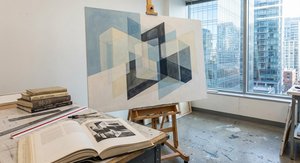
The artwork’s visual language is dominated by a mesmerizing grid pattern composed entirely of interlocking squares. These squares vary subtly in size, creating a dynamic interplay between order and suggestion. Poon eschews any illusionistic representation—there are no shading gradients or textural variations—leaving the viewer to contemplate solely the geometric relationships inherent within the composition.
- Style: Geometric Abstraction
- Technique: Acrylic Painting on Canvas
- Size: 186 x 186 cm
Roots in European Avant-Garde
Poon’s artistic journey began at Nanyang Academy of Fine Arts (NAFA) in Singapore, where he honed his foundational skills before embarking on a transformative study grant to Bynam Shaw School of Art in London and Regional College of Art in Bradford. These experiences exposed him to the influential ideas circulating within European art circles during this period—artists like Piet Mondrian and Kazimir Malevich championed radical simplification as a means of conveying spiritual truths.
The influence of Malevich’s Suprematism is particularly evident in “Black and White.” Malevich famously reduced painting to pure geometric forms – squares, rectangles, circles – rejecting representational imagery altogether. Poon's work reflects this ethos, prioritizing conceptual clarity over visual embellishment.
Symbolism Beyond Surface Appearance
While seemingly devoid of overt narrative content, “Black and White” possesses a subtle yet compelling symbolic resonance. The repetition of the square motif can be interpreted as representing stability, permanence, and perhaps even the underlying structure of existence. Its stark monochrome palette—a deliberate choice by Poon—amplifies these ideas, stripping away distracting colors to concentrate on pure form and tonal variation.
Furthermore, the artwork’s quiet contemplation invites viewers to consider questions of perception and abstraction itself. It encourages us to appreciate beauty not in imitation of nature but in recognizing the inherent elegance of geometric principles.
A Legacy of Singaporean Modernism
"Black and White" solidified Poon Kin Soon's position as a pioneer of abstract art in Singapore, securing him the Cultural Medallion in 1991. It also served as inspiration for his monumental sculpture commissioned for the Beijing Olympics in 2008—a testament to his enduring commitment to exploring the expressive potential of minimalist forms.
This artwork remains a cornerstone of Singaporean modernism, demonstrating how artists can grapple with complex philosophical concepts through deceptively simple visual vocabularies. Its enduring appeal lies in its ability to provoke thought and inspire appreciation for the beauty of pure geometric abstraction.
Kérdések és válaszok
Hogyan tölthetem le a(z) „Black and White”, Anthony Poon Kin Soon alkotása képét?
A „Black and White”, Anthony Poon Kin Soon alkotása letölthető a mű Letöltés oldaláról, magas felbontású digitális kép letöltése formátumban.
Milyen érzelmet közvetít a Geometric Abstraction korszakból származó "Black and White" című alkotás?
A "Black and White" a Geometric Abstraction korszak Calm érzelmi hangulatát tükrözi.
„Black and White”, Anthony Poon Kin Soon alkotása egy világos vagy egy sötét tónusú alkotás?
A „Black and White”, Anthony Poon Kin Soon alkotása rögzített értékei: deep_shadow fényerő és Dark luminancia.
A művész életrajza
The Architect of Abstraction: The Life and Legacy of Anthony Poon Kin Soon
In the vibrant tapestry of Singapore’s modern art history, few threads are as structurally profound or visually rhythmic as those woven by Anthony Poon Kin Soon. Born on April 21st, 1945, in Singapore, Poon emerged as a pivotal figure who helped define the landscape of geometric abstraction on the island. His journey was one of dual mastery, blending the precision of an architect with the soulful intuition of a painter. After graduating from the Nanyang Academy of Fine Arts in 1964, his thirst for global perspectives led him to the Bynam Shaw School of Art in London. Supported by a prestigious Lee Foundation study grant, this period of immersion in European traditions allowed him to absorb the complexities of contemporary movements, ultimately fueling his ambition to forge an independent artistic voice that was both internationally informed and deeply rooted in his Southeast Asian identity.
Poon’s evolution as an artist is characterized by a fascinating transition from the tactile dimensions of sculpture to the layered depths of canvas. His early explorations were deeply sculptural, focusing on the physical manifestation of movement. This fascination birthed his celebrated Wave Series, which began in 1976. In these works, Poon sought to capture the kinetic energy of oceanic motion through meticulously crafted geometric forms. These pieces were not merely static objects but intellectual meditations on spatial relationships and textural contrasts, using simplified shapes to convey the overwhelming power of nature’s rhythms. This ability to translate organic fluidity into structured, geometric language became a hallmark of his creative genius.
A Symphony of Geometry and Form
As his career progressed, Poon’s mastery of geometric abstraction reached new heights through works that balanced minimalist restraint with profound complexity. His paintings often functioned as architectural blueprints of emotion, utilizing intricate grid patterns, interlocking squares, and prominent circles to guide the viewer's eye through a structured yet dynamic space. One of his most striking achievements, Squa-Forma, serves as a quintessential example of this style. This large-scale acrylic work, now held in the permanent collection of the National Gallery Singapore, showcases his ability to use mathematical precision to create a sense of visual equilibrium and monumental presence.
Beyond the rigid structures of his geometric works, Poon possessed a remarkable capacity for emotional resonance through color and atmosphere. In pieces such as Jobless Son, he moved away from pure abstraction toward a more poignant, atmospheric expressionism. Through the use of layered blues and greens, he captured themes of melancholy and uncertainty, reflecting the shifting social landscapes of Singaporean life. Conversely, his work Black and White demonstrates his dialogue with the giants of modernism, such as Malevich’s Suprematism, utilizing a minimalist palette to explore the fundamental tension between light and shadow, presence and absence.
Recognition and Lasting Significance
The significance of Anthony Poon Kin Soon extends far beyond the aesthetic beauty of his canvases and sculptures; he was a foundational pillar of Singapore's cultural identity. His contributions were formally recognized with the prestigious Cultural Medallion in 1990, an honor that cemented his status as a master of his craft and a vital contributor to the nation's artistic heritage. His work bridged the gap between the structural discipline of architecture and the expressive freedom of fine art, leaving behind a legacy that continues to inspire generations of abstract artists.
Today, the works of Anthony Poon Kin Soon remain essential touchstones for understanding the development of modernism in Singapore. His ability to synthesize diverse influences—from London’s academic traditions to the rhythmic pulses of the natural world—ensures that his art remains a living, breathing part of the global conversation on abstraction. Through his meticulous use of form and his profound dedication to exploring spatial relationships, Poon transformed the canvas into a site of architectural wonder and emotional depth.

Anthony Poon Kin Soon
1945 - 2006 , Singapore
Rövid információk
- Full Name: Anthony Poon Kin Soon
- Nationality: Singaporean
- Date Of Birth: 1945
- Date Of Death: 2006
- Place Of Birth: Singapore, Singapore
- Notable Artworks:
- Wave Series
- Squa-Forma
- Black and White
- Artistic Movement Or Style: Abstract Art
Kapcsolódó cikkek

Beyond Form & Color: Geometric Abstraction's Evolution in 20th/21st Century Art
Explore the evolution of geometric abstraction from Cubism to contemporary art. Discover key artists like Malevich & Mondrian, investment insights, and expert collecting advice at OriginalUniqueArt.

Neo-Abstract Art: The High-Impact Evolution of Modern Visual Energy and Geometric Sophistication
Discover the power of Neo-Abstract art. Explore how bold geometric forms and high-impact visual energy are redefining modern design. Learn to curate sophisticated, high-energy spaces with the latest trends in contemporary abstraction and structural color.

Kandinsky Mesterművei: 25 Lenyűgöző Festmény a Modern Művészet Gyöngyszemeiből | OriginalUniqueArt
Fedezze fel Wassily Kandinsky 25 legikonikusabb művét! Merüljön el az absztrakt művészet világában, ismerje meg a színek és formák lenyűgöző történetét. Prémium minőségű reprodukciók és inspiráló dekorötletek a OriginalUniqueArt.com-on.
Beyond Form & Color: Geometric Abstraction's Enduring Legacy in Art History
Explore the captivating world of geometric abstraction! Discover its origins, key artists like Malevich & Mondrian, and why this movement remains highly valued by art collectors today. Expert insights at OriginalUniqueArt.

Geometrikus Absztrakció Mesterei: 10 Alapvető Műalkotás a Lakberendezéshez
Fedezze fel a geometrikus absztrakció 10 legikonikusabb műalkotását! Kandinsky, Mondrian és más mesterek festményeinek története inspirálja otthona dekorációját. Múzeumi minőségű reprodukciók a OriginalUniqueArt.com-on – fedezze fel online!