- Főoldal

- Vászonra nyomtatás
- André Masson
- Furious Suns
 Preview
 Készíttetnék festményként Kép letöltése
 Megosztás
 Megosztás
 Részletek
 Kedvencekhez ad

 Letöltés
 Hasonló alkotások
 X-ray felvétel
 Diavetítés
Furious Suns
 Surrealist Movement
 1925
1925 42.0 x 32.0 cm
 Modern Művészeti Múzeum (New York)
 Tovább olvasom
Giclée / Műnyomat
Múzeumi minőségű giclée vagy vászonnyomat, gyors gyártással és rugalmas finomítási lehetőségekkel.




P118B $10

P118H $10

P118W $10

P438Z $10

P508JH $12

P508YH $12

P805H $10

P805Z $10

P919BZ $10

P919G $10

P919XJ $10

P959ZH $10

P968JZ $12

W106C $8

W218G $10

W218JH $8

W218Y $10

W307PJ $10

W316G $10

W316PJ $8

W316Y $10

W398PJ $8

W4111J $10

W500HY $15

W500JH $15

W692G $12

W849H $8

W940BG $15

W953PJ $8




Válasszon előre meghatározott méreteink közül, amelyek megfelelnek a műalkotás eredeti arányainak.

Megadhat saját méreteket is egy konkrét kerethez vagy helyszínhez igazítva. Amennyiben a kiválasztott méret nem egyezik az eredeti kép arányokkal, a műalkotást le fogjuk vágni, vagy kiegészítjük a képet tükrözött vagy egyszínű szélekkel. A gyártás megkezdése előtt egy digitális tervezetet küldünk jóváhagyásra.
Kérjük, vegye figyelembe, hogy a képernyőn látható előnézet nem tükrözi a tényleges levágást vagy kiegészítést. Csak a tervezet mutatja pontosan a végső kompozíciót.
Bár az egyedi méretek is elérhetőek, az eredeti arányok megőrzése érdekében azt javasoljuk, hogy válasszon a előre meghatározott listából származó méretet.
Világszerte történő kiszállítás területére 2 hét alatt, a szokásos 4-5 hét helyett. 24 július

Ingyenes globális expressz szállítás

Prémium minőségű len vászon

Teljes szállítási biztosítás

Vámvisszatérítési Garancia

Tökéletes színpontosság garancia

60 napos visszaküldési lehetőség (csak gyártási hibák esetén)

100%-os pénzvisszatérítési garancia

Kedvezmény több termény esetén
 Az üvegkeretes opció csak 110 cm alatti méretben érhető el

Furious Suns
Giclée / Műnyomat
A reprodukció mérete
-


Összesített ár
-
Termékinformációk
André Masson’s Furious Suns: A Descent into Surrealist Automatism
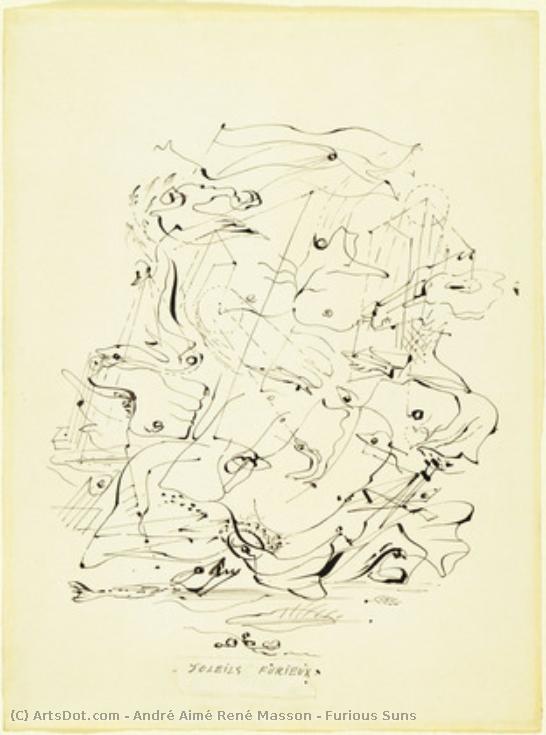
André Masson's “Furious Suns,” created in 1925, stands as a cornerstone of Surrealist art—a testament to the movement’s radical exploration of the subconscious mind and its rejection of rational representation. This striking black ink drawing on cream-colored paper isn’t merely an image; it’s a visceral embodiment of anxiety, primal energy, and the unsettling beauty found within dreams.
- Composition & Form: The artwork eschews traditional perspective, opting instead for a sprawling horizontal expanse dominated by interwoven lines. These lines don't converge on a focal point but rather guide the viewer’s gaze across the surface, creating an immersive experience akin to navigating a turbulent landscape. Organic shapes emerge from and dissolve into the linework, hinting at influences drawn from nature—perhaps abstracted representations of clouds or waves—further amplifying the sense of dynamism.
- Technique & Material: Masson employed freehand drawing using ink on paper – a technique known as automatism – deliberately bypassing conscious control. This method allowed him to tap into the unconscious, resulting in lines that appear spontaneous and imbued with raw emotion. The ink itself, likely India ink or similar, contributes to a subtle textural quality, mirroring the roughness of natural surfaces.
- Style & Movement: “Furious Suns” firmly establishes Masson within the Surrealist canon. Like fellow artists such as Joan Miró and Antonin Artaud, he sought to liberate art from logical constraints, prioritizing intuition and emotional expression over intellectual analysis. The swirling lines—thickest in some areas, thinnest in others—generate a palpable sense of movement, mirroring the turbulent forces underlying the subconscious.
- Symbolism & Emotion: The title itself – “Furious Suns” – is laden with symbolic significance. It speaks to an overwhelming intensity and passion, reflecting Masson’s preoccupation with themes of violence and metamorphosis—recurring motifs within Surrealist art. The drawing isn't attempting to depict literal suns; rather, it conveys a feeling of unrestrained energy and primal instinct.
- Historical Context: Produced during the height of the Surrealist movement, “Furious Suns” reflects the broader artistic climate of the era—a reaction against bourgeois values and a fascination with psychoanalysis. Masson’s work aligns closely with André Breton's manifesto, which championed automatism as a method for accessing the hidden depths of human consciousness.
Currently residing in the Museum of Modern Art (MoMA), “Furious Suns” continues to captivate viewers with its uncompromising honesty and evocative visual language. Its enduring appeal lies not only in its masterful execution but also in its ability to transport us into a realm where logic yields to emotion, and form transcends representation.
A művész életrajza
André Masson: A Surrealist Pioneer’s Journey Through the Unconscious
André Masson, a name synonymous with both surrealism and groundbreaking artistic techniques, was born in Balagny-sur-Thérain, a small town just north of Paris, on January 4th, 1896. His life unfolded as a fascinating tapestry woven from early artistic training, wartime experiences, and an unwavering dedication to exploring the depths of the human subconscious. Masson’s legacy isn't simply defined by his paintings; it resides in his revolutionary approach to artmaking – a method that blurred the lines between conscious control and spontaneous expression, forever altering the landscape of 20th-century art.Early Years and Artistic Foundations
Masson’s artistic journey began at the tender age of eleven when he enrolled at the Académie Royale des Beaux-Arts in Brussels. Under the tutelage of Constant Montald, he received a solid foundation in traditional painting techniques, developing a keen eye for form and composition. However, it was during this period that his initial inclinations towards Cubism began to surface – an early engagement with the radical experimentation taking place within the modern art world. These formative years instilled in him not just technical skill but also a restless curiosity, a desire to push beyond conventional boundaries and delve into uncharted artistic territories.The Surrealist Embrace: Automatic Drawing and Beyond
Masson’s life took a dramatic turn in the mid-1920s when he became deeply immersed in the burgeoning Surrealist movement. He wholeheartedly embraced automatic drawing – a technique that involved creating artwork without conscious control, allowing the subconscious to dictate the hand's movements. This wasn’t merely chance; it was a deliberate attempt to bypass rational thought and tap into the raw, unfiltered imagery residing within the mind. He collaborated closely with other prominent Surrealists like Antonin Artaud, Michel Leiris, Joan Miró, Georges Bataille, Jean Dubuffet, and Georges Malkine, fostering an incredibly vibrant artistic community fueled by shared experimentation and a desire to challenge established norms. Masson’s work during this period frequently explored themes of violence, eroticism, and metamorphosis – subjects that deliberately defied traditional artistic conventions, reflecting a profound shift in perspective.Innovative Techniques: Sand, Glue, and the Canvas
Masson's most distinctive contribution to art lies in his innovative techniques. He developed a method of applying sand and glue directly onto canvas, creating textured, layered paintings based on the unpredictable patterns formed by the materials. This process wasn’t about meticulous control; it was about embracing chance and allowing the resulting shapes to guide the artist’s hand. He also pioneered automatic drawing – numerous pen-and-ink works showcasing his innovative approach to art. These techniques combined to produce a uniquely expressive style, characterized by dynamic lines, biomorphic forms, and a palpable sense of movement. His work during this period often explored violent or erotic themes, reflecting a departure from traditional artistic conventions.War, Exile, and American Influence
The outbreak of World War II dramatically altered the course of Masson’s life. His work was condemned as “degenerate” by the Nazis, forcing him to flee France with the assistance of Varian Fry. He sought refuge in the United States, where he encountered a new wave of artistic experimentation. This period proved profoundly influential, exposing him to American Abstract Expressionists like Jackson Pollock and significantly shaping his own evolving style. Returning to France after the war, Masson settled in Aix-en-Provence, shifting his focus towards landscape painting – a move that reflected a desire for greater naturalism while retaining the expressive qualities of his earlier work.Legacy and Enduring Impact
André Masson’s impact on the art world is undeniable. He wasn't simply an artist; he was a pioneer who redefined the possibilities of artistic expression. His exploration of the subconscious, combined with his innovative techniques, continues to inspire artists today. His influence can be seen across various movements, from Cubism to Abstract Expressionism, solidifying his position as one of the most important figures in modern art history. Masson’s legacy is a testament to the power of artistic experimentation and the enduring allure of the unconscious mind.
André Masson
1896 - 1987 , Franciaország
Rövid tények
- Artistic Movement Or Style:
- Surrealizmus
- Kubbizm
- Artists Or Movements Influenced By This Artist:
- Jackson Pollock
- Körkép
- Artists Who Influenced This Artist: ['André Derain']
- Date Of Birth: Január 4, 1896
- Date Of Death: Október 28, 1987
- Full Name: André Aimé René Masson
- Nationality: Francia
- Notable Artworks:
- Beyond
- Landsc. sziklákkal
- A szerelmek metamorfozása
- Pygmalion
- Place Of Birth: Balagny-sur-Thérain, Franciaország
Kapcsolódó cikkek

Morris Louis: Pioneering Color Field Painting & Abstract Expressionism's Legacy
Explore the groundbreaking abstract expressionism of Morris Louis, a pioneer of Color Field painting. Discover his innovative techniques, influential series & lasting legacy in post-war American art. Learn more at OriginalUniqueArt.
Jacob Kainen: A Pioneer of American Color Field Painting & Abstract Expressionism
Explore the life & work of Jacob Kainen, a pivotal figure in American Abstract Expressionism and Color Field painting. Discover his journey from Social Realism to vibrant abstraction and lasting influence on 20th-century art.

Beyond Reality's Grasp: Surrealism & Expressionism in 20th-Century Art
Explore the captivating interplay of Surrealism & Expressionism in 20th-century art. Discover key artists like Masson and Pollock, automatism techniques, and their lasting influence. Expert insights for art enthusiasts.
Beatrice Parsons: A Study in Abstract Expressionism & the Poetics of Color Field Painting
Explore the captivating world of Beatrice Parsons, a pioneering British abstract expressionist. Discover her journey from garden watercolors to evocative color field paintings and learn about her place within art history.

Arturo Souto: A Study in Abstract Expressionism & Emotional Resonance
Explore the captivating world of Arturo Souto's abstract expressionism. Discover his unique style, emotional depth, and investment potential – a guide for discerning art collectors.


