
() ·
A print made for you, with care
Giclée / Műnyomat
Múzeumi minőségű giclée vagy vászonnyomat, gyors gyártással és rugalmas finomítási lehetőségekkel. ( Kézzel festett másolat rendelése Áttérés digitális képre)
A művész életrajza
Dutch painter Gerard Sanders specialized in portraits and landscapes like Archibald Hope the Elder. Discover his exquisite fine art collection.
 Összes részlet megjelenítése
előbb ·
1. fejezet
On which medium should it be printed?
Canvas is printed with giclée inks and can be stretched or framed like a painting; paper comes flat, or framed behind glass.
2. fejezet
Mekkora méretű legyen?
Húzza a csúszkát a méret megváltoztatásához; a bal oldali kép a keret valós szélességét mutatja. Az eredeti arányok megmaradnak.
Válasszon előre meghatározott méreteink közül, amelyek megfelelnek a műalkotás eredeti arányainak.

Írja be a keretének vagy a falának megfelelő szélességet és magasságot. A nyomatot csak le lehet vágni, soha nem tehető nagyobbá, mint az eredeti kép, így egy eltérő alakú méretnél a kép egy része elveszik. Mielőtt bármit kinyatintanánk, küldünk egy digitális próbamodellt jóváhagyásra. Az oldalon látható kép nem tartalmazza a valós levágást — ezt csak a próbamodell mutatja meg.
3. fejezet
Hogyan érkezzen meg?
Válaszd ki a feszített vászon széleit
Válassza ki a keretet

Fehér Ft1

Elmosódott szélek Ft1

Kiterjesztett Ft1

P118B Ft10

P118H Ft10

P118W Ft10

P438Z Ft10

P508JH Ft12

P508YH Ft12

P805H Ft10

P805Z Ft10

P919BZ Ft10

P919G Ft10

P919XJ Ft10

P959ZH Ft10

P968JZ Ft12

W106C Ft8

W218G Ft10

W218JH Ft8

W218Y Ft10

W307PJ Ft10

W316G Ft10

W316PJ Ft8

W316Y Ft10

W398PJ Ft8

W4111J Ft10

W500HY Ft15

W500JH Ft15

W692G Ft12

W849H Ft8

W940BG Ft15

W953PJ Ft8

H24-GOLD Ft30

H24-SILVER Ft30

H36-GOLD Ft45

H36-SILVER Ft45
Keretezett
Keretprofil: . A kerettel együtt vett teljes méret: .
4. fejezet
Világszerte történő kiszállítás területére mindössze 2 hét alatt, a szokásos 4-5 hét helyett. (22 november)
Az utolsó finomhangolás
Egy felirat, mint egy múzeumban?
A gravírozott bronztábla részletei
This elegant plaque features the artist's name and the title of the artwork, finely engraved for a timeless presentation.
It is made from bronze with a refined, elegant finish. The text is precisely laser-engraved for a sharp and permanent result. Measuring 9x2 cm, the plaque is compact yet easy to read. It's built to be durable and scratch-resistant, offering a professional, museum-quality look. Mounting is simple thanks to the included adhesive backing.
Átlátszó akril tábla részletei
The plaque includes essential engraved details such as the artist's name, the title of the artwork, the date it was created, the type of media used-like oil on canvas or watercolor-a brief description of the piece, and a QR code that links to the complete artwork information.
It is crafted from clear acrylic, offering a sleek, modern appearance. The text is UV-engraved in black to ensure strong visual contrast. With a size of 10x15 cm, it ensures optimal readability. It comes equipped with two metal hooks for secure wall mounting. The plaque is designed to be weather-resistant, making it suitable for various environments, and it includes interactive features that work seamlessly with smartphone scanning.
Fekete akril tábla részletei
This elegant plaque includes engraved information such as the artist's name, the title of the artwork, the date it was created, the type of media used (like oil on canvas or watercolor), a short description of the artwork, and a QR code for quick access to more information.
The plaque itself is made from refined black acrylic with a premium finish. The text is laser-engraved in white for high contrast and readability. Its size is 10x15 cm, designed to be easy to read. It comes with two metal hooks for professional mounting. The design is sleek and fits any interior style. It is also weather-resistant and durable, with built-in digital integration for mobile compatibility.
Egy védőréteg?
Mikor lenne szüksége rá?
5. fejezet
Your print, as you ordered it

Amorous Couple
Reprodukciós technika
Reprodukció mérete
-

Reprodukció keretezése
-
-
A bármely oldalsó méretét túlszálaló 105 cm (kb. 41 hüvelyk) meghaladó műalkotások vagy reprodukciók esetében a keret összeszerelhető készletként, szétszerelve kerül szállításra. Ez a módszer biztosítja a biztonságos szállítást, és megakadályozza a szállítás során fellépő sérüléseket.
Szakmész összeszerelést igényel – ez nem DIY (önösszeszerelhető) termék.
A készletet egy tapasztalt keretező szakembernek kell összeszerelnie és a vásznat feszítenie kell, fa ragasztó (nem tartalmazza a csomag), vásznfeszítő fogó és szorítók használatával, amelyek a ragasztó száradásáig a keretrészeket egymáshoz vuôngjba tartják. A helytelen összeszerelés vagy a nem egyenletes vásznfeszítés maradandó károsíthatja a műalkotást, és ez nem része a garanciánknak.
 A bármely oldalsó méretét túlszálaló 105 cm (kb. 41 hüvelyk) meghaladó műalkotások vagy reprodukciók esetében a keret összeszerelhető készletként, szétszerelve kerül szállításra. Ez a módszer biztosítja a biztonságos szállítást, és megakadályozza a szállítás során fellépő sérüléseket.
A készlet tartalmazza az összes tömörfa rudat, pontosan méretre vágva.
A mellékelt csavarokkal, valamint a sarokszerekhez szükséges faütő ragasztóval kell összeszerelnie (ez nem tartalmazható a csomagban), így a keretrendezőnek külön kell beszereznie.
A csomag nem tartalmazza a szükséges professzionális eszközöket: egy vászonfeszítőt és klipseket a rácsok vízszintes tartásához a ragasztó megszáradásáig.
Fontos:
A sarokcsatlakozásokhoz fánylagra van szükség, a keretrudakat szorítókapcsokkal kell rögzíteni, amíg a rag teljesen meg nem szárad, a kész keretre feszített vászonhoz pedig vászonfeszítő fogat szükséges. Ezek egyike sem található meg a készletben. Kérjük, rendelés előtt győződjön meg róla, hogy rendelkezik tapasztalt keretező szakemberrel.

Névtábla
-
-

Védőréteg (Lakk)
Fényes lakk (intenzívabb színek, védelem a fény és a nedvesség hatása ellen)
-

Sürgős
Világszerte szállítás () 2 héten belül a szokásos 4-5 hét helyett. (22 november)
-
Express szállítás
Világszerte szállítás területére 4-5 hét alatt. (29 november).
A szállítás díja tartalmazza
Összesített ár
Ft 26482
Az üvegkeretes opció csak 110 cm alatti méretben érhető el
Minden rendelés mellé tartalmazva
- Ingyenes globális expressz szállítás
- Prémium minőségű len vászon
- Teljes körű szállítási biztosítás
- Vámvisszatérítési Garancia
- Hiteles színarányosság garancia
- 100 napos visszaküldési lehetőség (csak hibás termékek esetén)
- 100% pénzvisszatérítési garancia
- Több darab vásárlásakor kedvezmény


 Megtekintés

 Küldés
 Megosztás
 Részletek
 Útmutató


 Letöltés
 Hasonló darabok
 X-ray felvétel
 Diavetítés
 Kérdések és válaszok
 Statisztika
Számokban kifejezve
- 1752a festés éve
- 29választható keretek
- standard méretek, saját arányokkal
- 5hetek a festésre és a kézbesítésre
Az eredeti műről

- 41.0 x 36.0cm


Ez a műalkotás szerzői jogi védelem alatt áll
Az ezen az oldalon megjelenített műalkotások szerzői jogi védelem alatt állnak, ami azt jelenti, hogy törvényileg nem készíthetünk és nem adhatunk el belőlük pontos másolatokat. Ez a védelem olyan nemzetközi megállapodások alapján érvényesül, mint például a Berni Egyezmény és a nemzeti jogszabályok által, beleértve azokat is, amelyeket meghatározott Az USA szerzői jogi törvénye – 17. cím.
Mint tiszteletes és törvényes alternatívát, olyan egyedi, kézzel festett alkotásokat kínálunk, amelyek az eredetiből merítnek inspirációt. Tapasztalt és professzionális művészeink alaposan tanulmányozzák az eredeti stílusát, hangulatát és művészeti esszenciáját, hogy egy olyan új, egyedi alkotást hozzunk létre, amely ugyanazt az érzést kelti – miközben önálló, eredeti alkotásként létezik.
Ez a módszer teljes mértékben megfelel a szerzői jogi szabályozásnak, mivel nem tartalmazza a védett műalkotás másolását vagy duplikálását. Ehelyett ez egy kreatív újinterpretáció – egy új festmény, amely az eredetivel való összefüggései miatt hatással van rá, de nem az az.

Gerard Sanders
1702 - 1767
Gyors információk Gerard Sanders művészről
- Artists Who Influenced This Artist:
- Tobias van Nijmegen
- Elias van Nijmegen
- Full Name: Gerard Sanders
- Nationality: Dutch
- Notable Artworks:
- Archibald Hope the Elder
- Amorous Couple
- Portrait of Johannes Wilhelmus Bussingh
- Portrait of Elisabeth van der Linden
- Place Of Birth: Wesel am Rhein, Germany
- Date Of Birth: 1702
- Date Of Death: 1767
A művész életrajza
Early Life, Family and Training
Born in 1702 in Wesel am Rhein, Germany, Gerard Sanders entered a world of visual craft through the intimate ties of family. His early years were shaped by a significant transition when his mother remarried Tobias van Nijmegen. This change in family structure provided the young artist with his first formal introduction to the arts, as he became a pupil of his stepfather. Under Tobias's guidance, Sanders began to develop the foundational skills of a painter and draughtsman, learning the nuances of composition and form within a domestic apprenticeship.
The trajectory of his education shifted when he reached the age of eighteen. Seeking to broaden his technical horizons, he moved to Rotterdam to study under Elias van Nijmegen. This period of study was essential in refining his ability to navigate both portraiture and landscape, preparing him for a career that would eventually see him decorating the interiors of the social elite. Throughout his life, he was occasionally known by the alias Gerhard Sanders, a variation that reflects the shifting linguistic borders of his era.
Patrons, Workshop and Commissions
Sanders’s professional life was defined by his ability to navigate the social hierarchies of the eighteenth century, moving between the private splendor of aristocratic homes and the public dignity of civic institutions. His early training under his stepfather, Tobias van Nijmegen, provided a foundation in the art of decoration, a skill that would lead him to decorate the interiors of the elite. This expertise in large-scale decorative schemes allowed him to secure significant placements, including work for the Elector Palatinate in Düsseldorf. Such commissions required a versatility that bridged the gap between fine art and the functional requirements of interior design.
His reputation for handling both private and public spaces is evident in the varied nature of his patronage. He was entrusted with the decoration of the house of Isaac Hope, a commission that placed his work within the intimate, domestic settings of the wealthy. This ability to cater to the specific tastes of prominent families ensured a steady presence in the high-society circles of the era. His work was not confined to the private sphere, however; he also engaged with the civic identity of the Netherlands. In 1764, he was commissioned to paint several scenes of civic virtues for the Town Hall of Middelburg, a task that required a shift from the personal nuances of portraiture to the formal demands of public morality.
Key Works and Artistic Subjects
Sanders focused his creative energy on the formal demands of portraiture, history subjects, and landscapes. His ability to navigate these diverse genres allowed him to move between the intimate scale of a private study and the grander requirements of civic decoration. In 1730, he produced a portrait historiée of a mother with her children, a work that suggests an interest in the allegorical or narrative potential of the human figure. This interest in character and status is further evidenced by his 1737 portrait of Archibald Hope the Elder, a piece that captures the dignity of its subject within the social hierarchies of the era.
As his career progressed, his output continued to reflect the tastes of the Dutch elite. He turned his attention to the likenesses of prominent individuals, including a portrait of Johannes Wilhelmus Bussingh (1727-1782) and a portrait of Elisabeth van der Linden (1735-1783), both dating to about 1760. These works demonstrate a steady hand in capturing the specificities of his sitters. Beyond the human form, he also engaged with the natural world, as seen in his 1763 watercolor over graphite, Fleurs et châtaignes sur un entablement.
- Portrait historiée of a mother with her children (1730)
- Portrait of Archibald Hope the Elder (1737)
- Portrait of Johannes Wilhelmus Bussingh (1727-1782) (about 1760)
- Portrait of Elisabeth van der Linden (1735-1783) (about 1760)
- Fleurs et châtaignes sur un entablement (1763)
Technique and Style
Sanders operated with the versatility required of a professional working in the Dutch tradition, moving fluidly between the roles of painter, draughtsman, and decorator. His training under his stepfather and later in Rotterdam provided him with a technical foundation that allowed him to navigate diverse commissions. Whether he was executing large-scale decorations for the interiors of the elite or working on more intimate studies, his hand remained steady and purposeful. He was as comfortable as a schilder handling canvas as he was a tekenaar capturing the essential lines of a subject.
In his more delicate works, Sanders demonstrated the precision of an aquarellist. He frequently employed watercolor over graphite on laid paper, a method that allowed for a controlled yet expressive application of color. This technique was particularly suited to his botanical studies and his ability to render the subtle textures of still life. The use of graphite provided a structural clarity to his compositions, ensuring that even his most light-handed washes of color maintained a sense of formal order.
His stylistic range was dictated by the demands of his environment. As a decorator, his work had to harmonize with the architectural spaces of the wealthy, requiring a sense of scale and decorative rhythm. In his portraiture and history subjects, he focused on the clarity of form and the character of his sitters. This adaptability—the ability to shift from the broad requirements of interior decoration to the fine, meticulous detail of a watercolor on paper—defined his professional practice.
Kapcsolódó cikkek
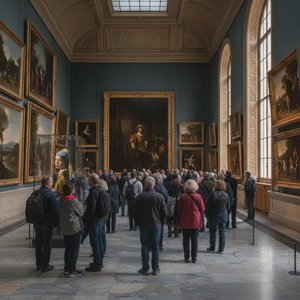
Masterpieces of the Dutch Soul: Top 25 Must-See Artworks in Amsterdam's Rijksmuseum
Embark on a journey through the Dutch Golden Age. From Rembrandt's drama to Vermeer's light, explore 25 iconic Rijksmuseum masterpieces and find museum-quality art reproductions for your decor. Discover all masterpieces on OriginalUniqueArt.com.

Masterpieces Unveiled: The Top 25 Artworks at the J. Paul Getty Museum
Explore 25 iconic masterpieces from the J. Paul Getty Museum. From Renaissance to Baroque, discover the legends on OriginalUniqueArt.com.