Sol Lewitt portréja

A 40 legnevezesebb Sol Lewitt festmény, egy galériaválaszték

Frissítve: október 2026 · rangsorolva népszerűségi pontszámunk alapján (minden mű keresései, látogatásai és megrendelései alapján) · 42 mű Sol Lewitt alkotása a katalógusunkban

Röviden

Sol Lewitt hagyatékából a leghíresebb alkotás Serial Project #1 ABCD (1966), amely a New York városi MoMA - Museum of Modern Art gyűjteményében található. Röviddel ezután követik őket Wall drawing #1091: arcs, circles and bands (room) (2003) és Distorted Cubes Bozuk Küpler. Katalógusunkban 42 mű található Sol Lewitt alkotótól; a galéria megőrizte a világ által leginkább csodált 40 darabot, melyeket a dátummal, a múzeummal és a történetükkel együtt mutatunk be.

1928 – 2007, Hartford Minimalism A legtöbb mű: MASS MoCA

Sol Lewitt legjobb 10 festménye: a galéria válogatása

1
Serial Project #1 ABCD (1966) (1889) -ja Sol Lewitt

Serial Project #1 ABCD

1966 · Sculpture · MoMA - Museum of Modern Art, New York

A systematic arrangement of white cubes and rectangular prisms occupies a grid-like base, set against a stark black void. This geometric composition, titled Serial Project #1 ABCD, functions as an architectural exploration of structure and seriality. Rather than representing a specific building, the work investigates the permutations of simple shapes. The arrangement follows a predetermined algorithm, where the placement of each element is dictated by a logical sequence rather than…

2
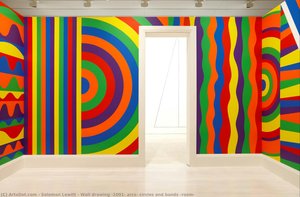
Wall drawing #1091: arcs, circles and bands (room) (2003) (1889) -ja Sol Lewitt

Wall drawing #1091: arcs, circles and bands (room)

2003 · Installation Art · Art Gallery of New South Wales, Sydney

To stand before Wall drawing #1091: arcs, circles and bands (room) is to witness not merely an arrangement of pigment on a surface, but the vibrant echo of artistic reinvention. This monumental piece by Solomon Lewitt captures a moment of profound resurgence in his later career. Where earlier works might have favored a more restrained palette, this drawing explodes with exuberant color—a joyous chromatic symphony applied across the architectural expanse…

3
Distorted Cubes Bozuk Küpler (1889) -ja Sol Lewitt

Distorted Cubes Bozuk Küpler

Painting · Borusan Contemporary, Istanbul

In the realm of conceptual mastery, few works capture the rhythmic pulse of modern abstraction as vibrantly as Sol LeWitt’s Distorted Cubes Bozuk Küpler. This captivating piece serves as a brilliant testament to the artist's ability to transform rigid mathematical precision into a dance of visual delight. At first glance, the viewer is greeted by an intricate mosaic of fourteen distinct colored squares, each meticulously arranged to create a sense…

4
Wall Drawing #391 (1983) (1889) -ja Sol Lewitt

Wall Drawing #391

1983 · Indian Ink · MASS MoCA, Adams

Wall Drawing #391 is an artwork by Solomon Lewitt. Created in April 1983, this two-part drawing occupies a specific space within the MASS MoCA in Adams. The work exists as a structural dialogue between two adjacent surfaces, mapping out a logic that relies on the intersection of planes and the direction of the line.

5
Wall Drawing #831 (1997) (1889) -ja Sol Lewitt

Wall Drawing #831

1997 · Drawing · Guggenheim Múzeum Bilbao, Bilbao

In the vast landscape of twentieth-century modernism, few names resonate with as much intellectual rigor as Solomon Lewitt. His Wall Drawing #831, created in 1997, serves as a breathtaking testament to the power of the idea over the hand. As a pioneer of both Minimalism and Conceptual Art, Lewitt famously posited that the concept itself is the machine that makes the art. This particular work is not merely a painting…

6
Wall Drawing #915 (1999) (1889) -ja Sol Lewitt

Wall Drawing #915

1999 · Installation Art · MASS MoCA, Adams

Wall Drawing #915 exists as an installation of mathematical precision. Created in 1999, the work utilizes a palette of pastels, anchored by a primary tone of steel blue. The composition relies on geometric patterns and interlocking shapes that transform architectural surfaces into active participants in the art. Through the use of arcs and circles, the piece establishes a rhythmic movement across the wall.

7
Incomplete open cube 5/6 (1974) (1889) -ja Sol Lewitt

Incomplete open cube 5/6

1974 · Metal · Art Gallery of New South Wales, Sydney

Incomplete Open Cube No.5-6 – A Testament to Minimalist Geometry The ‘Incomplete open cubes’ represent a pivotal moment in Sol LeWitt's artistic trajectory, encapsulating the core tenets of his conceptual approach and solidifying his position as one of the pioneers of Minimalism. Created in 1974, this sculpture—a precisely crafted aluminum structure—isn’t merely an object; it’s an embodiment of intellectual rigor distilled into a deceptively simple form. LeWitt himself famously articulated…

8
Kaldor Public Art Project 06: Sol LeWitt 1977 (1977) (1889) -ja Sol Lewitt

Kaldor Public Art Project 06: Sol LeWitt 1977

1977 · Drawing · Kaldor Public Art Projects, Sydney

In the quiet, transformative moment captured in this 1977 photograph, we witness more than just the documentation of a mural; we see the physical manifestation of an idea. Part of the prestigious Kaldor Public Art Project, this work by Solomon LeWitt serves as a profound testament to the power of Conceptualism. The image presents a stark, monochromatic dialogue between two observers and a monumental wall drawing that consumes the architectural…

9
Wall Drawing #146A (2000) (1889) -ja Sol Lewitt

Wall Drawing #146A

2000 · Crayon · MASS MoCA, Adams

In the realm of contemporary minimalism, few names resonate with as much intellectual authority as Solomon LeWitt. His work, particularly the mesmerizing Wall Drawing #14 6A, serves as a profound testament to the power of the concept over the physical object. This particular piece, captured in its striking blue crayon medium, transcends the boundaries of traditional painting to become an immersive environment. As one gazes upon the composition, the distinction…

A Sol Lewitt válogatás folytatódik: 11 – 40

11Pyramid (2005) (1889) -ja Sol LewittPyramid2005 · Art Gallery of New South Wales 12Black with White Lines, Vertical Not Touching (1970) (1889) -ja Sol LewittBlack with White Lines, Vertical Not Touching1970 · MoMA - Museum of Modern Art 13Cubo (1889) -ja Sol LewittCuboCAMUSAC Cassino Museum of Contemporary Art 14Vertical Lines, Not Touching (1970) (1889) -ja Sol LewittVertical Lines, Not Touching1970 · MoMA - Museum of Modern Art 15Objectivity (1962) (1889) -ja Sol LewittObjectivity1962 16Irregular Grid (1889) -ja Sol LewittIrregular GridElgiz Museum of Contemporary Art 17Wall Drawing #822 (1997) (1889) -ja Sol LewittWall Drawing #8221997 · MASS MoCA 18Four Color Woodcuts-Curvy Bands I-IV (1996) (1889) -ja Sol LewittFour Color Woodcuts-Curvy Bands I-IV1996 · Borusan Contemporary 19Kaldor Public Art Project 11: Sol LeWitt 1998 (1998) (1889) -ja Sol LewittKaldor Public Art Project 11: Sol LeWitt 19981998 · Kaldor Public Art Projects 20Blue Vertical (2000) (1889) -ja Sol LewittBlue Vertical2000 21Wal Drawing #999 (2001) (1889) -ja Sol LewittWal Drawing #9992001 · MASS MoCA 22Isometric Figures in Five and Six Colors (2002) (1889) -ja Sol LewittIsometric Figures in Five and Six Colors2002 · Borusan Contemporary 23Wall Drawing #1171 (2005) (1889) -ja Sol LewittWall Drawing #11712005 · MASS MoCA 24Wall Drawing #1185 (2005) (1889) -ja Sol LewittWall Drawing #11852005 · MASS MoCA 25brushstrokes 2 (1889) -ja Sol Lewittbrushstrokes 2CAMUSAC Cassino Museum of Contemporary Art 26Lincoln Center Print (1889) -ja Sol LewittLincoln Center PrintBorusan Contemporary 27brushstrokes (1889) -ja Sol LewittbrushstrokesCAMUSAC Cassino Museum of Contemporary Art 28Wall drawing #338: Two part drawing. The wall is divided vertically into two parts. Each part is divided horizontally and vertically into four equal parts. 1st part: Lines in four directions, one direction in each quarter. 2nd part: Lines in four dir.... (1971) (1889) -ja Sol LewittWall drawing #338: Two part drawing. The wall is divided vertically into two parts. Each part is divided horizontally and vertically into four equal parts. 1st part: Lines in four directions, one direction in each quarter. 2nd part: Lines in four dir....1971 · Art Gallery of New South Wales 29Wall Drawing #340 (1980) (1889) -ja Sol LewittWall Drawing #3401980 · MASS MoCA 30Untitled (1889) -ja Sol LewittUntitled 31Untitled from Squares with a Different Line Direction in Each Half Square (3) (1889) -ja Sol LewittUntitled from Squares with a Different Line Direction in Each Half Square (3) 32Untitled from Squares with a Different Line Direction in Each Half Square (1889) -ja Sol LewittUntitled from Squares with a Different Line Direction in Each Half Square 33Untitled from Squares with a Different Line Direction in Each Half Square (2) (1889) -ja Sol LewittUntitled from Squares with a Different Line Direction in Each Half Square (2) 34Wall Drawing #154, #155, #162, #163, #157, #158 (1889) -ja Sol LewittWall Drawing #154, #155, #162, #163, #157, #158Modern Art Oxford 35Distorted Cubes from Distorted Cubes (1889) -ja Sol LewittDistorted Cubes from Distorted Cubes 36Distorted Cubes from Distorted Cubes (2) (1889) -ja Sol LewittDistorted Cubes from Distorted Cubes (2) 37Irregular tower (1889) -ja Sol LewittIrregular towerCAMUSAC Cassino Museum of Contemporary Art 38Irregular tower (1889) -ja Sol LewittIrregular towerCAMUSAC Cassino Museum of Contemporary Art 39Irregular Arcs, Bands and Loops (1889) -ja Sol LewittIrregular Arcs, Bands and LoopsBorusan Contemporary 40Eight-Pointed Stars (1889) -ja Sol LewittEight-Pointed StarsChrysler Museum of Art

Sol Lewitt híres festményei, korszakonként

A témák, amelyek Sol Lewitt figyelmét meghúzták

A négy leggyakorobban előforduló téma ebben az eredeti művekben, mindegyik a legkiválóbb példájával.

A műemlékek, amelyek Sol Lewitt eredeti műveit őrzik

A 8 olyan múzeum, amely a legtöbb ezen az oldalon szereplő festményet őrzi.

Múzeum Város Sol Lewitt művei Ebből a listából származó festmények
MASS MoCA, AdamsMASS MoCA Adams 9 Wall Drawing #391, Wall Drawing #915, Wall Drawing #146A
Borusan Contemporary, IstanbulBorusan Contemporary Istanbul 5 Distorted Cubes Bozuk Küpler, Four Color Woodcuts-Curvy Bands I-IV, Isometric Figures in Five and Six Colors
CAMUSAC Cassino Museum of Contemporary Art, CassinoCAMUSAC Cassino Museum of Contemporary Art Cassino 5 Cubo, brushstrokes 2, brushstrokes
Art Gallery of New South Wales, SydneyArt Gallery of New South Wales Sydney 4 Wall drawing #1091: arcs, circles and bands (room), Incomplete open cube 5/6, Pyramid
MoMA - Museum of Modern Art, New YorkMoMA - Museum of Modern Art New York 3 Serial Project #1 ABCD, Black with White Lines, Vertical Not Touching, Vertical Lines, Not Touching
Kaldor Public Art Projects, SydneyKaldor Public Art Projects Sydney 2 Kaldor Public Art Project 06: Sol LeWitt 1977, Kaldor Public Art Project 11: Sol LeWitt 1998
Guggenheim Múzeum Bilbao, BilbaoGuggenheim Múzeum Bilbao Bilbao 1 Wall Drawing #831
Elgiz Museum of Contemporary Art, İstanbulElgiz Museum of Contemporary Art İstanbul 1 Irregular Grid

Sol Lewitt évtizede folgtva: az eredeti művek, amelyek meghatározzák az egyes korzakot

Művek évtizedenként

Váassz ki egy évtizedet, hogy megnézhesd az azt meghatározó eredetiműveket.

Gyűjtői kérdések Sol Lewitt festményeivel kapcsolatban

Melyik művel a(z) Sol Lewitt a leghíresebb?Fedje fel a választ

Serial Project #1 ABCD (1966), MoMA - Museum of Modern Art, New York. Ezután Wall drawing #1091: arcs, circles and bands (room) (2003) és Distorted Cubes Bozuk Küpler következik.

Hány éves volt Sol Lewitt, amikor a Serial Project #1 ABCD készült?Fedje fel a választ

38 éves: Serial Project #1 ABCD 1966-ből származik, Sol Lewitt pedig 1928-ben született.

Melyek a tíz leghíresebb Sol Lewitt festmény?Fedje fel a választ

Serial Project #1 ABCD, Wall drawing #1091: arcs, circles and bands (room), Distorted Cubes Bozuk Küpler, Wall Drawing #391, Wall Drawing #831, Wall Drawing #915, Incomplete open cube 5/6, Kaldor Public Art Project 06: Sol LeWitt 1977, Wall Drawing #146A és Wall Drawing #793B Certificate. A fenti rangsor a művek évszamarát és a múzeumát jelzi.

Hány festményet hagyott hátra Sol Lewitt?Fedje fel a választ

Katalógusunkban 42 mű található Sol Lewitt alkotótól, 1962 és 2005 év közötti időszakból.

Mely múzeumokban állnak Sol Lewitt remekművei?Fedje fel a választ

Leginkább MASS MoCA (Adams), Borusan Contemporary (Istanbul) és CAMUSAC Cassino Museum of Contemporary Art (Cassino) található. A fenti múzeumi táblázatban mindegyik felsorolásra került.

Mely években festette Sol Lewitt leghíresebb műveit?Fedje fel a választ

2000s alatt: a jelen laphonon található 40 műből 8 készült ebben az időszakban, köztük Wall drawing #1091: arcs, circles and bands (room).

Mikszétek az első és az utolsó híres eredeti műve a(z) Sol Lewitt alkotótól?Fedje fel a választ

Ezen az oldalon a leghitelesebb Objectivity (1962), a legutóbbi pedig Pyramid (2005).

Milyen témaköröket választott leggyakrabban Sol Lewitt?Fedje fel a választ

Geometric abstraction (8), Conceptual art (7) és Wall drawing (5), a jelen oldalon található 40 műművészeti alkotás között.

Melyik technikát alkalmazta leggyakrabban Sol Lewitt?Fedje fel a választ

Sculpture, a jelen oldalon található 40 műből 2 darab esetén.

Mely művészeti irányba tartozik Sol Lewitt?Fedje fel a választ

Minimalism, ezen az oldalon található eredetiek alapján.

Mely Sol Lewitt művei láthatóak a MASS MoCA kiállتításán?Fedje fel a választ

Wall Drawing #391, Wall Drawing #915 és Wall Drawing #146A: a MASS MoCA, Adams 9 művet őrzi ezen az oldalon.

Sol Lewitt: életmű és életút

Az ötletek építésze: Sol LeWitt élete és öröksége

A twentieth century modernizmus hatalmas tájában kevés olyan alak vet olyan hosszú vagy intellektuálisan mély árnyékot, mint Solomon LeWitt. Oroszországból származó zsidó bevándorló családba született 1928. szeptember 9-én Hartford, Connecticut államban; útját a tiszta gondolkodás keresése határozta meg a puszta fizikai kivitel helyett. Korai éveket szigorú, analitikus kíváncsiság formált, amelyet a Syracuse University 1945 és ąg 1949 közötti tanulmányai öltözött meg. A matematika és a geometria ilyen akadémiai alapjai később művészeti nyelvének maga lett a szíve, lehetővé téve számára, hogy letisztítsa a hagyományos művészet díszes excesszióit, és feltárja a logika és a struktúra csontvázszerű szépségét.

LeWitt művészi fejlődése nem hirtelen szakadás volt, hanem tudatos migráció a megfoghatótól a koncepciós irányba. Bár korai kísérletei a festészet és a rajz művészetének haptikus jellegét foglalták, hamar arra merült, hogy egyre inkább a vonal mögötti ötlet vonzza őt, nem pedig maga a vonal. Ez a váltás egy olyan úttörő születését jelezte, aki áthidalta a szakadékot a minimalizmus és a koncepciális művészet között. A művészt már nem a kézzel kötött kézművesként látta, hanem az utasítások építészeként. Azzal, hogy a mentális tervet fontosabbá tette a befejezett objektumnál, LeWitt megkérdőjelezte a szerzői alkotás fogalmát is, felvetve, hogy amint egy ötlet létrejött, annak fizikai megjelenése csupán egy sekundus következmény.

A falrajzok forradalma

A 1960-as évek vége a kortárs művészet egyik legradikusabb átalakulásának tanúja volt LeWitt ikonikus falrajzaival. A hagyományos szobrászat állandóságát és értékességét elvetve bevezette a „struktúrákat” – egy kifejezést, amelyet a „szobrok” helyett preferált, hogy hangsúlyozza matematikai esszenciájukat –, valamint egy olyan utasítások sorozatát, amelyet bárki végrehajthatott, aki képes volt követni azokat. Ezek a művek nem csupán dekorációk voltak, hanem élő élmények; gyakran pontos geometriai mintákból, ívekből és egymásba vetődő formákból álltak össze, amelyek életet leheltek a lakhelyükül szolgáló építészeti terekbe.

Egy LeWitt-falrajz megtekintése olyan, mintha a logikát poesziává alakulná. Legyen szó a Black with White Lines, Vertical Not Touching című művében található rideg, ritmikus ismétlődésről, vagy a Wall Drawing #1091: arcs, circles and bands vibráló, exuberant energiájáról, munkássága a vonal erejét használta fel a tér uralására. Ezek az alkotások gyakran egy logikai, gyakran matematikai utasítások rendszerére támaszkodtak, amelyek segítők vagy múzeum-installátorok munkáját irányították. Ez a módszer demokratizálta az alkotás folyamatát, miközben egyidejűleg emelte az koncepció fontosságát, biztosítva, hogy a művészeti alkotás alapvetően egy intellektuális szikraként létezzen, mielőtt bármilyen fal érintené.

Tartós nyom a modernitásban

Gazdag karrierje során, amely évtizedeket ölt magában és magában foglalta a grafika, a fotográfia és az installáció mesteri szintű gyakorlatát is, LeWitt hűséges maradt tisztaság iránti elkötelezettségéhez és precizitásához. Képes volt mély szépséget találni a legegyszerűbb formákban – legyen szó a lenyűgöző fehér Pyramid-ról vagy a krétával készített falrajzai komplex, színes ritmusairól –, ezzel újradefiniálva a 20. század végi esztétikai határokat. Bebizonyította, hogy a művészet megbonthatatlanul megczépíthető az ego és az ornamentika nélkül, mégis megőrtheti azt a lelket, amely mélyen rezonál az emberi rendettségi és felfedezési vágyjal.

Sol LeWitt történelmi jelentőségét nem lehet alulbecsülni. Szóhasználatot biztosított művészek generációi számára, hogy feltárják a határokat a gondolat és az anyag között. Öröksége életre kel minden olyan múzeumban és galériában, ahol a teremtő és az kivitelező közötti von line elmosódik, és ahol az ötlet erejét a végső médiumként ismerik fel. Ahogy visszatekintünk életére, Hartford kezdetektől New York 2007-es utolsó napjáig, egy olyan embert látunk, aki nem csupán művészetet alkotott, hanem megtanított minket arra, hogyan lássuk magát a gondolkodás mély építészetét is.