Portret Jan Baptist Weenix

78 najpoznatijih djela umjetnika Jan Baptist Weenix, galerijska selekcija

Ažurirano Studeni 2026 · rangirano prema našoj ocjeni popularnosti (pretraživanja, posjeti i narudžbe za svako djelo) · 86 djela Jan Baptist Weenix u našem katalogu

Ukratko

Od svih originala koje je Jan Baptist Weenix ostavio, najpoznatiji je Tobit, asleep under a vine, is blinded (1642) u kolekciji muzeja Museum Boijmans Van Beuningen, Rotterdam. Samo iza njih slijede Italian landscape with shelter and antiques ruins (1658) i Still Life with a Dead Swan (1651). Naš katalog sadrži 86 djela umjetnika Jan Baptist Weenix; galerija je čuvala onih 78 koja svijet najviše divi, a svako je prikazano s datumom nastanka, muzejom i pričanom.

1621 – 1659, Amsterdam Dutch golden age Najviše djela: Bavarske državne slikopisne zbirke

Top 10 djela umjetnika Jan Baptist Weenix: izbor galerije

1
Tobit, asleep under a vine, is blinded (1642) od Jan Baptist Weenix

Tobit, asleep under a vine, is blinded

1642 · Oil On Canvas · Museum Boijmans Van Beuningen, Rotterdam

A single man reclines in the heavy shade of a vine. He is Tobit, lost to a deep, unsuspecting sleep. The air around him feels thick, weighted by the muted tones of ochre and forest green. Sunlight does not flood this scene; instead, it pierces through the foliage in sharp, controlled beams, illuminating the textures of his slumped posture and the coarse fabric of his clothing. He rests amidst a…

2
Italian landscape with shelter and antiques ruins (1658) od Jan Baptist Weenix

Italian landscape with shelter and antiques ruins

1658 · Oil On Panel · Mauritshuis, Haag

The oil on panel painting titled Italian landscape with shelter and antiques ruins was executed by the artist Jan Baptist Weenix in 1658. This landscape painting depicts a specific pastoral setting within an Italianate environment. The scene is populated by a group of peasants and various livestock, including sheep and goats. These figures are situated near a rustic cottage and several ancient architectural ruins that occupy the landscape.

3
Still Life with a Dead Swan (1651) od Jan Baptist Weenix

Still Life with a Dead Swan

1651 · Oil On Canvas · Detroit Institute of Arts, Detroit

The painting Still Life with a Dead Swan by Jan Baptist Weenix captures a heavy, silent moment of the hunt. Created about 1651, the work presents a collection of fallen game as a trophy of the chase. A white swan rests at the center, its pale plumage a stark contrast to the darker forms surrounding it. This central figure is accompanied by a turkey, two partridges, and a small finch,…

4
Tobit Sleeping Under the Vine (1641) od Jan Baptist Weenix

Tobit Sleeping Under the Vine

1641 · Oil · Museum Catharijneconvent, Utrecht

In this work, titled Tobit Sleeping Under the Vine, we encounter a significant piece by the Dutch Golden Age painter Jan Baptist Weenix. Created around 1642, the painting belongs to the Baroque period, a time when the interplay of light and shadow began to define the dramatic tension of Northern European art. Weenix, born in Amsterdam, Netherlands, brought a disciplined approach to his subjects, often blending meticulous observation with a…

5
The Scissors Grinder (1641) od Jan Baptist Weenix

The Scissors Grinder

1641 · Oil · Bavarske državne slikopisne zbirke, München

The air feels heavy with the scent of damp stone and the rhythmic, metallic scrape of steel against stone. Under a vast, expansive sky, a group of figures gathers within the skeletal remains of a classical ruin. A man leans into his work, operating a grinding wheel that cuts through the quietude of the scene. Beside him, a woman sits in repose, while a small child stands close by, watching…

6
Hunters Near Ruins (1648) od Jan Baptist Weenix

Hunters Near Ruins

1648 · Oil On Canvas · Cleveland Museum of Art, Cleveland

Hunters Near Ruins is an oil on canvas painting by Jan Baptist Weenix. The work is dated 1648. This piece belongs to the Dutch Golden Age, a period during which the artist developed a specific approach to landscape and human figures.

7
Portrait of René Descartes (1647) od Jan Baptist Weenix

Portrait of René Descartes

1647 · Oil · Centraal Museum, Utrecht

In this 1647 oil painting, Jan Baptist Weenix captures the French philosopher René Descartes. The subject appears in a medium close-up, his presence defined by a heavy, somber stillness. He is an elderly man, his face marked by the weight of thought and the passage of years. A bright white collar cuts through the darkness of his attire, framing a pale countenance that emerges from a deep, umber shadow.

8
Monument at a Harbour (1648) od Jan Baptist Weenix

Monument at a Harbour

1648 · Oil · Statens Museum For Kunst, Kopenhagen

The composition relies on strong vertical elements, primarily through imposing columns and a central, highly ornate pedestal topped with a large urn. These structures anchor the scene, providing a sense of scale against the scattered human figures in the foreground and middle ground. Through a use of deep recession, the perspective draws the eye past a colonnade toward a distant, hazy horizon where the masts of ships are visible.

9
Harbour with Antique Ruins (1648) od Jan Baptist Weenix

Harbour with Antique Ruins

1648 · Oil On Canvas · Nationalmuseum, Stockholm

The scene unfolds in 1648, a moment captured in the oil on canvas known as Harbour with Antique Ruins. This work belongs to the hand of Jan Baptist Weenix, an artist who brings the weight of history into a living, breathing maritime setting. The painting presents a world where the weathered stone of classical antiquity meets the constant, rhythmic movement of a working harbor. It is a vision of a…

10
The Angel Raphael Leaving Tobias's Family (1648) od Jan Baptist Weenix

The Angel Raphael Leaving Tobias's Family

1648 · Oil · Nationalmuseum, Stockholm

In "The Angel Raphael Leaving Tobias's Family" by Jan Baptist Weenix, a divine departure unfolds with sudden, celestial energy. The scene captures the exact moment the Angel Raphael ascends toward the heavens, leaving the family below in a state of profound awe and reverence. A powerful diagonal movement pulls the eye from the lower left foreground upward toward the upper left, where the angelic figure climbs into a swirling formation…

Izbor umjetnika Jan Baptist Weenix se nastavlja, od 11 do 78

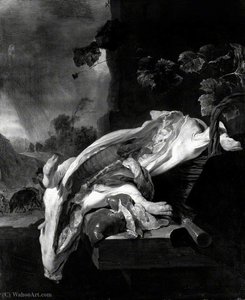
11vegetable-sellers at the house-door, 5 figures (1646) od Jan Baptist Weenixvegetable-sellers at the house-door, 5 figures1646 12caravane near the shore (1646) od Jan Baptist Weenixcaravane near the shore1646 13Mother and Child (1647) od Jan Baptist WeenixMother and Child1647 14Circumcision of Moses' son (1640) od Jan Baptist WeenixCircumcision of Moses' son1640 · Narodni muzej u Varšavi 15Still Life with Game, Hunter and Two Dogs (1652) od Jan Baptist WeenixStill Life with Game, Hunter and Two Dogs1652 · Bavarske državne slikopisne zbirke 16Butterfly Dog and Dead Bird (1649) od Jan Baptist WeenixButterfly Dog and Dead Bird1649 · Museum Mayer van den Bergh 17Pleasure boating (1650) od Jan Baptist WeenixPleasure boating1650 18The Sleeping Shepherdess (1658) od Jan Baptist WeenixThe Sleeping Shepherdess1658 · National Gallery of Ireland 19Roman Tinker (1656) od Jan Baptist WeenixRoman Tinker1656 · Städel Museum 20The love letter (1650) od Jan Baptist WeenixThe love letter1650 · National Museum of Art, Architecture and Design 21Italian Harbour (1651) od Jan Baptist WeenixItalian Harbour1651 · Ermitaž 22Italian Peasants among Ruins (1650) od Jan Baptist WeenixItalian Peasants among Ruins1650 · Detroit Institute of Arts 23Sleeping girl (1656) od Jan Baptist WeenixSleeping girl1656 · Bavarske državne slikopisne zbirke 24Rest on the Flight into Egypt (1657) od Jan Baptist WeenixRest on the Flight into Egypt1657 · Museum Boijmans Van Beuningen 25Merry Company on a Ferry (1649) od Jan Baptist WeenixMerry Company on a Ferry1649 · Museum Gouda 26Battle at the foot of the mountain. (1650) od Jan Baptist WeenixBattle at the foot of the mountain.1650 · Narodni muzej u Varšavi 27Christina Lepper de Kempenaer and Her Children (1653) od Jan Baptist WeenixChristina Lepper de Kempenaer and Her Children1653 28Italian port scene, 1649 (1649) od Jan Baptist WeenixItalian port scene, 16491649 · Centraal Museum 29Italian Landscape with Horsemen by a Spring (1657) od Jan Baptist WeenixItalian Landscape with Horsemen by a Spring1657 · Centraal Museum 30Before the walls of Rome (1650) od Jan Baptist WeenixBefore the walls of Rome1650 · National Museum in Wrocław 31Portrait of a man with a letter (1650) od Jan Baptist WeenixPortrait of a man with a letter1650 · Agnes Etherington Art Center 32A Landscape with a Ford (1660) od Jan Baptist WeenixA Landscape with a Ford1660 · Regionalna galerija u Libericu 33In the Campagna (1669) od Jan Baptist WeenixIn the Campagna1669 · National Gallery of Ireland 34Dead Fowl Being Eaten by a Cat (1653) od Jan Baptist WeenixDead Fowl Being Eaten by a Cat1653 · Städel Museum 35Departure of an Oriental Entourage (1647) od Jan Baptist WeenixDeparture of an Oriental Entourage1647 · Louvre 36Display of Dead Game (1641) od Jan Baptist WeenixDisplay of Dead Game1641 · Petit Palais 37Dead Game (1641) od Jan Baptist WeenixDead Game1641 38River Landscape with a Ferry (1650) od Jan Baptist WeenixRiver Landscape with a Ferry1650 · Montreal Museum of Fine Arts 39Still Life with Dead Game and Poultry (1656) od Jan Baptist WeenixStill Life with Dead Game and Poultry1656 · Centraal Museum 40Still Life with Fowl (1650) od Jan Baptist WeenixStill Life with Fowl1650 · Museum of Fine Arts Ghent (MSK) 41Marine with a Venetian Bucintoro (1650) od Jan Baptist WeenixMarine with a Venetian Bucintoro1650 · Staatliche Kunsthalle Karlsruhe 42The Dutch Ambassador on his Way to Isfahan, Jan Baptist Weenix, 1653 - 1659 (1659) od Jan Baptist WeenixThe Dutch Ambassador on his Way to Isfahan, Jan Baptist Weenix, 1653 - 16591659 · Rijksmuseum 43After the Hunt, Jan Baptist Weenix, c. 1656 (1656) od Jan Baptist WeenixAfter the Hunt, Jan Baptist Weenix, c. 16561656 · Rijksmuseum 44Still Life with White Mouse (1680) od Jan Baptist WeenixStill Life with White Mouse1680 · Ernest Zmeták Art Gallery 45Still Life with Game od Jan Baptist WeenixStill Life with GameHarvard Art Museums 46The Ford in the River (1647) od Jan Baptist WeenixThe Ford in the River1647 · Ermitaž 47Harbor View with Rider in Oriental Dress, od Jan Baptist WeenixHarbor View with Rider in Oriental Dress,Groninger Museum 48The Holy Women at the Tomb od Jan Baptist WeenixThe Holy Women at the TombNational Gallery of Ireland 49An Italian Seaport od Jan Baptist WeenixAn Italian SeaportKraljevski muzej fine umjetnosti u Antverpenu 50Architectural interior with foreign shippers, ruins and a shipyard beyond od Jan Baptist WeenixArchitectural interior with foreign shippers, ruins and a shipyard beyond 51Study of a sheep od Jan Baptist WeenixStudy of a sheep 52A pig's carcase od Jan Baptist WeenixA pig's carcase 53The Tinker and His Dog od Jan Baptist WeenixThe Tinker and His Dog 54Landscape with Peasants and Animals od Jan Baptist WeenixLandscape with Peasants and Animals 55Dead Partridge (1650) od Jan Baptist WeenixDead Partridge1650 · Mauritshuis 56Goat Lying Down, Jan Baptist Weenix, 1645 - 1660 (1660) od Jan Baptist WeenixGoat Lying Down, Jan Baptist Weenix, 1645 - 16601660 · Rijksmuseum 57A Dog and a Cat near a partially disembowelled Deer, Jan Baptist Weenix, 1645 - 1660 (1660) od Jan Baptist WeenixA Dog and a Cat near a partially disembowelled Deer, Jan Baptist Weenix, 1645 - 16601660 · Rijksmuseum 58Still Life with Dead Poultry, Lidded Pitcher and Passglas od Jan Baptist WeenixStill Life with Dead Poultry, Lidded Pitcher and PassglasBavarske državne slikopisne zbirke 59Game-piece od Jan Baptist WeenixGame-pieceNational Gallery of Ireland 60Dead game and hunting tackle in landscape od Jan Baptist WeenixDead game and hunting tackle in landscape 61Hound with a Joint of Meat and a Cat Looking on od Jan Baptist WeenixHound with a Joint of Meat and a Cat Looking on 62Bouquet of flowers od Jan Baptist WeenixBouquet of flowersGemäldegalerie 63Shipping in Harbour od Jan Baptist WeenixShipping in Harbour 64Herons and Lapwings od Jan Baptist WeenixHerons and Lapwings 65Still Life of Dead Game in a Landscape with a Huntsman od Jan Baptist WeenixStill Life of Dead Game in a Landscape with a Huntsman 66An italian port scene od Jan Baptist WeenixAn italian port scene 67Shepherds and Flocks among Classical Ruins od Jan Baptist WeenixShepherds and Flocks among Classical Ruins 68A Coast Scene with Classical Ruins od Jan Baptist WeenixA Coast Scene with Classical RuinsWallace Collection 69Still Life with Dead Game od Jan Baptist WeenixStill Life with Dead Game 70Hounds and an Owl with Dead Birds and Sculptures in a Landscape od Jan Baptist WeenixHounds and an Owl with Dead Birds and Sculptures in a Landscape 71Still Life with Dead Birds od Jan Baptist WeenixStill Life with Dead Birds 72Family in a Mediterranean Seaport od Jan Baptist WeenixFamily in a Mediterranean Seaport 73Figures near a Seaport od Jan Baptist WeenixFigures near a SeaportScottish National Gallery 74A Huntsman cutting up a Dead Deer, with Two Deerhounds od Jan Baptist WeenixA Huntsman cutting up a Dead Deer, with Two DeerhoundsNational Gallery 75Ancient Ruins od Jan Baptist WeenixAncient RuinsSzépművészeti Múzeum 76Figures among ruins od Jan Baptist WeenixFigures among ruinsThe Kremer Collection 77Ancient Ruins (detail) od Jan Baptist WeenixAncient Ruins (detail)Szépművészeti Múzeum 78Girl as Shepherdess (1650) od Jan Baptist WeenixGirl as Shepherdess1650 · Musée de Picardie

Slavna djela Jan Baptist Weenix po razdobljima

Motivi koji su privukli pažnju Jan Baptist Weenix

Četiri teme koje se najčešće ponavljaju u ovim originalima, svaka s svojim vrhunskim primjerom.

Muzeji koji čuvaju originalna djela umjetnika Jan Baptist Weenix

8 muzeja u kojima se nalazi najviše djela s ove stranice.

Muzej Grad Djela autora Jan Baptist Weenix Slike iz ovog popisa
Bavarske državne slikopisne zbirke, MünchenBavarske državne slikopisne zbirke München 4 The Scissors Grinder, Still Life with Game, Hunter and Two Dogs, Sleeping girl
Centraal Museum, UtrechtCentraal Museum Utrecht 4 Portrait of René Descartes, Italian port scene, 1649, Italian Landscape with Horsemen by a Spring
National Gallery of Ireland, DublinNational Gallery of Ireland Dublin 4 The Sleeping Shepherdess, In the Campagna, The Holy Women at the Tomb
Rijksmuseum, AmsterdamRijksmuseum Amsterdam 4 The Dutch Ambassador on his Way to Isfahan, Jan Baptist Weenix, 1653 - 1659, After the Hunt, Jan Baptist Weenix, c. 1656, Goat Lying Down, Jan Baptist Weenix, 1645 - 1660
Museum Boijmans Van Beuningen, RotterdamMuseum Boijmans Van Beuningen Rotterdam 2 Tobit, asleep under a vine, is blinded, Rest on the Flight into Egypt
Mauritshuis, HaagMauritshuis Haag 2 Italian landscape with shelter and antiques ruins, Dead Partridge
Detroit Institute of Arts, DetroitDetroit Institute of Arts Detroit 2 Still Life with a Dead Swan, Italian Peasants among Ruins
Nationalmuseum, StockholmNationalmuseum Stockholm 2 Harbour with Antique Ruins, The Angel Raphael Leaving Tobias's Family

Jan Baptist Weenix iz godine u godinu: originalna djela koja definiraju svaku od njih

Od 1640 do 1659, Jan Baptist Weenix je stvarao tijekom 20 godina: ovaj izbor prati tu dugogodišnju karijeru godinu po godinu, kroz njegova najfinija originalna djela.

Djela po godinama

Odaberite godinu kako biste vidjeli originalna djela.

Pitanja kolekcionara o slikama umjetnika Jan Baptist Weenix

Po kojem je djelu Jan Baptist Weenix najpoznatiji/a?Otkrijte odgovor

Tobit, asleep under a vine, is blinded (1642), Museum Boijmans Van Beuningen, Rotterdam. Nakon njih slijede Italian landscape with shelter and antiques ruins (1658) i Still Life with a Dead Swan (1651).

Koliko je godina Jan Baptist Weenix imao/la kada je nastalo djelo Tobit, asleep under a vine, is blinded?Otkrijte odgovor

21 godina: Tobit, asleep under a vine, is blinded datira iz 1642, a Jan Baptist Weenix je rođen/a 1621.

Koja su deset najpoznatijih djela umjetnika Jan Baptist Weenix?Otkrijte odgovor

Tobit, asleep under a vine, is blinded, Italian landscape with shelter and antiques ruins, Still Life with a Dead Swan, Tobit Sleeping Under the Vine, The Scissors Grinder, Hunters Near Ruins, Portrait of René Descartes, Monument at a Harbour, Harbour with Antique Ruins i The Angel Raphael Leaving Tobias's Family. Gornji rang prikazuje godinu i muzej za svako od njih.

Koliko je slika ostavio/la Jan Baptist Weenix?Otkrijte odgovor

Naš katalog sadrži 86 djela umjetnika Jan Baptist Weenix, datiranih od 1640 do 1659.

U kojim se muzejima nalaze remek-djela umjetnika Jan Baptist Weenix?Otkrijte odgovor

Većinom u Bavarske državne slikopisne zbirke (München), Centraal Museum (Utrecht) i National Gallery of Ireland (Dublin). Gornja tablica muzeja navodi sve njih.

U kojim je godinama Jan Baptist Weenix naslikao svoja najpoznatija djela?Otkrijte odgovor

U 1650: 11 od 78 djela na ovoj stranici nastalo je tada, od čega je Pleasure boating Pleasure boating.

Koja su prva i posljednja poznata originalna djela umjetnika Jan Baptist Weenix?Otkrijte odgovor

Na ovoj stranici najstarije djelo je iz Circumcision of Moses' son (1640), a najnovije iz The Dutch Ambassador on his Way to Isfahan, Jan Baptist Weenix, 1653 - 1659 (1659).

Koje je motive Jan Baptist Weenix najčešće birao?Otkrijte odgovor

Landscape (18), Ruins (17) i Sky (13), kroz svih 78 djela na ovoj stranici.

Koju je tehniku najčešće koristio/la Jan Baptist Weenix?Otkrijte odgovor

Oil On Canvas, za 30 od 78 djela na ovoj stranici.

Pripada li Jan Baptist Weenix kojem umjetničkom pokretu?Otkrijte odgovor

Dutch golden age i Baroque, sudeći po originalima na ovoj stranici.

Koji se radovi umjetnika Jan Baptist Weenix nalaze u muzeju Bavarske državne slikopisne zbirke?Otkrijte odgovor

The Scissors Grinder, Still Life with Game, Hunter and Two Dogs i Sleeping girl: Bavarske državne slikopisne zbirke, München posjeduje 4 djela s ove stranice.

Jan Baptist Weenix: život i djelo

Vizionar holandskog zlatnog doba

Jan Baptist Weenix izdvaja se kao jedinstvena figura unutar holandskog zlatnog doba, slavljen zbog svoje prepoznatljive mješavine pedantnog opažanja i maštovite vizije. Iako je njegov umjetnički opus bio relativno skroman u usporedbi s contemporaryima poput Rembrandta ili Vermeera, Weenixov doprinos povijesti holandske umjetnosti neosporan je—osobito njegovo revolucionarno istraživanje talijanskih krajolika prožetih ljudskim likovima, čime je uspostavio stilski presedan koji će odjekivati kroz generacije. Rođen u Amsterdamu blizu užurbanog luke 1621. godine, Weenix je potjecao iz obitelji arhitekata, što je vjerojatno oblikovalo njegove formativne godine usred intelektualnog i strukturnog fervora tog doba.

Unatoč osobnim izazovima—prema zapisima, patio je od poteškoća u govoru zbog medicinskog stanja—Weenix je posjedovao strastnu ljubav prema književnosti i umjetnosti, koju je potaknula majka koja je proaktivno organizirala njegov šegrtovanje kod Jana Mickera, Rembrandtaovog šogora. Ovo rano eğitim ugradio mu je discipliniran pristup crtanju i promatranju koji će postati zaštitni znak njegovog djela. Svoje vještine dalje je usavršavao u Utrechtu pod vodstvom Abrahama Bloemaerta, a zatim se vratio u Amsterdam kako bi studirao kod Claes Cornelisa Moeyaerta, čvrsto utemeljivši svoje znanje u aktualnim umjetničkim strujama Nizozemske.

Putovanje kroz svjetlost i krajolik

Trajektorija Weenixove karijere izrazito je promijenjena njegovim putovanjima, a najznačajnije bilo ono u Rim 1643. godine uz Nicolaesa Pieterszoona Berchema. Ovo putovanje omogućilo mu je susret s živopisnim intelektualnim i umjetničkim okruženjem ceha Bentvueghels, iskustvo koje ga je potaknulo prema širem stilskom rasponu. U Rimu je priabrao italijanski stil, karakteriziran toplom, zlatnom svjetlošću i klasičnim krajolicima koji su se prekrasno kontrastirali s hladnijim, ozbiljnijim tonovima tradicionalnog holandskog slikarstva. Ovo razdoblje rimskog utjecaja omogućilo mu je da ovlada umjetnošću "italijanskog krajolika", gdje je sirova ljepota južne Europe ponovno zamišljena kroz prizmu sjevernoeuropskog pogleda.

Njegov rad u tom razdoblju često je spajao veličinu klasičnih okruženja s intimnim, ljudskim elementima. Bilo da je prikazivao luke koje su šaputale o pomorskoj trgovini ili prostrane vidike koji su evocirali osjećaj bezvremenskosti, Weenix je posjedovao jedinstvenu sposobnost dočaravanja atmosfere nekog mjesta. Njegovo majstorstvo nije bilo ograničeno samo na prostrane horizonte; bio je podjednako vješt u hvatanju tihe, često visceralne stvarnosti života kroz svoje velike mrtve prirode. Njegovi prikazi ulovljenog plesa i životinja obilježeni su zapanjujućim realizmom, gdje je svaka tekstura—od grubog krzna lovačkog psa do nježnog sjaja perja—izvedena s nevjerojatnom preciznošću.

Naslijeđe realizma i umjetničke vještine

Značaj Jana Baptista Weenixa leži u njegovoj sposobnosti da premosti jaz između sirovog realizma holandske tradicije i idealizirane ljepote italijanskog pokreta. Njegova svestranost omogućila mu je kretanje kroz raznolike teme, od dramatične napetosti pronađene u djelima poput Nakon lova do tihe, gotovo mračne intenziteta njegovih studija životinja. Kroz njegove četkice, promatrač je pozvan u svijet u kojem su granice između promatranog prirodnog svijeta i zamišljene klasične prošlosti predivno zamagljene.

Dok razmišljamo o njegovom životu i radu, nekoliko ključnih elemenata definira njegov trajni značaj:

  • Stilski inovativnost: Bio je pionir u integraciji elemenata italijanskog krajolika u holandsku tradiciju, stvarajući novi vizualni jezik za svoje suvremenike.
  • Tehničko majstorstvo: Njegovo disciplinirano eğitim omogućilo je izvanrednu razinu detalja kako u velikim krajolicima, tako i u intimnim mrtvim prirodi.
  • Svestranost: Njegova sposobnost besprekorno se kretati između luka, lovačkih motiva i portreta životinja pokazuje rijetku širinu talenta.
  • Povijesni utjecaj: Kao član Bentvueghels, pomogao je potaknuti međunarodnu razmjenu umjetničkih ideja koja je definirala umjetnički svijet 17. stoljeća.

Iako je njegov život bio relativno kratak, završen 1661. godine, otisak koji je ostavio Jan Baptist Weenix i dalje je vidljiv u evoluciji slikarstva krajolika. Poučio je buduće generacije kako gledati u horizont ne samo kao granicu, već kao platno za svjetlost, povijest i ljudske emocije.