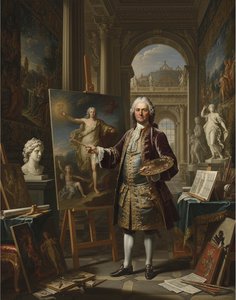
The Master of Versailles: The Life and Legacy of Gilles Joubert
In the gilded corridors of eighteenth-century France, where the splendor of the Rococo era reached its most decadent heights, few names commanded as much respect as Gilles Joubert. Born in Paris in 1689 into a world shaped by the artistic rigor of his sculptor father, Joubert was destined to become more than a mere craftsman; he was an architect of luxury. His journey into the heart of French decorative arts began with a profound apprenticeship under the legendary Jean-François Oeben, a mentorship that infused his work with an unparalleled mastery of technique and a deep appreciation for the exotic. Through this lineage, Joular absorbed the secrets of working with precious Asian lacquers and intricate veneers, elements that would later define the visual language of the French court.
As the reign of Louis XV unfolded, Joubert’s talent propelled him from a skilled artisan to the very center of royal life. His career was marked by an extraordinary ascent, characterized by his appointment as ébéniste ordinaire du Garde-Meuble in 1758 and eventually achieving the prestigious title of Ébéniste du Roi (Cabinetmaker to the King) in 1763. This was not merely a professional milestone but a gateway to an unprecedented level of patronage. For over twenty-five years, Joubert served as the primary supplier to the royal household, delivering a staggering volume of work that ranged from the functional elegance of simple bidets to the breathtaking complexity of ceremonial writing desks and commodes.
A Symphony of Wood, Bronze, and Light
The true genius of Joubert lay in his ability to translate the fluid, asymmetrical spirit of the Rococo style into tangible, structural forms. His work was a masterclass in the balance between strength and delicacy. One might look upon his famous bureau plat, delivered to the King’s Cabinet Intérieur in 1759, and see a masterpiece of storytelling through material. Crafted from lacquered oak and adorned with brilliant crimson surfaces that mimicked Chinese lacquer, the piece featured gilded bronze mounts that acted as a frame for pseudo-Asian landscapes. These elements did more than decorate; they created a sense of movement and light, capturing the playful exuberance and theatricality so beloved by the aristocracy.
The sheer scale of his production speaks to a level of industriousness rarely seen in the decorative arts. Between 1763 and 1773 alone, Joubert’s workshop was responsible for delivering approximately 2,200 pieces for use at court. This immense demand required him to act not just as an artist, but as a conductor of a vast orchestra of skilled sub-contractors, ensuring that every piece—whether one of the five hundred commodes or the thousand small tables—met his exacting standards of excellence. His ability to maintain such high quality across such a massive output is a testament to his organizational brilliance and his unwavering commitment to the aesthetic ideals of his era.
Historical Significance and Enduring Influence
The historical weight of Gilles Joubert’s contribution cannot be overstated. He was instrumental in defining the visual identity of the Garde-Meuble de la Couronne, shaping the very interiors that would become the global standard for luxury. While much of his work was exempt from the mandatory maker's stamps due to its royal status, his presence is felt in the most significant collections of the world today, from the halls of Versailles to the prestigious galleries of the Metropolitan Museum of Art and the Getty Museum.
His legacy remains etched in the fine details of French furniture history:
- Technological Mastery: His pioneering use of exotic veneers and complex marquetry set a benchmark for subsequent generations of cabinetmakers.
- Stylistic Evolution: He successfully navigated the transition from the rigid formalities of the Baroque to the fluid, organic curves of the Rococo.
- Royal Patronage: By supplying the French monarchy with thousands of pieces, he helped establish the furniture of the Louis XV period as the pinnacle of European decorative art.
Pitanja i odgovori
Mogu li proučiti način na koji Gilles Joubert koristi boju u svim svojim djelima?
Profil boja u radovima umjetnika Gilles Joubert prikazan je na njegovoj stranici Genom palete.
Postoji li pregled svih tema koje je Gilles Joubert naslikao/la?
Stranica Atlas tema prikazuje umjetnička djela autora Gilles Joubert prema tematici.
Mogu li pregledavati djela umjetnika Gilles Joubert prema paleti boja?
Kako biste pronašli djela umjetnika Gilles Joubert u određenoj paleti boja, posjetite stranicu Prema paletama boja za tog umjetnika.
Mogu li pregledavati djela umjetnika Gilles Joubert prema umjetničkom pravcu?
Pokrete u kojima je Gilles Joubert stvarao možete vidjeti na umjetnikovoj stranici Svi umjetnički pravci, koja grupirira umjetnička djela prema pokretu.
Po kojim drugim imenima je Gilles Joubert poznat/a?
Gilles Joubert je poznat/a i pod imenom Jean-François Oeben.
Postoji li kronološki prikaz djela umjetnika Gilles Joubert?
Postoji vremenska linija djela umjetnika Gilles Joubert: stranica Kronologija umjetnina prikazuje umjetnička djela poredana prema datumu nastanka.
Kako se umjetnost autora Gilles Joubert razvijala tijekom vremena?
Karijera umjetnika Gilles Joubert razvija se razdoblje po razdoblje na stranici Kronika: horizontalna vremenska linija umjetničkih djela, grupiranih u poglavlja prema razdobljima stvaranja.
Postoji li 3D virtualna obilaznost djela umjetnika Gilles Joubert?
3D muzej umjetnika Gilles Joubert stranica je koja prikazuje umjetnikova djela u virtualnoj trodimenzionalnoj galeriji.