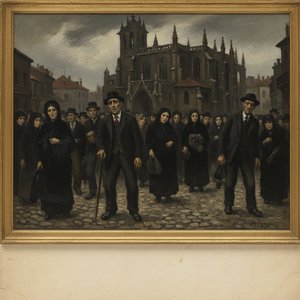
A Legacy Forged in Madrid
In the heart of Madrid, a life began that would eventually challenge the rigid boundaries of the Spanish art academies. Born in 1865, Elena Brockmann grew up surrounded by the shadows of great figures, including her grandmother, Fanny Keats. This lineage of creativity was not merely a matter of blood, but a direct path to the brush. Under the guidance of her uncle, Juan Llanos y Keats, she first learned to command the canvas, finding her footing in a world where women were often kept at the periphery of formal training.
Her ambition led her to the Royal Academy of San Fernando, a prestigious institution where she became one of the few women permitted to study during the nineteenth century. It was here that her technical skill began to sharpen, shaped by the influence of the great history painter José Benlliure y Gil and the light-filled approach of Joaquin Sorolla. She did not merely study art; she lived it, moving through the halls of the academy with a purpose that would soon be recognized by the most important institutions in Spain.
The Pursuit of History and Form
As her talent matured, Brockmann turned her attention toward the grand narratives of the past. She became a painter of history, a demanding genre that required not only technical precision but a deep understanding of costume, architecture, and human emotion. Her ability to reconstruct the atmosphere of bygone eras earned her significant recognition during the National Fine Arts Exhibitions. Her progress was marked by specific honors that signaled her rising stature:
- An honorable mention in 1887.
- A third medal in 1892.
- Recognition as the first female history painter to participate in the National Fine Arts Exhibitions.
Her work often sought to capture the solemnity of religious or royal moments. She painted processions moving through the cloisters of Toledo and the heavy weight of news reaching the ears of kings. Whether she was depicting the courtyard of a parador or the quietude of a Roman hostelry, her brush captured a sense of place that felt lived-in and authentic.
The Final Brushstrokes
The later years of her life saw her remaining a significant figure in the Spanish art scene, a woman who had successfully navigated the transition from a student in a restricted academy to a recognized professional. Her paintings, such as those depicting the loss of the Spanish Armada, remain as records of her skill in the costumbrista style, blending the observation of daily life with the grandeur of historical events. She passed away in Madrid in 1946, leaving behind a body of work that reflects the discipline and passion of a life dedicated to the canvas.
Pitanja i odgovori
Kako mogu pronaći sva djela umjetnika Elena Brockmann prema određenom mediju?
Kako biste pronašli sva djela autora Elena Brockmann u određenom mediju, posjetite stranicu Svi mediji ovog umjetnika.
Mogu li pregledavati djela umjetnika Elena Brockmann prema raspoloženju?
Djela umjetnika Elena Brockmann možete pregledavati prema raspoloženju na njegovoj stranici Soba po raspoloženju, koja prikazuje umjetnička djela poredana prema njihovom zabilježenom raspoloženju.
Kako mogu pratiti radove umjetnika Elena Brockmann kronološki?
Stranica Kronologija umjetnina prikazuje djela umjetnika Elena Brockmann poredana kronološki, godinu po godinu.
Gdje mogu vidjeti profil boja u radovima umjetnika Elena Brockmann?
Profil boja u radovima umjetnika Elena Brockmann možete pogledati na njegovoj stranici Genom palete.