

 Pregledaj u stvarnoj veličini
 Podijeli
 Podijeli
 Detalji
 Vodič
Vodič

 Preuzmi datoteku
 Slični predmeti
 Rentgenska snimka
 Slide show
 Statistika
Still-Life
 Oil On Canvas
- WallArt
- Baroque
 1653
1653- Early Modern
 105.0 x 88.0 cm
 Ermitaž
 Pročitajte više
Ručno rađena uljana reprodukcija
Ručno oslikano uljanim bojama na platnu u dimenzijama i okviru po vašem izboru, izrađeno po narudžbi od strane naših umjetnika. ( Prebacite na prodaju printova Prebacite na digitalnu prodaju slika)




P118B €10

P118H €10

P118W €10

P438Z €10

P508JH €12

P508YH €12

P805H €10

P805Z €10

P919BZ €10

P919G €10

P919XJ €10

P959ZH €10

P968JZ €12

W106C €8

W218G €10

W218JH €8

W218Y €10

W307PJ €10

W316G €10

W316PJ €8

W316Y €10

W398PJ €8

W4111J €10

W500HY €15

W500JH €15

W692G €12

W849H €8

W940BG €15

W953PJ €8




Odaberite jednu od naših unaprijed definiranih veličina koje odgovaraju izvornim proporcijama umjetničkog djela.

Unesite širinu i visinu koja vam je potrebna, kako bi odgovarali vašem okviru ili zidu. Budući da je ovo ručno oslikano djelo, umjetnik može malo proširiti rubove slike ili ih skratiti kako bi postigao željeni oblik — izbor je vaš. Prije početka slikanja poslat ćemo vam digitalni prikaz (mockup) radi potvrde. Slika prikazana na ovoj stranici ne predstavlja stvarni rezultat — samo digitalni prikaz to čini.
Nakon narudžbe, tim OriginalUniqueArt.com kontaktirat će klijenta putem e-pošte radi dobivanja uputa te dostaviti probni prikaz (mockup)
Isporuka širom svijeta () u roku od 3-4 tjedna umjesto standardnih 5 tjedana. (26 Listopad). Bez kompromisa u kvaliteti.

Besplatna ekspresna dostava širom svijeta

Visokokvalitetno laneno platno

Potpuno osiguranje transporta

Jamstvo povrata carine i uvoznih poreza

Jamstvo vjernosti boja

Politika povrata u roku od 100 dana (samo u slučaju nedostataka)

Jamstvo povrata 100% novca

Popust na više proizvoda
 Opcija stakla dostupna je samo za dimenzije manje od 110 cm

Still-Life
Tehnika izrade
Veličina reprodukcije
-


Ukupna cijena
€ 263
A Symphony of Light and Luxury
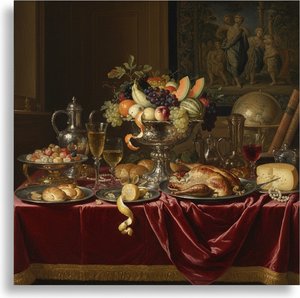
In the quiet, shadowed corners of the Dutch Golden Age, few masters could command the stage with as much dramatic flair as Willem Kalf. His 1653 masterpiece, Still Life with Lobster, Drinking Horn and Glasses, is not merely a painting of objects; it is a carefully orchestrated performance of light, texture, and prestige. As one gazes upon this canvas, they are immediately transported into an era of unprecedented maritime prosperity, where the spoils of global trade were celebrated through the meticulous brushstrokes of the pronkstilleven—the grand, opulent still life. The composition serves as a window into a world of sensory indulgence, where every glint of silver and every dewdrop on a peach tells a story of wealth, discovery, and the fleeting nature of earthly delights.
The artwork captures a moment of suspended animation, presenting an arrangement that feels both bountiful and profoundly intimate. A vibrant lobster, its shell a testament to Kalf’s ability to render organic complexity, rests amidst the soft, velvety skins of peaches and pears. These natural elements are juxtaposed against the hard, reflective surfaces of man-made treasures: a gleaming silver goblet, a sturdy drinking horn, and delicate glassware that catches the light with ethereal precision. This interplay between the perishable fruit and the enduring precious metals creates a tension that is central to the Baroque experience, inviting the viewer to linger on the exquisite details of each meticulously rendered form.
The Mastery of Chiaroscuro and Texture
Technically, Kalf’s work represents the pinnacle of seventeenth-century Dutch realism. He employs chiaroscuro—the dramatic use of intense light and deep shadow—to sculpt his subjects out of the darkness. This technique does more than provide depth; it breathes life into the inanimate. The way light spills across a silver vessel or pierces through a glass, casting long, evocative shadows across a richly patterned tablecloth, creates a palpable sense of three-dimensionality. For the discerning collector or interior designer, this mastery of contrast offers a profound visual weight that can anchor a room, providing a focal point that changes character as the ambient light of a space shifts throughout the day.
Beyond the play of light, Kalf’s true genius lies in his tactile virtuosity. He possesses an uncanny ability to translate the language of touch into oil on canvas. One can almost feel the cool, smooth surface of the bronze candlestick, the rougher texture of the drinking horn, and the soft, yielding flesh of the ripening fruit. This commitment to hyper-realistic detail ensures that a high-quality reproduction of this piece retains its soul, offering an immersive experience that celebrates the beauty of material existence. It is this level of craftsmanship that makes Kalf’s work eternally relevant for those seeking to infuse their environments with a sense of historical grandeur and sophisticated elegance.
Symbolism and the Soul of the Baroque
To look closely at Kalf’s arrangement is to read a silent poem about the human condition. In the seventeenth century, nothing was purely decorative; every element carried a weight of meaning. The lobster, often associated with luxury and abundance, serves as a symbol of the era's economic triumphs. Meanwhile, the drinking horn alludes to conviviality and social standing, reminding the viewer of the communal joys of the Dutch mercantile class. Yet, beneath this layer of opulence lies a subtle memento mori—a gentle reminder of mortality. The very ripeness of the fruit suggests an approaching decay, a poignant contrast to the enduring brilliance of the silver and gold.
This duality—the celebration of life’s richness alongside a contemplation of its transience—is what gives the painting its profound emotional resonance. It evokes a sense of quiet melancholy wrapped in a cloak of splendor. For those looking to decorate with art that possesses depth and narrative, Kalf’s work offers an unparalleled opportunity. A reproduction of this still life does not just adorn a wall; it invites conversation, stimulates the intellect, and brings a touch of timeless, scholarly prestige to any curated collection or thoughtfully designed interior.
Pitanja i odgovori
Kakav je emocionalni ton djela "Still-Life" autora Willem Kalf?
"Still-Life" autora Willem Kalf prenosi Dramatic emocionalni ton.
Koji umjetnički pravac obuhvaća "Still-Life" autora Willem Kalf?
"Still-Life" autora Willem Kalf pripada pokretu Baroque. Ovaj pokret pruža stilski kontekst djela.
Koja su tehnika i datum nastanka djela "Still-Life" autora Willem Kalf?
"Still-Life" nastalo je 1653. godine, u tehnici Oil On Canvas.
Biografija umjetnika
Život uronjen u raskoš: Willem Kalfov svijet
Willem Kalf, ime koje je postalo sinonim za raskošne mrtve prirode holandskog zlatnog doba, rođen je u Rotterdamu 1619. godine u obitelji plemenitog imućka. Njegov otac, Jan Jansz Calff, obavljao je važne dužnosti u gradskoj upravi, pružajući mladom Willemu odgoj koji je donosio sigurnost, ali i izloženost rastućem trgovačkom svijetu koji će kasnije tako duboko utjecati na njegovu umjetnost. Iako detalji o Kalfovom ranoj školovanju ostaju pomalo neuhvatljivi, poznato je da je tijekom 1630-ih prošao kroz razdoblje umjetničkog razvoja u Parizu, uronivši u živopisnu zajednicu flamanskih umjetnika koji su djelovali u Saint-Germain-des-Prés. To formativno iskustvo prvotno ga je usmjerilo prema manjim, rustikalnim interijerima i mrtvim prirodama – skromnim početcima koji će se s vremenom pretvoriti u veličanstvene pronkstillevene, po kojima je danas slavni. Gubitak oba roditelja do 1638. godine naveo ga je na povratak u Nizemozem, postavljajući scenu za njegovu zrelu umjetničku razdregu.Od skromnih početaka do majstorskog prikaza
Kalfova rana parizska djela otkrivaju umjetnika koji tek pronalazi svoj put. Te su slike često prikazivale jednostavne aranžmane – povrće, uobičajeni kuhinjski pribor poput kanti i tava – postavljene ispred prigušenih pozadina gdje su likovi bili samo naznačeni, a ne potpuno razrađeni. Ovaj stil odjekivao je slikar렵skim tradicijama koje su bile prisutne u Flandri početkom 17. stoljeća, posebno kroz rad umjetnika poput Davida Teniersa mlađeg. Međutim, Kalfove su ambicije ubrzo prerasile te skromne kompozicije. Nakon povratka u Nizemozem, započeo je nevjerojatan evolucijski proces prema onome što će postati njegov prepoznatljivi stil: pronkstilleven, ili „bahata mrtva priroda“. To nisu bili samo prikazi predmeta; bili su to pažljivo konstruirani izložbi bogatstva i sofisticiranosti, prikazujući luksuzne predmete poput srebrnog posuđa, delikatnog porculana, egzotičnog voća i svjetlucavog stakla.Umjetnost iluzije i simbolične rezonance
Ono što je uistinu izdvojilo Kalfove pronkstillevene bila je njegova neusporediva vladavina svjetlom i teksturama. Posjedovao je izvanrednu sposobnost prikazivanja refleksivnih svojstava srebra, prozirnosti stakla i baršunastih površina voća s nevjerojatnim realizmom. Njegove kompozicije nisu bile nasumični aranžmani; bile su to pedantno planirane orkestracije osmišljene da uhvate igru svjetla i sjene, stvarajući osjećaj dubine i drame. Iako je osnovna struktura njegovih slika – raspored predmeta – ostala relativno dosljedna, svako djelo bilo je svjedočanstvo Kalfove vještine u varijacijama tekstura i hvatanju suptilnih svjetlosnih efekata. Ipak, izvan same tehničke briljantnosti, ležala je i suptilna simbolička dimenzija. Luksuzni predmeti koje je prikazivao nisu bili samo lijepi; oni su aludirali na teme prolaznosti, bogatstva i nestojnosti zemaljskih užitaka – što je bio odjek tradicije vanitas koja je bila raširena u nizemozemskom slikarstvu.Naslijeđe i utjecaj
Utjecaj Willema Kalfa protezao se izvan njegovog vlastitog plodnog stvaralaštva. Njegove polu-monokromatske mrtve prirode imali su značajan utjecaj na francusku umjetnost, posebno unutar kruga braće Le Nain, koji su se divili njegovoj sofisticiranoj upotrebi svjetla i sjene. Iako pojedinačna djela možda nisu toliko široko prepoznata kao djela nekih njegovih suvremenika, Kalfov doprinos ovom žanru je neosporan. Pomogao je definirati pronkstilleven, hvatajući duh nizemozemskog društva 17. stoljeća – razdoblja obilježena neviđenim ekonomskim prosperitetom i rastućom trgovačkom klasom koja je željela pokazati svoje bogatstvo i ugled. Danas njegova djela krase prestižne muzejske kolekcije diljem svijeta, uključujući Museum Boijmans Van Beuningen u Rotterdamu, National Gallery of Art u Washingtonu i Getty Museum, osiguravajući da njegovo naslijeđe majstora nizemorske mrtve prirode nastavi izazivati strahopoštovanje i divljenje. Njegova pedantna pažnja prema detaljima i majstorska upotreba svjetla ostaju obilježja umjetničke izvrsnosti.Istražite dalje
- Wikipedia: https://en.wikipedia.org/wiki/Willem_Kalf
- National Gallery of Art: https://www.nga.gov/artists/1430-willem-kalf
- Getty Museum: https://www.getty.edu/art/collection/person/103JR3

Willem Kalf
1619 - 1693 , Nizozemska
Brzi pregled
- Artistic Movement Or Style: Dutch Golden Age, Still Life
- Artists Or Movements Influenced By This Artist:
- Francuska umjetnost
- Braća Le Nain
- Artists Who Influenced This Artist:
- Simon Luttichuys
- Pieter Claesz
- Willem Claeszoon Heda
- Date Of Birth: 1619.
- Date Of Death: 1693.
- Full Name: Willem Kalf
- Nationality: Nizozemski
- Notable Artworks:
- Stil života s nautilušem
- Le vieux puits
- Srebrna posuda i porculanska zdjela
- Place Of Birth: Rotterdam, Nizozemska
Povezani članci

Golden Light & Dutch Skies: The Timeless Magic of Dutch Golden Age Landscapes
Discover the breathtaking beauty of Dutch Golden Age landscapes. Explore the mastery of light, chiaroscuro, and 17th-century realism through an expert art history lens, celebrating the enduring legacy of the Dutch Masters for discerning collectors and art lovers.
Abraham Hendricksz van Beyeren: Pioneering Dutch Still Life & the Banquet Tradition
Explore the captivating world of Dutch Golden Age still life with Abraham van Beyeren. Discover his innovative techniques, symbolic banquet scenes & lasting influence on art history. Learn about collecting these masterpieces.

Illuminating Innovation: Exploring the Dutch Golden Age of Painting
Explore the Dutch Golden Age of painting with OriginalUniqueArt. Discover Rembrandt, Vermeer & other Masters. Learn about key characteristics, iconic artworks, and lasting influence. Expert insights for collectors & enthusiasts.

Zlatno Dobo Nizozemske: 10 Remekdjela Koja Su Definirala Umjetnost i Dekor
Otkrijte remekdjela nizozemskog Zlatnog doba! Uronite u svijet Rembrandta, Vermeera i drugih majstora. 10 slika koje su definirale holandsku umjetnost & barokni stil. Inspirirajte se za dekoraciju doma s OriginalUniqueArt.com – reprodukcije vrhunske kvalitete!

Golden Age Reflections: Dutch Baroque Painting & Cultural Innovation
Explore the Dutch Golden Age of painting! Discover key artists like Vermeer & ter Borch, their innovative techniques, and the rich cultural context behind these Baroque masterpieces. Learn about collecting & appreciating this iconic art period.
