 Pregledaj u stvarnoj veličini
 Pošalji
 Podijeli
 Detalji o umjetničkom djelu

 Preuzmi
 Slični predmeti
 Rentgenska snimka
 Automatska prezentacija
The pictorial content


 Prikaži više
Giclée / Umjetnički otisak
Giclée tisak muzejske kvalitete ili otisak na platnu uz brzu proizvodnju i fleksibilne opcije završne obrade. ( Kupi ručno naslikanu sliku Kupi digitalnu sliku)




P118B $10

P118H $10

P118W $10

P438Z $10

P508JH $12

P508YH $12

P805H $10

P805Z $10

P919BZ $10

P919G $10

P919XJ $10

P959ZH $10

P968JZ $12

W106C $8

W218G $10

W218JH $8

W218Y $10

W307PJ $10

W316G $10

W316PJ $8

W316Y $10

W398PJ $8

W4111J $10

W500HY $15

W500JH $15

W692G $12

W849H $8

W940BG $15

W953PJ $8




Odaberite jednu od naših unaprijed definiranih veličina koje odgovaraju izvornim proporcijama umjetničkog djela.

Možete unijeti vlastite dimenzije kako biste umjetničko djelo prilagodili specifičnom okviru ili prostoru. Ako odabrana veličina ne odgovara proporcijama izvornog rada, izrezat ćemo dio slike ili je proširiti pomoću ogledalnog efekta ili jednobojne rubne površine. Digitalni prikaz (mockup) bit će vam poslan na odobrenje prije početka proizvodnje.
Imajte na umu da pregled na zaslonu ne odražava stvarno izrezivanje ili proširivanje. Samo će mockup točno prikazati konačnu kompoziciju.
Iako su dostupne prilagođene veličine, preporučujemo odabir dimenzije iz unaprijed definirane liste kako biste očuvali izvorne proporcije.
Dostava širom svijeta () u roku od 2 tjedna umjesto standardnih 4/5 tjedana. (13 Kolovoz)

Besplatna ekspresna dostava širom svijeta

Visokokvalitetno laneno platno

Potpuno osiguranje dostave

Jamstvo povrata carine i uvoznih poreza

Garancija vjernog podudaranja boja

Politika povrata u roku od 60 dana (samo u slučaju nedostataka)

Jamstvo povrata 100% novca

Popust na više proizvoda
 Opcija stakla dostupna je samo za dimenzije manje od 110 cm

The pictorial content
Giclée / Umjetnički otisak
Veličina reprodukcije
-


Ukupna cijena
$ 80
Opis djela
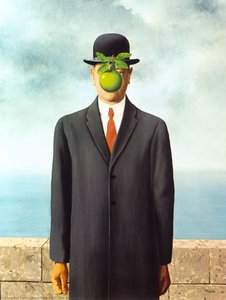
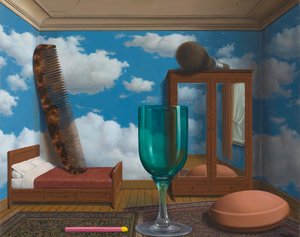
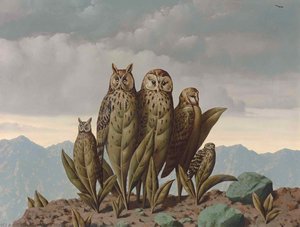
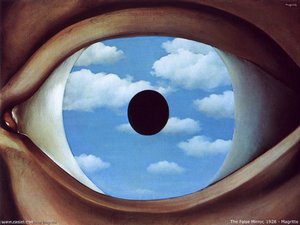
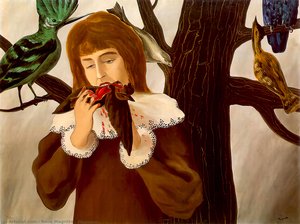
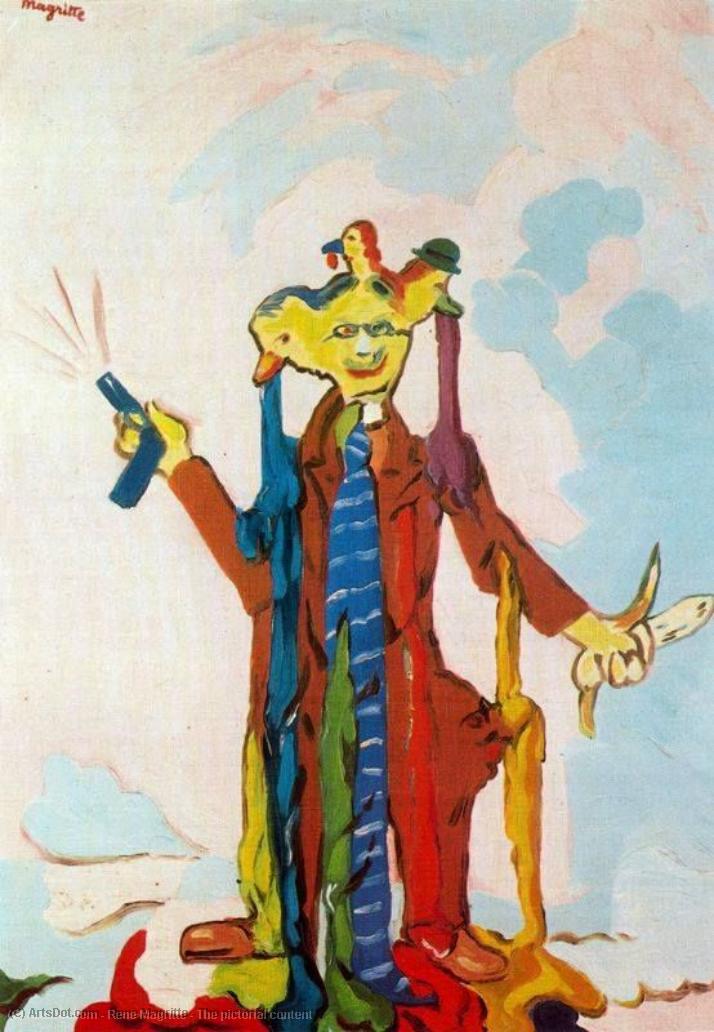
A Dreamscape Unveiled: René Magritte’s ‘The Pictorial Content’ (1947)
“The visible world is what we wrongly believe to be reality.” – René Magritte This captivating artwork, created in 1947 by the master of Surrealism, René Magritte, presents a compelling and unsettling vision. ‘The Pictorial Content’ isn't merely a painting; it’s an invitation to question perception itself—a hallmark of Magritte’s artistic philosophy.Subject & Composition: A Figure in Flux
At the heart of the composition lies a strikingly elongated figure draped in a vibrant, flowing robe. The figure's features are deliberately exaggerated – large, expressive eyes and a wide mouth contribute to an almost mask-like quality. Arms extend outwards in a gesture that feels both inviting and ambiguous, perhaps offering direction or simply acknowledging the viewer’s presence.- The composition is intentionally unbalanced; the central figure dominates while swirling brushstrokes create a dynamic, chaotic background.
- Adding to the dreamlike quality, the robe appears to be dissolving or dripping, suggesting impermanence and fluidity.
- A whimsical yet unsettling detail – several small birds perch atop the figure’s head, introducing an element of unexpectedness and perhaps symbolizing freedom or fragility.
Style & Technique: Echoes of Expressionism & Surrealist Innovation
While firmly rooted in Surrealism, ‘The Pictorial Content’ displays stylistic leanings towards Expressionism. Magritte employs a loose, gestural brushwork and prioritizes emotional impact over precise representation.- Impasto technique: The thick application of paint creates texture and depth, enhancing the visual richness.
- Color Palette: Bold and vibrant hues – whites, pinks, yellows, and blues – clash and harmonize simultaneously, contributing to a sense of unease and dynamism.
- Flattened Perspective: The lack of traditional perspective further amplifies the surreal atmosphere, drawing the viewer into an ambiguous space.
Historical Context & Artistic Evolution
Born in 1898, René Magritte navigated various artistic movements before solidifying his signature Surrealist style. Initially influenced by Impressionism and Futurism, he found his true voice through the exploration of dreams, subconscious imagery, and the subversion of everyday objects. Created post-World War II, ‘The Pictorial Content’ reflects a period of profound societal upheaval and existential questioning – themes that resonate deeply within the artwork's unsettling atmosphere.Symbolism & Interpretation: A Fragmented Self?
Magritte rarely offered definitive interpretations of his work, preferring to leave them open to individual contemplation. However, several readings emerge from ‘The Pictorial Content’.- Alienation and Isolation: The figure’s ambiguous expression and the chaotic background could represent feelings of detachment and loneliness.
- Fragmented Identity: The dissolving robe and distorted features might symbolize a fractured sense of self, grappling with internal conflicts.
- The Power of Perception: As with much of Magritte’s oeuvre, the painting challenges our understanding of reality, prompting us to question what we see and how we interpret it.
Emotional Impact & Interior Design Considerations
‘The Pictorial Content’ evokes a complex range of emotions – disorientation, anxiety, curiosity, and perhaps even a touch of wonder. Its bold colors and dynamic composition make it a striking focal point for any interior space.- Modern Living Rooms: The artwork's surreal quality complements contemporary design schemes.
- Eclectic Collections: It adds an intriguing layer to collections that blend different artistic styles.
- Creative Offices: Its thought-provoking nature can inspire creativity and innovation in a professional setting.
Biografija umjetnika
Early Life and the Seeds of Surrealism
René Magritte, born René François Ghislain Magritte on November 21, 1898, in Lessines, Belgium, emerged into a world that would profoundly shape his enigmatic artistic vision. His early years were marked by an unsettling event – the suicide of his mother when he was just thirteen. The image of her body being recovered from the River Sambre, with her dress obscuring her face, became a haunting motif that would subtly permeate his later work, manifesting in veiled figures and a persistent exploration of hidden realities. This early trauma instilled within him a fascination with mystery, loss, and the unsettling power of what remains unseen. While details of his childhood remain somewhat elusive, it’s clear this formative experience laid the groundwork for his lifelong questioning of perception and representation. He began drawing lessons at age ten, revealing an innate inclination towards visual expression, but initially explored Impressionism before embarking on a path that would lead him to become one of the most significant figures in Surrealist art.
Artistic Development and Influences
Magritte’s artistic journey was not immediate or straightforward. He studied at the Académie Royale des Beaux-Arts in Brussels, yet found its traditional methods stifling. His early work experimented with Futurism and Cubism, absorbing elements of these avant-garde movements but ultimately rejecting their purely formal concerns. It wasn't until encountering Giorgio de Chirico’s painting *The Song of Love* in 1922 that Magritte discovered a resonance that would irrevocably alter his artistic course. De Chirico’s dreamlike landscapes and unsettling juxtapositions unlocked within Magritte a new way of seeing – a world where the familiar could be rendered strange, and the ordinary imbued with profound mystery. This encounter sparked his commitment to Surrealism, though he often maintained a unique distance from its more overtly psychological or automatic approaches. He preferred a meticulous, almost clinical precision in his painting, using realistic techniques to depict illogical scenarios.
The Heart of Surrealism: Challenging Reality
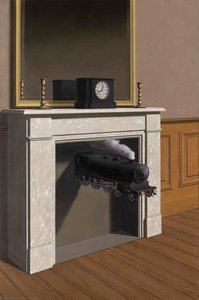
By 1926, Magritte had fully embraced the tenets of Surrealism, producing *Le Jockey Perdu (The Lost Jockey)*, widely considered his first truly surrealist work. However, his brand of Surrealism was distinct. He wasn’t interested in exploring the subconscious through free association or dream imagery in the manner of some of his contemporaries. Instead, Magritte sought to challenge viewers' perceptions of reality by presenting ordinary objects in unexpected contexts, forcing them to question their assumptions about the world around them. Iconic works like *The Treachery of Images (This is not a pipe)* (1929) brilliantly deconstructs the relationship between image and object, reminding us that a representation is never the thing itself. *Les Amants (The Lovers)* (1927-1928), with its shrouded figures, echoes the trauma of his mother’s death while simultaneously exploring themes of concealment and intimacy. *Time Transfixed* (1938) presents a locomotive bursting through a brick wall, disrupting our sense of space and time. And *The Human Condition* (1933), a canvas within a canvas, blurs the boundaries between representation and reality, prompting us to consider how we perceive and interpret the world.
Later Life, Recognition, and Enduring Legacy
Despite initial struggles for recognition, Magritte’s work gradually gained prominence, particularly in the United States with exhibitions in 1936 and later retrospective shows at the Museum of Modern Art (1965) and the Metropolitan Museum of Art (1992). He continued to refine his signature style, exploring themes of repetition, illusion, and the power of language in paintings that are both intellectually stimulating and visually arresting. Magritte died on August 15, 1967, leaving behind a body of work that continues to captivate and challenge audiences worldwide. His influence extends far beyond the realm of painting, impacting pop art, minimalist art, conceptual art, and even advertising and film. Today, his paintings are held in major museum collections around the globe, including the Musées royaux des beaux-arts de Belgique in Brussels, which houses the Magritte Museum – dedicated entirely to his work and boasting the world’s largest collection of his creations.
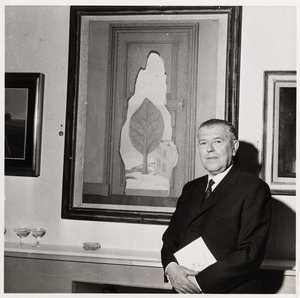
René Magritte
1898 - 1967 , Belgija
Osnovne informacije
- Artistic Movement Or Style: Surealizam
- Artists Who Influenced This Artist: ['Giorgio de Chirico']
- Date Of Birth: 21. studenog 1898.
- Date Of Death: 15. kolovoza 1967.
- Full Name: René François Ghislain Magritte
- Nationality: Belgijanin
- Notable Artworks:
- Les Amants
- The Treachery of Images
- Time Transfixed
- The Human Condition
- Place Of Birth: Lessines, Belgiji
Srodni članci
René Magritte: 25 Remek-djela Surrealizma za Uljepšanje Vašeg Prostora | OriginalUniqueArt
Uronite u svijet nadrealizma s 25 remek-djela René Magritta. Otkrijte priče iza ikoničnih slika, simbolizam i tehniku belgijskog umjetnika. Pronađite savršenu reprodukciju za vaš dom na OriginalUniqueArt.com!
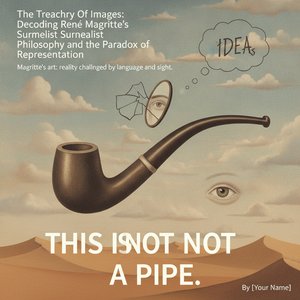
The Treachery of Images: Decoding René Magritte’s Surrealist Philosophy and the Paradox of Representation
Explore the profound mystery of René Magritte’s 'The Treachery of Images.' Dive into an expert analysis of his Surrealist philosophy, the paradox of representation, and how he challenged reality through the interplay of language and visual perception.
Beyond Reality: The Dreamlike Power of Surrealist Expressionism and the Subconscious Mind
Explore the profound depths of Surrealist Expressionism. Discover how masters like Dalí used dream logic and subconscious imagery to redefine reality through emotionally resonant, museum-quality art.
Desetak remek-djela koja definiraju 'Surrealistički Ekspresionizam': Putovanje kroz umjetnost i dekor
Otkrijte 10 remek-djela koja su definirala 'Surrealistički Ekspresionizam'! Uronite u svijet Dalija, Miróa i Magritta. Istražite priče iza slika, tehnike i emocije. Inspirirajte svoj interijer s vrhunskim reprodukcijama na OriginalUniqueArt.com!

Surrealist Expressionism: A Visual Journey Through Dream Logic and Raw Emotion
Dive into the visceral world of Surrealist Expressionism. Explore how dream logic meets raw emotion through a visual journey of iconic techniques, post-war history, and bold aesthetics to transform your modern space with high-impact, unforgettable art.