
 Pregledaj u realnoj veličini
 Pošalji
 Podijeli
 Detalji o umjetničkom djelu
 Vodič
Vodič

 Preuzmi umjetničko djelo
 Slični predmeti
 Rentgenska snimka
 Slide show
 Q&A
Q&A Statistika
The Difficult Crossing


 Prikaži više
Preuzmite datoteku spremnu za tisak koja kvalitom daleko nadilazi web prikaz. Svaka digitalna slika koju prodajemo prosljeđuje se iz visokorezolucijske master datoteke iz naše baze — obično širine od 5.000 do 15.000 piksela — što vam omogućuje tisak velikih dimenzija, precizno izrezivanje ili sigurnu reprodukciju najfinijih detalja.
Nijedna datoteka ne napušta naš studio netaknuta. Digitalni stručnjak uspoređuje boje s izvornim slikama i po potrebi ih ispravlja, a zatim poboljšava jasnoću i detalje pomoću profesionalnih alata za retuširanje — uvijek ostajući vjerni umjetnikovim potezima četkice i stilu. Rezultat je prikaz koji izgleda kao prava slika, a ne kao sken s filtrima.
Odobravanje prije završetka: naš stručnjak šalje sliku e-poštom u roku od 72 sata na vaš pregled. Niste zadovoljni? Zatražite poboljšanja ili ispravke, ili tražite povrat novca ako kvaliteta ne ispunjava vaša očekivanja.
To je kvaliteta na koju se oslanjaju izdavači, dizajn studiji, galerije i tiskare.
Digitalna slika
Preuzmite datoteku visoke rezolucije za osobnu izložbu, tisak i kreativne projekte. ( Prebacite na printove Kupi ručno oslikano djelo)
Uključeno uz svaku narudžbu digitalne slike
Profesionalna digitalna dostava, zajamčena
Odabirom OriginalUniqueArt.com ne dobivate samo sliku – dobivate profesionalno unapređeno digitalno umjetničko djelo, izrađeno s najvećom preciznošću uz jamstvo zadovoljstva. Evo svega što automatski dolazi uz vašu narudžbu:

Brza dostava e-poštom
Vaša digitalna slika visoke rezolucije bit će vam poslana e-mailom u roku od 72 sata od trenutka narudžbe – spremna za neposrednu upotrebu.

Digitalna datoteka poboljšana umjetnom inteligencijom
Vaše umjetničko djelo profesionalno je optimizirano pomoću naprednih AI alata i ručnog uređivanja, čime se osigurava maksimalna razina detalja, oštrine i točnosti boja.

Besplatna doživotna ponovna dostava
Slučajno ste obrisali ili izgubili svoju datoteku? Ne brinite – ponovno ćemo vam je poslati u bilo kojem trenutku, potpuno besplatno.

Bez uvoznih pristojnika – ikada
Uživajte u svojim umjetničkim djelima trenutno, bez carina, pristojbi ili troškova dostave – digitalni downloadi uvijek su oslobođeni poreza.

Jamstvo točnosti boja
Uz pomoć profesionalnih alata i upravljanja bojama, osiguravamo da vaša digitalna slika što vjernije odražava izvorne boje.

Jamstvo zadovoljstva u trajanju od 100 dana
Ako niste zadovoljni svojom digitalnom slikom, revidirat ćemo je ili vratiti 100% iznosa u roku od 100 dana – bez suvišnih pitanja.

100% Jamstvo povrata novca
Niste zadovoljni? Osigurajte puni povrat novca u roku od 100 dana od primitka digitalne datoteke – bez suvišnih pitanja.

Popusti na velike narudžbe
Kupite 3 slike, uštedite 10% - Kupite 5 slika, uštedite 15% - Kupite 10+ slika, uštedite 20%. Odlično za kreativne projekte, galerije i agencije.
A Dreamscape of Disquiet: Unveiling The Difficult Crossing
In the realm of Surrealism, few works possess the haunting, cerebral tension found in René Magritte’s The Difficult Crossing. This masterpiece invites the viewer into a fractured interior that defies the laws of physics and logic, creating an atmosphere that is simultaneously still and deeply unsettling. As one gazes upon the pale pink walls and the stark, yellow door, there is an immediate sense of being trapped within a dream where the familiar has been rendered alien. The composition is a masterful exercise in ambiguity; a window offers a glimpse of a stormy, turbulent seascape, yet it remains unclear whether we are looking through glass or peering into a canvas nestled within the room itself. This deliberate blurring of boundaries between reality and representation is the hallmark of Magritte’s genius, making the piece an irresistible focal point for those who appreciate art that challenges the intellect.
The technical execution of this work reflects Magritte’s meticulous approach to oil on canvas. Eschewing the frantic brushwork of his contemporaries, he employed a smooth, almost hyperrealistic technique that lends a deceptive clarity to the impossible. The subtle gradations of color—from the muted beige of distant buildings to the deep, somber tones of the draped green curtain—create a palpable sense of depth and mystery. This precision serves a profound purpose: by rendering bizarre elements with such tangible realism, Magritte forces the viewer to accept the illogical as truth. For the discerning collector or interior designer, this painting offers a sophisticated texture, providing a layer of psychological complexity that can transform a modern space into a gallery of contemplation.
Symbolism and the Subconscious Mind
Beyond its striking visual arrangement, The Difficult Crossing is a labyrinth of symbolic enigmas. The central figure—a disembodied hand resting upon a white object that oscillates between a loaf of bread and a stylized bird—evokes themes of vulnerability and the fragility of existence. Magritte’s work often draws from his own history, where the unseen and the veiled represent the hidden anxieties of the human condition. Nearby, the bilboquet, or cup-and-ball, appears with an anthropomorphic single eye, acting as a silent, watchful presence that heightens the sense of surveillance and unease. This interplay of objects suggests a world where even the inanimate possesses a haunting consciousness.
Historically situated during Magritte’s pivotal transition into full Surrealism in 1926, the painting captures the post-World War I zeitgeist of disillusionment. The storm depicted within the frame serves as a metaphor for inner turmoil and the chaotic forces that lie beneath the surface of our structured lives. To possess a reproduction of this work is to invite a conversation about perception, memory, and the nature of reality into one's home. It is not merely a decoration, but an evocative piece of storytelling that promises to provoke thought and inspire wonder long after the first glance.
Pitanja i odgovori
Gdje mogu pronaći umjetnička djela slična djelu "The Difficult Crossing" autora René Magritte?
Djela slična djelu "The Difficult Crossing" možete pronaći na stranici Slična djela tog umjetničkog djela.
Gdje mogu kupiti print djela "The Difficult Crossing" autora René Magritte?
"The Difficult Crossing" je dostupan kao umjetnički otisak na pamučnom platnu ili arhivskom kanvas papiru. Narudžbe možete izvršiti na stranici Umjetnička litografija, u dimenziji po vašem izboru.
U kojem se razdoblju karijere umjetnika René Magritte nalazi djelo "The Difficult Crossing"?
Unutar karijere umjetnika René Magritte, djelo "The Difficult Crossing" pripada razdoblju Early Surrealism. Ova faza omogućuje usporedbu s ostalim djelima tog umjetnika.
Biografija umjetnika
Early Life and the Seeds of Surrealism
René Magritte, born René François Ghislain Magritte on November 21, 1898, in Lessines, Belgium, emerged into a world that would profoundly shape his enigmatic artistic vision. His early years were marked by an unsettling event – the suicide of his mother when he was just thirteen. The image of her body being recovered from the River Sambre, with her dress obscuring her face, became a haunting motif that would subtly permeate his later work, manifesting in veiled figures and a persistent exploration of hidden realities. This early trauma instilled within him a fascination with mystery, loss, and the unsettling power of what remains unseen. While details of his childhood remain somewhat elusive, it’s clear this formative experience laid the groundwork for his lifelong questioning of perception and representation. He began drawing lessons at age ten, revealing an innate inclination towards visual expression, but initially explored Impressionism before embarking on a path that would lead him to become one of the most significant figures in Surrealist art.
Artistic Development and Influences
Magritte’s artistic journey was not immediate or straightforward. He studied at the Académie Royale des Beaux-Arts in Brussels, yet found its traditional methods stifling. His early work experimented with Futurism and Cubism, absorbing elements of these avant-garde movements but ultimately rejecting their purely formal concerns. It wasn't until encountering Giorgio de Chirico’s painting *The Song of Love* in 1922 that Magritte discovered a resonance that would irrevocably alter his artistic course. De Chirico’s dreamlike landscapes and unsettling juxtapositions unlocked within Magritte a new way of seeing – a world where the familiar could be rendered strange, and the ordinary imbued with profound mystery. This encounter sparked his commitment to Surrealism, though he often maintained a unique distance from its more overtly psychological or automatic approaches. He preferred a meticulous, almost clinical precision in his painting, using realistic techniques to depict illogical scenarios.
The Heart of Surrealism: Challenging Reality
By 1926, Magritte had fully embraced the tenets of Surrealism, producing *Le Jockey Perdu (The Lost Jockey)*, widely considered his first truly surrealist work. However, his brand of Surrealism was distinct. He wasn’t interested in exploring the subconscious through free association or dream imagery in the manner of some of his contemporaries. Instead, Magritte sought to challenge viewers' perceptions of reality by presenting ordinary objects in unexpected contexts, forcing them to question their assumptions about the world around them. Iconic works like *The Treachery of Images (This is not a pipe)* (1929) brilliantly deconstructs the relationship between image and object, reminding us that a representation is never the thing itself. *Les Amants (The Lovers)* (1927-1928), with its shrouded figures, echoes the trauma of his mother’s death while simultaneously exploring themes of concealment and intimacy. *Time Transfixed* (1938) presents a locomotive bursting through a brick wall, disrupting our sense of space and time. And *The Human Condition* (1933), a canvas within a canvas, blurs the boundaries between representation and reality, prompting us to consider how we perceive and interpret the world.
Later Life, Recognition, and Enduring Legacy
Despite initial struggles for recognition, Magritte’s work gradually gained prominence, particularly in the United States with exhibitions in 1936 and later retrospective shows at the Museum of Modern Art (1965) and the Metropolitan Museum of Art (1992). He continued to refine his signature style, exploring themes of repetition, illusion, and the power of language in paintings that are both intellectually stimulating and visually arresting. Magritte died on August 15, 1967, leaving behind a body of work that continues to captivate and challenge audiences worldwide. His influence extends far beyond the realm of painting, impacting pop art, minimalist art, conceptual art, and even advertising and film. Today, his paintings are held in major museum collections around the globe, including the Musées royaux des beaux-arts de Belgique in Brussels, which houses the Magritte Museum – dedicated entirely to his work and boasting the world’s largest collection of his creations.
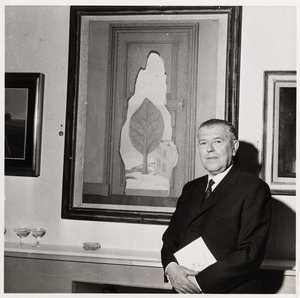
René Magritte
1898 - 1967 , Belgija
Kratki pregled
- Artistic Movement Or Style: Surealizam
- Artists Who Influenced This Artist: ['Giorgio de Chirico']
- Date Of Birth: 21. studenog 1898.
- Date Of Death: 15. kolovoza 1967.
- Full Name: René François Ghislain Magritte
- Nationality: Belgijanin
- Notable Artworks:
- Les Amants
- The Treachery of Images
- Time Transfixed
- The Human Condition
- Place Of Birth: Lessines, Belgiji