

 Pošalji
 Podijeli
 Detalji o umjetničkom djelu

 Preuzmi
 Slični predmeti
 Automatska prezentacija
Le drapeau noir (The Black Flag)


 Prikaži više
Kupite digitalnu sliku visoke rezolucije i poboljšane kvalitete, koja je znatno superiornija od online prikaza.
Svaka datoteka pedantno je pripremljena od strane naših internih stručnjaka koristeći napredne alate i vještinsku ručnu retušu. Osiguravamo da svaka slika ima iznimnu jasnoću, preciznu točnost boja i visoku razinu detalja.
Konačna datoteka dostavlja se putem e-pošte u roku od 72 sata, optimizirana za neposrednu upotrebu u profesionalnim, uredničkim i tiskarskim okruženjima. To je ista kvaliteta kojoj vjeruju vrhunski studiji dizajna, izdavači i galerije.
Digitalna slika
Preuzmite datoteku visoke rezolucije za osobnu izložbu, tisak i kreativne projekte. ( Kupi print Kupi ručno naslikanu sliku)
Uključeno uz svaku narudžbu digitalne slike
Profesionalna digitalna dostava, zajamčena
Odabirom OriginalUniqueArt.com ne dobivate samo sliku – dobivate profesionalno unapređeno digitalno umjetničko djelo, izrađeno s najvećom preciznošću uz jamstvo zadovoljstva. Evo svega što automatski dolazi uz vašu narudžbu:

Brza dostava e-poštom
Vaša digitalna slika visoke rezolucije bit će vam poslana e-mailom u roku od 72 sata od narudžbe – spremna za neposrednu upotrebu.

Digitalna datoteka poboljšana AI-om
Vaše umjetničko djelo profesionalno je optimizirano pomoću naprednih AI alata i ručnog uređivanja, čime se osigurava maksimalna razina detalja, oštrine i točnosti boja.

Besplatna ponovna dostava doživotno
Slučajno ste obrisali ili izgubili svoju datoteku? Ne brinite – ponovno ćemo vam je poslati u bilo kojem trenutku, potpuno besplatno.

Bez uvoznih carina – ikada
Uživajte u svojim umjetničkim djelima trenutno, bez carina, pristojbi ili troškova dostave – digitalne datoteke uvijek su oslobođene poreza.

Jamstvo točnosti boja
Uz pomoć profesionalnih alata i upravljanja bojama, osiguravamo da vaša digitalna slika što vjernije odražava izvorne boje.

Jamstvo zadovoljstva u trajanju od 60 dana
Ako niste zadovoljni svojom digitalnom slikom, revidirat ćemo je ili vratiti 100% novca u roku od 60 dana – bez ikakvih pitanja.

100% Jamstvo povrata novca
Niste zadovoljni? Osigurajte puni povrat novca u roku od 60 dana od primitka vaše digitalne datoteke – bez suvišnih pitanja.

Popusti na velike narudžbe
Kupite 3 slike, uštedite 10% - Kupite 5 slika, uštedite 15% - Kupite 10+ slika, uštedite 20%. Odlično za kreativne projekte, galerije i agencije.
Opis kolekcionarskog djela
A Vision of Technological Anxiety
In the hauntingly beautiful expanse of René Magritte’s Le drapeau noir (The Black Flag), the viewer is invited into a realm where the boundaries of reality and dream coalesce into a singular, unsettling vision. Created during a period of profound global tension, this masterpiece serves as a surreal landscape of technological anxiety. Against a backdrop that shifts with an ominous grace from deep, abyssal black to a muted, somber green-gray near the horizon, several abstract forms drift through the void. These geometric shapes—predominantly circular and rectangular—resemble futuristic spacecraft or mechanical entities suspended in an indifferent sky. The composition is intentionally asymmetrical, creating a sense of disorientation that pulls the observer into Magritte’s carefully constructed mystery, where every floating object feels like a fragment of a forgotten or perhaps yet-to-arrive future.
The style of this work is a profound testament to the Surrealist movement, reflecting Magritte’s unique ability to manipulate familiar geometric structures to evoke profound psychological unease. While there are whispers of abstract expressionism in the ambiguity of the floating forms, the precision of the lines suggests a fascination with the rigid, cold aesthetics of mid-century modern design. This tension between the organic flow of the gradient background and the sharp, mechanical nature of the objects creates a visual friction that is both captivating and chilling. For the collector or interior designer, this piece offers a sophisticated interplay of form and shadow, making it an ideal focal point for spaces that demand intellectual depth and a touch of avant-garde elegance.
The Mastery of Atmosphere and Technique
Technically, Le drapeau noir achieves a level of clinical perfection that enhances its otherworldly atmosphere. The execution utilizes smooth, seamless gradients that eliminate the presence of visible brushstrokes, lending the scene an almost artificial, hyper-real quality. This lack of physical texture emphasizes the detachment and coldness of the subject matter, as if we are peering through a high-definition lens into a dystopian dimension. Magritte masterfully employs light and shadow to grant these abstract shapes a deceptive three-dimensionality; they do not merely sit upon the canvas but appear to occupy a heavy, silent space within it. This meticulous control over light contributes significantly to the overall mood of isolation and gloom, transforming a simple arrangement of shapes into a profound emotional experience.
Beyond its visual splendor, the painting carries a weight of historical and symbolic significance that resonates with the human condition. Created in 1937, the work sits within the shadow of an era defined by the looming threat of war and the rapid, often frightening, advancement of industrial technology. The "Black Flag" may serve as a metaphor for the dark heralds of conflict or the dehumanizing potential of unchecked mechanical progress. To possess a reproduction of this work is to hold a piece of history that continues to challenge our perceptions of what is real and what is imagined. It is an evocative choice for those seeking to infuse their surroundings with a sense of mystery, contemplation, and the enduring power of the surreal imagination.
Biografija umjetnika
Early Life and the Seeds of Surrealism
René Magritte, born René François Ghislain Magritte on November 21, 1898, in Lessines, Belgium, emerged into a world that would profoundly shape his enigmatic artistic vision. His early years were marked by an unsettling event – the suicide of his mother when he was just thirteen. The image of her body being recovered from the River Sambre, with her dress obscuring her face, became a haunting motif that would subtly permeate his later work, manifesting in veiled figures and a persistent exploration of hidden realities. This early trauma instilled within him a fascination with mystery, loss, and the unsettling power of what remains unseen. While details of his childhood remain somewhat elusive, it’s clear this formative experience laid the groundwork for his lifelong questioning of perception and representation. He began drawing lessons at age ten, revealing an innate inclination towards visual expression, but initially explored Impressionism before embarking on a path that would lead him to become one of the most significant figures in Surrealist art.
Artistic Development and Influences
Magritte’s artistic journey was not immediate or straightforward. He studied at the Académie Royale des Beaux-Arts in Brussels, yet found its traditional methods stifling. His early work experimented with Futurism and Cubism, absorbing elements of these avant-garde movements but ultimately rejecting their purely formal concerns. It wasn't until encountering Giorgio de Chirico’s painting *The Song of Love* in 1922 that Magritte discovered a resonance that would irrevocably alter his artistic course. De Chirico’s dreamlike landscapes and unsettling juxtapositions unlocked within Magritte a new way of seeing – a world where the familiar could be rendered strange, and the ordinary imbued with profound mystery. This encounter sparked his commitment to Surrealism, though he often maintained a unique distance from its more overtly psychological or automatic approaches. He preferred a meticulous, almost clinical precision in his painting, using realistic techniques to depict illogical scenarios.
The Heart of Surrealism: Challenging Reality
By 1926, Magritte had fully embraced the tenets of Surrealism, producing *Le Jockey Perdu (The Lost Jockey)*, widely considered his first truly surrealist work. However, his brand of Surrealism was distinct. He wasn’t interested in exploring the subconscious through free association or dream imagery in the manner of some of his contemporaries. Instead, Magritte sought to challenge viewers' perceptions of reality by presenting ordinary objects in unexpected contexts, forcing them to question their assumptions about the world around them. Iconic works like *The Treachery of Images (This is not a pipe)* (1929) brilliantly deconstructs the relationship between image and object, reminding us that a representation is never the thing itself. *Les Amants (The Lovers)* (1927-1928), with its shrouded figures, echoes the trauma of his mother’s death while simultaneously exploring themes of concealment and intimacy. *Time Transfixed* (1938) presents a locomotive bursting through a brick wall, disrupting our sense of space and time. And *The Human Condition* (1933), a canvas within a canvas, blurs the boundaries between representation and reality, prompting us to consider how we perceive and interpret the world.
Later Life, Recognition, and Enduring Legacy
Despite initial struggles for recognition, Magritte’s work gradually gained prominence, particularly in the United States with exhibitions in 1936 and later retrospective shows at the Museum of Modern Art (1965) and the Metropolitan Museum of Art (1992). He continued to refine his signature style, exploring themes of repetition, illusion, and the power of language in paintings that are both intellectually stimulating and visually arresting. Magritte died on August 15, 1967, leaving behind a body of work that continues to captivate and challenge audiences worldwide. His influence extends far beyond the realm of painting, impacting pop art, minimalist art, conceptual art, and even advertising and film. Today, his paintings are held in major museum collections around the globe, including the Musées royaux des beaux-arts de Belgique in Brussels, which houses the Magritte Museum – dedicated entirely to his work and boasting the world’s largest collection of his creations.
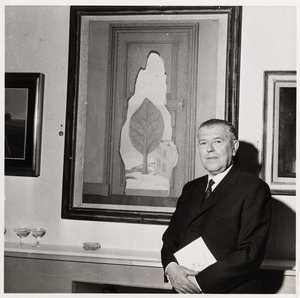
René Magritte
1898 - 1967 , Belgija
Kratke činjenice
- Artistic Movement Or Style: Surealizam
- Artists Who Influenced This Artist: ['Giorgio de Chirico']
- Date Of Birth: 21. studenog 1898.
- Date Of Death: 15. kolovoza 1967.
- Full Name: René François Ghislain Magritte
- Nationality: Belgijanin
- Notable Artworks:
- Les Amants
- The Treachery of Images
- Time Transfixed
- The Human Condition
- Place Of Birth: Lessines, Belgiji

