Prebacite na printove
 Prikaži više







































 Za umjetnička djela ili reprodukcije veće od 105 cm (približno 41 inč) na bilo kojoj strani, okvir će biti isporučen u obliku rastavljenog seta za montažu. Ovaj način osigurava sigurnu dostavu i sprječava oštećenja tijekom transporta.


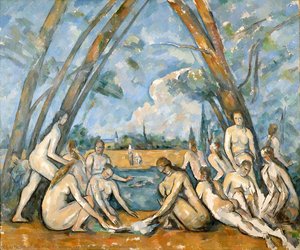
A Moment Frozen in Time: Cézanne’s “The Harvesters”
Paul Cézanne's "The Harvesters," painted in 1878, stands as a pivotal work within the Impressionist movement, yet simultaneously foreshadows the radical stylistic innovations that would define Cubism. It’s more than just a depiction of rural labor; it’s an exploration of perception itself—a deliberate attempt to capture not what the eye sees directly, but how memory and emotion transform visual experience. The painting depicts three figures standing amidst rocks and sand, their gaze directed towards an unseen point beyond the frame. This seemingly simple composition is imbued with layers of significance that resonate deeply within Cézanne’s artistic vision.Impressionistic Roots: Capturing Light and Atmosphere
Cézanne's stylistic approach firmly anchors itself in Impressionism, albeit with a crucial divergence from its contemporaries. Like Monet and Renoir, he sought to convey the fleeting effects of light on surfaces—the dappled sunlight filtering through foliage, the shimmering heat haze over the landscape. However, Cézanne eschewed the optical blending characteristic of Impressionist technique. Instead, he employed visible brushstrokes—thick, textured marks that disrupt the illusion of smoothness—to build up form and volume. This deliberate rejection of optical realism is evident in the rendering of the rocks and sand; they aren’t blended into a seamless expanse but presented as individual masses of pigment, conveying their materiality with remarkable accuracy. The muted palette – predominantly earthy tones punctuated by hints of ochre and umber – reinforces this sense of solidity and contributes to the painting's contemplative mood.Symbolism Within Simplicity: Gestures and Spatial Illusion
Beyond its technical prowess, “The Harvesters” possesses a subtle symbolic dimension that elevates it beyond mere representation. The figures themselves are positioned in a manner that suggests a profound connection—a shared awareness of something larger than their immediate surroundings. Cézanne’s masterful use of perspective creates an unsettling spatial illusion; the horizon line appears to recede further back than it should, compressing the space and emphasizing the figures' isolation within this expansive landscape. The outstretched hands of one harvester – particularly prominent in the central figure – gesture outwards, hinting at a yearning for connection and perhaps representing the universal human desire for sustenance and fulfillment. These gestures are not merely descriptive; they embody an emotional resonance that speaks to the fundamental concerns of Cézanne’s artistic philosophy.A Bridge Between Eras: Anticipating Cubism
“The Harvesters” is considered a transitional piece, marking Cézanne's move away from Impressionistic conventions toward the geometric abstraction that would characterize Cubism. The fragmented forms—particularly noticeable in the depiction of the rocks—prefigure Picasso and Braque’s groundbreaking experiments with multiple viewpoints and flattened planes. Cézanne wasn’t aiming for a literal portrayal of reality; he was striving to distill it down to its essential elements, capturing not just what is seen but how it feels. This pioneering spirit continues to inspire artists today, cementing Cézanne's place as one of the most influential figures in modern art history.Pitanja i odgovori
Je li prikaz "The Harvesters" autora Paul Cezanne u javnom vlasništvu?
Status autorskih prava za "The Harvesters" autora Paul Cezanne: djelo je u javnom vlasništvu – autorska prava su istekla. To određuje smiju li se slobodno izrađivati reprodukcije slike.
Mogu li "The Harvesters" gledati kao prezentaciju preko cijelog zaslona?
Dostupna je i prezentacija slika na stranici Galerija slika za djelo "The Harvesters" autora Paul Cezanne.
Koja je dominantna boja djela "The Harvesters" autora Paul Cezanne?
Boja koja najviše dolazi do izražaja u djelu "The Harvesters" je Rosy Brown (#a99e95). Dominantna boja korisna je pri uklapanju umjetničkog djela u interijer.
 Pregledaj u realnoj veličini
 Pošalji
 Podijeli
 Detalji o umjetničkom djelu
 Vodič
Vodič

 Preuzmi umjetničko djelo
 Slični predmeti
 Rentgenska snimka
 Slide show
 Q&A
Q&A Statistika