
() ·
A painting made for you, by hand
Ručno rađena uljana reprodukcija
Ručno oslikano uljanim bojama na platnu u dimenzijama i okviru po vašem izboru, izrađeno po narudžbi od strane naših umjetnika. ( Prebacite na printove Prebacite na digitalnu sliku)
Opis kolekcionarskog predmeta
Explore 'Three Graces Blue' by Lester F. Johnson (1966). This expressive oil painting boasts bold colors, impasto texture & simplified figures. A key work of the NY School, embodying tribal abstraction.
Biografija umjetnika
Explore the figurative expressionism of Lester Johnson (1919-2010), a New York School painter known for his human figures & NYC scenes. Exhibited at major galleries, member of American Academy.
 Prikaži više
from ·
Chapter 1
How large should it be?
Slide to change the size; the picture on the left shows the frame at its real width. The proportions of the original are kept.
Odaberite jednu od naših unaprijed definiranih veličina koje odgovaraju izvornim proporcijama umjetničkog djela.

Unesite potrebnu širinu i visinu kako bi dimenzije odgovarale vašem okviru ili zidu. Budući da je riječ o ručno oslikanom djelu, umjetnik može malo proširiti rubove slike ili ih skratiti kako bi postigao drugačiji oblik — izbor je vaš. Prije početka slikanja poslat ćemo vam digitalni prikaz (mockup) radi potvrde. Slika prikazana na ovoj stranici ne predstavlja stvarni rezultat — samo digitalni prikaz to čini.
Chapter 2
How should it arrive?
Choose the edges of the stretched canvas
Choose your frame

White €1

Blurside €1

Extended €1

P118B €10

P118H €10

P118W €10

P438Z €10

P508JH €12

P508YH €12

P805H €10

P805Z €10

P919BZ €10

P919G €10

P919XJ €10

P959ZH €10

P968JZ €12

W106C €8

W218G €10

W218JH €8

W218Y €10

W307PJ €10

W316G €10

W316PJ €8

W316Y €10

W398PJ €8

W4111J €10

W500HY €15

W500JH €15

W692G €12

W849H €8

W940BG €15

W953PJ €8

H24-GOLD €30

H24-SILVER €30

H36-GOLD €45

H36-SILVER €45
Uokvireno
Moulding: . Overall size with the frame: .
Chapter 3
Who paints it, and should anything change?
After order, OriginalUniqueArt.com team will email client for instructions and provide a mockup preview
Isporuka širom svijeta () u roku od 3-4 tjedna umjesto standardnih 5 tjedana. (30 Listopad). Bez kompromisa u kvaliteti.
Chapter 4
The finishing touches
A nameplate, as in a museum?
Detalji gravirane brončane pločice
This elegant plaque features the artist's name and the title of the artwork, finely engraved for a timeless presentation.
It is made from bronze with a refined, elegant finish. The text is precisely laser-engraved for a sharp and permanent result. Measuring 9x2 cm, the plaque is compact yet easy to read. It's built to be durable and scratch-resistant, offering a professional, museum-quality look. Mounting is simple thanks to the included adhesive backing.
Detalji prozirne akrilne pločice
The plaque includes essential engraved details such as the artist's name, the title of the artwork, the date it was created, the type of media used-like oil on canvas or watercolor-a brief description of the piece, and a QR code that links to the complete artwork information.
It is crafted from clear acrylic, offering a sleek, modern appearance. The text is UV-engraved in black to ensure strong visual contrast. With a size of 10x15 cm, it ensures optimal readability. It comes equipped with two metal hooks for secure wall mounting. The plaque is designed to be weather-resistant, making it suitable for various environments, and it includes interactive features that work seamlessly with smartphone scanning.
Detalji crne akrilne pločice
This elegant plaque includes engraved information such as the artist's name, the title of the artwork, the date it was created, the type of media used (like oil on canvas or watercolor), a short description of the artwork, and a QR code for quick access to more information.
The plaque itself is made from refined black acrylic with a premium finish. The text is laser-engraved in white for high contrast and readability. Its size is 10x15 cm, designed to be easy to read. It comes with two metal hooks for professional mounting. The design is sleek and fits any interior style. It is also weather-resistant and durable, with built-in digital integration for mobile compatibility.
A protective varnish?
When do you need it?
Chapter 5
Your painting, as you ordered it

Three Graces Blue
Tehnika reprodukcije
Veličina reprodukcije
-

Odabrani vrhunski umjetnik
Više detalja, profinjenosti i dodatnog vremena za izradu
-

Okvir za reprodukciju
-
-
Za umjetnička djela ili reprodukcije veće od 105 cm (približno 41 inč) na bilo kojoj strani, okvir će biti isporučen u obliku rastavljenog seta za montažu. Ovaj način osigurava sigurnu dostavu i sprječava oštećenja tijekom transporta.
Potrebna je profesionalna montaža – ovo nije proizvod za samostalnu izradu.
Set mora sastaviti i platno zategnuti iskusni profesionalni uokvirivač, koristeći drvno ljepilo (nije uključeno u set), kljeste za zatezanje platna i stege kako bi se održao pravilan kut letvica dok se ljepilo suši. Nepravilna montaža ili neravnomjerno zategnuto platno mogu trajno oštetiti umjetničko djelo, a takva oštećenja nisu pokrivena našim jamstvom.
 Za umjetnička djela ili reprodukcije veće od 105 cm (približno 41 inč) na bilo kojoj strani, okvir će biti isporučen u obliku rastavljenog seta za montažu. Ovaj način osigurava sigurnu dostavu i sprječava oštećenja tijekom transporta.
Sve letvice od punog drveta su uključene, precizno izrezane po mjeri.
Montira se pomoću priloženih vijaka, uz dodatak ljepila za drvo za spojeve u kutovima, koje nije uključeno u set i koje vaš okviraš mora vlastito nabaviti.
Potrebni su profesionalni alati koji nisu uključeni: škripc za zatezanje platna (zatezač) i stezaljke za održavanje pravokonačnosti letvica tijekom sušenja ljepila.
Važno:
Za spojeve u kutovima potrebno je ljepilo za drvo, letvice se moraju pričvrstiti stezgama dok se ljepilo potpuno ne osuši, a za zatezanje platna na sastavljenom okviru potreban je alat za zatezanje platna. Nijedan od ovih alata nije uključen u set. Molimo vas da prije narudžbe ove veličine osigurate uslugu iskusnog profesionalnog uokvirivača.

Natpisna pločica
-
-

Zaštitni lak
Sjajni lak (pojačava intenzitet boja, štiti od svjetlosti i vlage)
-

Prilagodite svoje umjetničko djelo
Primjeri mogućnosti prilagodbe: Zamijenite lice fotografijom kupca; Dodajte ljubimca (npr. zamijenite mačku psom); Uključite skrivenu poruku u pozadinu; Promijenite pejzaž ili elemente pozadine.
-

Hitna dostava
Globalna dostava () u roku od 3-4 tjedna umjesto standardnih 5 tjedana. (30 Listopad). Bez kompromisa u kvaliteti.
-
Brza dostava
Dostava širom svijeta () u roku od 5 tjedana. (6 Studeni).
Uključeno u cijenu
Ukupna cijena
€ 311
Opcija stakla dostupna je samo za dimenzije manje od 110 cm
Included with every order
- Besplatna ekspresna dostava širom svijeta
- Visokokvalitetno laneno platno
- Potpuno osiguranje dostave
- Jamstvo povrata carine i uvoznih poreza
- Jamstvo vjernosti boja
- Politika povrata u roku od 100 dana (samo u slučaju nedostataka)
- Jamstvo povrata 100% novca
- Popust na više proizvoda


 Pregledaj u realnoj veličini
 Pošalji
 Podijeli
 Detalji o umjetničkom djelu
 Vodič
Vodič

 Preuzmi umjetničko djelo
 Slični predmeti
 Rentgenska snimka
 Slide show
 Q&A
Q&A Statistika
In numbers
- 1966the year it was painted
- 29frames to choose from
- standard sizes, in its own proportions
- 5weeks to paint and deliver it
About the original
 Abstract Expressionism
 1966
1966 168.0 x 178.0 cm
Ovo djelo je zaštićeno autorskim pravima
Djelo prikazano na ovoj stranici zaštićeno je autorskim pravima, što znači da zakonski ne možemo izraditi niti prodati identičnu reprodukciju. Ova se zaštita provodi u skladu s međunarodnim sporazumima kao što su Bernska konvencija i nacionalnim zakonima, uključujući i one koji su utvrđeni u Američki zakon o autorskom pravu – Title 17.
Kao poštovana i legalna alternativa, nudimo prilagođena, ručno oslikana umjetnička djela inspirirana originalom. Naši vješti i profesionalni umjetnici pažljivo proučavaju stil, raspoloženje i umjetničku bit originala kako bi stvorili novo, jedinstveno djelo koje izaziva isti osjećaj – ostajući pritom vlastito, originalno stvaralaštvo.
Ova metoda u potpunosti je usklađena s autorskim pravima jer ne uključuje kopiranje ili dupliciranje zaštićenih umjetničkih djela. Umjesto toga, riječ je o kreativnoj reinterpretaciji – novoj slici koja je dobila utjecaj na izvornik, ali nije identična njemu.

Lester F. Johnson
1919 - 2010
Quick facts about Lester F. Johnson
- Artistic Movement Or Style: Figurative Expressionism
- Artists Or Movements Influenced By This Artist: ['New York School']
- Artists Who Influenced This Artist: ['Hofmann']
- Date Of Birth: 1919
- Date Of Death: 2010
- Full Name: Lester F Johnson
- Nationality: American
- Notable Artworks:
- Various NYC scenes
- Human figure studies
- Place Of Birth: Minneapolis, Minnesota
Biografija umjetnika
Lester F. Johnson: A Figure in the Urban Landscape
Lester Frederick Johnson (1919-2010) wasn’t a name immediately recognized by the public, yet his work quietly held a significant place within the pantheon of New York School painters. He was an American figurative expressionist who dedicated his career to capturing the essence of the human figure amidst the vibrant, often gritty, backdrop of New York City. More than simply depicting individuals, Johnson sought to distill the spirit and energy of urban life—the anonymous faces in crowded streets, the fleeting moments of connection, and the underlying currents of a rapidly changing metropolis. His legacy lies not just in his paintings but also in his unwavering commitment to his craft, spanning nearly seven decades and witnessing profound shifts in artistic styles and cultural landscapes. Johnson’s early years provided a grounding for his future artistic pursuits. Born in Minneapolis, Minnesota, in 1919, the youngest of seven children within a Swedish homesteading family, he developed an appreciation for both the natural world and the complexities of human relationships. This formative experience instilled a deep sense of observation and empathy—qualities that would later inform his approach to painting. After studying at the Minneapolis School of Art and the St. Paul Art School, Johnson arrived in New York City in 1947, a pivotal moment that irrevocably shaped his artistic trajectory. His initial studio was nestled next door to Wolf Kahn on 6th Street and Avenue A, a location that immediately immersed him within the burgeoning art scene of Greenwich Village. This proximity fostered collaboration and exchange with other emerging artists, including Larry Rivers and Jim Fosberg, who shared a loft space with Johnson in St. Mark’s Place – a hub for creative experimentation during those formative years. Johnson's artistic development was deeply intertwined with the evolving currents of post-war American art. Initially influenced by Abstract Expressionism, particularly the gestural painting championed by artists like Jackson Pollock and Willem de Kooning, he gradually moved toward a more focused representation of the human figure. This shift wasn’t merely stylistic; it reflected a growing interest in exploring the psychological and social dimensions of urban experience. His early works often featured stark profiles and frontal depictions of anonymous figures, rendered in monochrome palettes that emphasized their integration into the city's landscape—as if they were integral components of its very fabric. The 1954 Provincetown summer proved to be a crucial period of artistic exploration, where Johnson joined a collective of artists including Kahn, Jan Müller, and Bob Thompson, absorbing the vibrant energy of the coastal arts community. This experience broadened his perspective and solidified his commitment to capturing the dynamism of urban life. Throughout the 1960s and beyond, Johnson’s style continued to evolve, incorporating richer colors and more detailed depictions of individuals within crowded street scenes. He moved away from purely abstract forms, imbuing his figures with a sense of personality and narrative—capturing not just their physical appearance but also their emotional states. His paintings became increasingly layered, reflecting the complexities of urban life and the diverse experiences of its inhabitants. Johnson’s work was exhibited at prestigious galleries across New York City – including the Martha Jackson Gallery, Zabriskie Gallery, Gimpel & Weitzenhoffer, and James Goodman Gallery – as well as in major museum group shows at institutions like the Guggenheim, Whitney Museum of American Art, and Metropolitan Museum of Art. Notably, he was elected a member to both the American Academy of Arts & Letters and National Academy of Design, recognizing his significant contribution to the art world. In 2010, his work was showcased in the Armory Show and Art Chicago, demonstrating his continued relevance and influence within contemporary art discourse. Johnson’s artistic journey wasn't confined solely to New York City; he also found inspiration in the quieter landscapes of Long Island, establishing a summer home in Springs, Long Island, beginning in 1955. This retreat provided him with respite from the intensity of urban life and allowed him to reconnect with nature—a recurring theme in his work. He also spent time teaching at Yale University (1969-1974), sharing his knowledge and experience with a new generation of artists. His dedication to art education underscored his belief in the transformative power of creative expression. Johnson’s life, marked by both artistic achievement and personal connection, culminated in 2010, leaving behind a rich legacy of paintings that continue to resonate with viewers today. Key achievements include: membership in prestigious artistic organizations, consistent exhibition at leading galleries, and the enduring impact of his unique vision within the New York School movement.The Figure as Urban Echo
Johnson’s approach to painting was deeply rooted in observation and empathy. He wasn't interested in creating idealized representations of individuals; instead, he sought to capture the essence of their humanity—their vulnerability, resilience, and connection to the urban environment. His figures are often rendered with a sense of immediacy and spontaneity, reflecting the fleeting moments of interaction that occur within crowded city streets. The use of monochrome palettes in his early works served to emphasize the anonymity of these individuals, highlighting their integration into the city’s landscape—as if they were simply another element within its complex tapestry. As he evolved his style, Johnson incorporated richer colors and more detailed depictions of figures, imbuing them with a sense of personality and narrative. His paintings became increasingly layered, reflecting the complexities of urban life and the diverse experiences of its inhabitants.- Early Influences: Abstract Expressionism (Pollock, de Kooning) provided a foundation for his exploration of gesture and emotion.
- Key Themes: The human figure in the context of urban life; anonymity versus individuality; the energy and dynamism of New York City.
- Technique: Characterized by bold brushstrokes, layered compositions, and a skillful use of color to convey mood and atmosphere.
Srodni članci
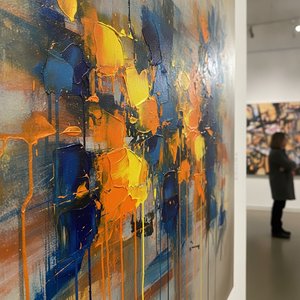
Beyond the Lines: Mastering the High-Impact World of Contemporary Abstraction
Master the high-impact world of contemporary abstraction. Discover how bold colors, textures, and modern movements like Abstract Expressionism can transform your space with premium, high-energy art curated for the design-conscious professional.

Kandinsky's Masterpieces: 25 Paintings That Define Abstract Art | OriginalUniqueArt
Journey through Wassily Kandinsky's 25 most iconic abstract paintings. Explore his revolutionary use of color, form & spiritual expressionism. Find museum-quality Kandinsky reproductions and elevate your home decor with OriginalUniqueArt.com. Discover all masterpieces on OriginalUniqueArt.com!

Geometrijska Apstrakcija: 10 Remek-djela Koja Su Promijenila Umjetnost | OriginalUniqueArt
Istražite 10 remek-djela geometrijske apstrakcije! Otkrijte priče Kandinskog, Mondriana i drugih majstora. Inspirirajte se za svoj interijer s vrhunskim reprodukcijama slika na OriginalUniqueArt.com

Desetak Remek-djela koja su Definirala Apstraktni Ekspresionizam: Uljane Slike i Moderna Dekoracija
Otkrijte 10 remek-djela koja su definirala apstraktni ekspresionizam! Jackson Pollock, Mark Rothko i drugi majstori uljane umjetnosti. Ispričajte priču svojim zidovima uz OriginalUniqueArt - vrhunske reprodukcije za vaš dom.