
 Pregledaj u realnoj veličini
 Pošalji
 Podijeli
 Detalji o umjetničkom djelu
 Vodič
Vodič

 Preuzmi umjetničko djelo
 Slični predmeti
 Rentgenska snimka
 Slide show
 Pitanja i odgovori
 Statistika
Self-Portrait.

- 75.0 x 62.0 cm


 Prikaži više
Giclée / Umjetnički otisak
Giclée tisak muzejske kvalitete ili otisak na platnu uz brzu izradu i raznolike opcije završne obrade. ( Kupi ručno oslikano djelo Prebacite na digitalnu sliku)




P118B €10

P118H €10

P118W €10

P438Z €10

P508JH €12

P508YH €12

P805H €10

P805Z €10

P919BZ €10

P919G €10

P919XJ €10

P959ZH €10

P968JZ €12

W106C €8

W218G €10

W218JH €8

W218Y €10

W307PJ €10

W316G €10

W316PJ €8

W316Y €10

W398PJ €8

W4111J €10

W500HY €15

W500JH €15

W692G €12

W849H €8

W940BG €15

W953PJ €8




Odaberite jednu od naših unaprijed definiranih veličina koje odgovaraju izvornim proporcijama umjetničkog djela.

Unesite potrebnu širinu i visinu kako bi odgovarali vašem okviru ili zidu. Print se može samo izrezati, nikada ne može biti veći od slike, stoga format s drugačijim omjerom stranica uzrokuje gubitak dijela slike. Prije bilo kakve štampe šaljemo vam digitalni prikaz (mockup) na odobrenje. Slika prikazana na ovoj stranici ne prikazuje stvarni rez — to prikazuje isključivo digitalni prikaz.
Dostava širom svijeta () u roku od 2 tjedna umjesto standardnih 4/5 tjedana. (10 Studeni)

Besplatna ekspresna dostava širom svijeta

Visokokvalitetno laneno platno

Potpuno osiguranje dostave

Jamstvo povrata carine i uvoznih poreza

Jamstvo vjernosti boja

Politika povrata u roku od 100 dana (samo u slučaju nedostataka)

Jamstvo povrata 100% novca

Popust na više proizvoda
 Opcija stakla dostupna je samo za dimenzije manje od 110 cm

Self-Portrait.
Giclée / Umjetnički otisak
Veličina reprodukcije
-


Ukupna cijena
€ 73
Ilya Repin’s ‘Self-Portrait’: A Window into a Russian Soul
The Tretyakov Gallery in Moscow holds within its walls not just paintings, but echoes of a nation's spirit – and few works capture that essence more powerfully than Ilya Yefimovich Repin’s “Self-Portrait,” painted in 1887. This oil on canvas, measuring a modest 75 x 62 cm, transcends the simple act of portraiture; it’s an intimate revelation, a glimpse into the mind and character of one of Russia's most significant realist painters. More than just a likeness, Repin presents himself as a thoughtful observer, a man wrestling with intellectual depth and quiet confidence – a figure both familiar and profoundly compelling.
Repin’s decision to depict himself in such a deliberate manner is crucial to understanding the painting's significance. Created during a period of intense social and political change in Russia, the portrait reflects a growing awareness of individual identity within a rapidly modernizing society. The neutral background – a subtle wash of grey-brown – serves not as distraction but as a carefully considered stage for the artist’s face. It allows the viewer to fully absorb his gaze, a direct challenge and invitation simultaneously. The meticulous rendering of his features—the strong jawline, the slightly furrowed brow, the piercing eyes—is executed with a remarkable sensitivity to light and shadow, creating a palpable sense of three-dimensionality that draws us into his world.
Realism as a Reflection of Life
“Self-Portrait” is a cornerstone of Repin’s commitment to Realism. Unlike the idealized portraits prevalent in earlier eras, this work eschews romantic embellishment and strives for an honest depiction of the artist himself. Repin wasn't interested in presenting a heroic or glamorous image; instead, he sought to capture the reality of his own appearance – the lines etched by time and thought, the subtle signs of a life lived with intensity. This commitment to accuracy is further emphasized by the muted color palette—a deliberate choice that avoids distracting from the details of his face and clothing. The dark suit and tie, rendered with careful attention to texture, speak to his status as a respected artist, while the slightly worn fabric hints at a groundedness, an awareness of the everyday realities of life.
Symbolism in Simplicity
While seemingly straightforward, “Self-Portrait” is rich in subtle symbolism. The serious expression on Repin’s face isn't merely one of contemplation; it suggests a burden of responsibility, perhaps reflecting his role as both an artist and a keen observer of the social landscape around him. The long, curly hair – a distinctive feature of his appearance – adds to the sense of individuality and challenges conventional notions of masculine beauty. It’s a deliberate statement of self-awareness, suggesting that Repin was comfortable in his own skin and unafraid to defy expectations. The painting can be interpreted as a meditation on identity, perception, and the complexities of being human.
A Legacy of Russian Art
“Self-Portrait” stands as a testament to Repin’s enduring legacy as one of Russia's most important artists. His work, deeply rooted in the experiences of ordinary people – from the barge haulers on the Volga to the Cossacks of Kursk Province – continues to resonate with audiences today. As evidenced by his other celebrated works like “Reply of the Zaporozhian Cossacks,” Repin possessed a rare ability to capture not just physical likeness but also the very essence of human emotion and experience. The painting’s placement within the Tretyakov Gallery, alongside masterpieces from Russian art history, underscores its significance as a pivotal work in the nation's artistic heritage. Reproductions like those offered by OriginalUniqueArt.com allow us to appreciate this powerful image with unparalleled clarity and detail, bringing Repin’s profound insights into our own lives.
Pitanja i odgovori
Koja se namjena i prostor preporučuju za "Self-Portrait." autora Ilja Jefimovič Repin?
"Self-Portrait." se preporučuje za Statement, a idealan prostor za nju je Living Room.
Je li "Self-Portrait." autora Ilja Jefimovič Repin preporuka za poklon i kome ga pokloniti?
"Self-Portrait." se predlaže kao idealan poklon za Birthday, uzimajući u obzir Statement.
Kako mogu otkriti umjetnička djela slična djelu "Self-Portrait." autora Ilja Jefimovič Repin?
Stranica Slična djela za djelo "Self-Portrait." autora Ilja Jefimovič Repin prikazuje srodna umjetnička djela.
Biografija umjetnika
Early Life and the Seeds of Realism
Ilya Yefimovich Repin, a name that resonates with the very soul of Russian art, was born in 1844 in the humble Ukrainian town of Chuguev. His origins were far removed from the aristocratic circles often associated with artistic patronage; his father, a former soldier who traded horses, and his mother, deeply rooted in local traditions, instilled in young Ilya a profound connection to the land and its people. This early immersion into rural life – its hardships, its vibrant spirit, and its unwavering resilience – would become the bedrock of his artistic vision. Formal education began at a local school where his mother taught, but a period at a military cantonist school followed, an experience Repin later recalled with little fondness. Yet, even within the rigid confines of military discipline, his innate talent for drawing blossomed. At sixteen, he apprenticed himself to Ivan Bunakov, an icon painter, embarking on a rigorous training in religious art that honed his skills in meticulous detail and compositional precision. These formative years were not merely technical exercises; they represented a crucial immersion into the visual language of Russian culture, laying the groundwork for his later explorations of national identity and social commentary. Through restoring ancient icons and fulfilling portrait commissions, Repin began to observe and capture the essence of human character – a skill he would master throughout his illustrious career.St. Petersburg and the Embrace of Social Consciousness
Driven by an unwavering ambition, Repin journeyed to St. Petersburg in 1863, seeking admission to the prestigious Imperial Academy of Fine Arts. Initial rejection did not deter him; he audited classes, immersing himself in the city’s vibrant artistic milieu. It was here that he encountered Ivan Kramskoi, a leading figure in the Peredvizhniki movement – a collective of realist artists who boldly rejected academic conventions and sought to depict Russian life with unflinching honesty. Kramskoi became Repin's mentor, guiding him towards a more socially conscious art. The influence of critic Vladimir Stasov was also pivotal, encouraging Repin to focus on contemporary themes and the lives of ordinary people. Repin’s talent quickly flourished, earning recognition and awards, including gold medals for works like “Job and His Friends” in 1869 and "The Raising of Jairus' Daughter" in 1871. These early successes signaled the arrival of a powerful new voice in Russian art – one that would challenge established norms and capture the spirit of a changing nation. A formative experience was his journey along the Volga River in 1870, sketching the arduous lives of barge haulers; this provided the inspiration for what would become his breakthrough masterpiece, a work that would forever cement his reputation as a champion of the downtrodden.Masterpieces of Realism and Historical Drama
Repin’s name became inextricably linked with realism through works that unflinchingly portrayed the realities of Russian society. “Barge Haulers on the Volga” (1873), a monumental canvas depicting exhausted laborers dragging boats along the river, shocked and captivated audiences. It was not merely a depiction of physical hardship; it was a powerful indictment of social injustice and a testament to human endurance. He meticulously studied anatomy and perspective, striving for accuracy and capturing the textures of fabric and skin with remarkable detail. This painting launched Repin into national prominence and established him as a leading voice for the marginalized. He continued to explore themes of Russian life in works like “Religious Procession in Kursk Province” (1883), which offered a nuanced portrayal of faith, superstition, and social hierarchy. Repin’s artistic style was characterized by a commitment to realism, meticulous attention to detail, and a profound understanding of human psychology. He masterfully employed light and shadow to create dramatic effects and convey emotional depth. His compositions are often dynamic and engaging, drawing the viewer into the scene. However, Repin also tackled historical subjects with dramatic flair. “Ivan the Terrible and His Son Ivan” (1885), depicting a moment of horrific violence and remorse, demonstrated Repin’s ability to convey complex emotions through dramatic lighting and gesture. The painting's psychological intensity captivated audiences and cemented Repin's reputation as one of Russia’s greatest artists. He meticulously researched historical sources and employed expressive brushstrokes to capture the drama and emotion of the scene.Legacy and Enduring Influence
Throughout his long and prolific career, Repin continued to paint portraits of prominent figures – Leo Tolstoy, Modest Mussorgsky, Pavel Tretyakov – capturing their personalities with remarkable insight. He skillfully rendered facial expressions and body language, conveying subtle nuances of emotion. Repin’s ability to capture the human condition with both empathy and unflinching honesty resonated deeply within Russia and beyond, establishing him as a major figure in European art. His unwavering dedication to realism and social commentary influenced generations of artists who followed him. He taught at the Imperial Academy of Fine Arts, fostering a new generation of realist painters. Repin’s home is now a museum, preserving not only his artistic legacy but also offering a glimpse into the life of one of Russia’s most important cultural figures. His enduring influence can be seen in the works of artists who embraced realism and sought to depict the complexities of human experience with honesty and compassion. He remains an icon of Russian art history—a testament to the power of observation, empathy, and artistic conviction.
Ilja Jefimovič Repin
1844 - 1930 , Rusija
Osnovne informacije
- Artistic Movement Or Style: Realizam
- Artists Or Movements Influenced By This Artist: ['Socialist Realizm']
- Artists Who Influenced This Artist:
- Ivan Kramskoi
- Vladimir Stasov
- Date Of Birth: 5 august 1844
- Date Of Death: 29 september 1930
- Full Name: Ilya Yefimovich Repin
- Nationality: Rusijan
- Notable Artworks:
- Barge Haulers on Volga
- Reply Zaporozhian Cossacks
- Ivan the Terrible...
- Religious Procession
- Place Of Birth (City And Country): Chuguev, Rusija
Srodni članci

Soul of the Steppes: Capturing the Majesty and Social Realism of 19th Century Russian Art
Explore the profound beauty of 19th-century Russian art. From Ilya Repin's realism to pastoral landscapes, discover the soul of the steppes through our expert historical analysis and museum-quality hand-painted reproductions for discerning collectors.

Russian Realism: The Soulful Power of Truth and the Unyielding Spirit of the Peredvizhniki
Explore the profound depth of Russian Realism. From the social truths of the Peredvizhniki to epic folklore, discover the soulful power of masters like Perov and Yaroshenko through our expert art history insights and museum-quality reproductions.
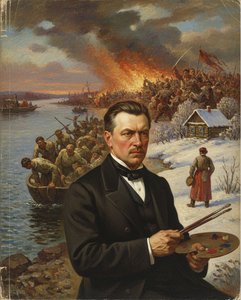
Ilya Repin: Realism, Revolution & the Russian Soul – A Comprehensive Exploration of Life and Legacy
Explore the life & legacy of Ilya Repin, Russia's leading realist painter. Discover his iconic works like 'Barge Haulers on the Volga,' social commentary, and profound portraits. A comprehensive guide for art enthusiasts.

Vladimir Makovsky: Realism, Social Commentary & Russian Life in Late 19th-Century Painting
Explore the captivating world of Vladimir Makovsky, a leading Russian realist painter. Discover his insightful depictions of 19th-century life, social commentary & legacy with OriginalUniqueArt.

Discover Russian Realism: Soulful Masterpieces and the Timeless Spirit of the Peredvizhniki for Your Modern Home
Elevate your home with the soulful beauty of Russian Realism. Discover exquisite hand-painted reproductions of Peredvizhniki masterpieces, from lyrical landscapes to profound portraits, curated to bring historical depth and timeless elegance to your modern interior design.


