Realism
The Reader (Honoré Daumier)
Honoré Daumier (1808–1879) je izradio The Reader. Pripada pokretu Realism. Izrađeno je u Oil On Panel. Dimenzije su 34 × 26 cm.
- Oil On Panel
- 34 × 26 cm

 Pregledaj u realnoj veličini

 Ručno oslikano uljanim bojama
 Pošalji
 Podijeli
 Vodič


 Preuzmi umjetničko djelo
 Slični predmeti
 Rentgenska snimka
 Slide show
 Pitanja i odgovori

 Statistika
The Reader: ključne informacije
- Naslov
- The Reader
- umjetnik
- Honoré Daumier (1808–1879)
- Rođen/a u
- Marseille, Francuska
- Tehnika
- Oil On Panel
- Dimenzije
- 34 × 26 cm
- Pokret
- Realism
- Razdoblje
- 19th Century
- Tema
- man, book, reading, brown, ochre, red
Što prikazuje The Reader?
Identification of The Reader by Honoré Daumier
The quiet intensity of The Reader meets the viewer through the focused gaze of its subject. Painted by Honoré Daumier, this work captures a moment of profound stillness. The piece emerges from around c. 1857, a time when the artist's hand moved with a particular sense of purpose and weight. It exists as a painting, a physical presence that holds the light and shadow of a private, contemplative world.
Honoré Daumier brings a sense of lived experience to this study. The figure remains lost in the pages of a book, oblivious to the world outside the frame. There is a weight to the atmosphere, a feeling of solitude that settles over the scene. The work carries the mark of its creation, a tangible connection to the era of its origin.
This specific painting, The Reader, remains a significant part of the artist's visual language. It avoids the distractions of a grand setting to focus entirely on the human condition in a state of deep engagement. Through this work, the act of reading becomes a heavy, significant event, frozen in time for those who stop to look.
Composition and Visual Elements
The composition follows a vertical orientation, drawing the eye immediately to the man positioned slightly off-center. He sits in a moment of profound stillness, his gaze directed steadily downwards toward the open book held in his hands. This downward focus creates a tight, intimate space around his head and shoulders. Behind him, a blurred object, perhaps a cushion or a potted plant, rests in the background, providing a sense of depth without pulling attention away from the central figure.
Soft, diffused light falls from an unseen source above and to the left, casting gentle shadows across the man's face. This lighting emphasizes his features and the texture of the pages before him, while the shallow perspective keeps the viewer's focus firmly on the interaction between the reader and his text. The atmosphere feels quiet and heavy with contemplation.
The color palette relies on a somber arrangement of earthy tones. Deep browns, ochres, and muted reds dominate the scene, grounding the subject in a warm but melancholic environment. These colors wrap around the figure, reinforcing the sense of solitude and the weight of the thoughts contained within the book.
Technique and Physical Materials
The oil paint clings to the panel with a palpable, heavy presence. Each stroke carries the weight of the artist's hand, applied with a loose and expressive energy that refuses to settle into stillness. You can see the evidence of layering, where colors are built upon one another to create a sense of depth and substance. These layers blend into one another, creating soft transitions that suggest the subtle shifts of light across a surface.
A visible roughness defines the texture of the work. The brushstrokes remain unpolished and direct, leaving a tactile quality that speaks to the immediacy of the moment. This ruggedness gives the surface a physical life, where the paint does not merely sit upon the panel but seems to emerge from it. The interplay of these thick applications and the careful blending of tones creates a surface that feels both spontaneous and deeply considered.
The Reader u visokoj rezoluciji


Honoré Daumier, The Reader. Javno dobro.
Digitalni stručnjak uspoređuje boje s izvornim slikarskim djelom i retušira datoteku, vjerno prateći umjetnikove poteze četkicom.
Kupite sliku visoke rezolucijePitanja o The Reader
U kojoj je tehnici izvedeno djelo "The Reader" autora Honoré Daumier?
Honoré Daumier koristio je tehniku Oil On Panel za "The Reader". Ova tehnika definira materijalnu prirodu izvornog djela.
Koje su dimenzije izvornog "The Reader"?
Dimenzije djela "The Reader" autora Honoré Daumier iznose 34 x 26 cm. Reprodukcije se mogu naručiti u drugim dimenzijama uz zadržavanje istih proporcija.
Što prikazuje "The Reader" autora Honoré Daumier?
Teme prisutne u djelu "The Reader" autora Honoré Daumier uključuju man, book, reading, brown, ochre, red, shoulders, face, što zajedno sažima samu bit umjetničkog djela.
Je li "The Reader" autora Honoré Daumier u javnom vlasništvu?
Status autorskih prava za "The Reader" autora Honoré Daumier: djelo je u javnom vlasništvu – autorska prava su istekla. To određuje smiju li se slobodno izrađivati reprodukcije slike.
Tko je stvorio "The Reader"?
Autorstvo djela "The Reader" pripisuje se Honoré Daumier.
Koji umjetnički pravac obuhvaća "The Reader" autora Honoré Daumier?
"The Reader" je djelo pokreta Realism. Taj pokret označava umjetničku tradiciju kojoj ovo djelo pripada.
U kojem se razdoblju karijere umjetnika Honoré Daumier nalazi djelo "The Reader"?
"The Reader" pripada Mature Period u karijeri umjetnika Honoré Daumier. Ova klasifikacija povezuje djelo s umjetnikovim stilskim razvojem.
Je li "The Reader" autora Honoré Daumier u javnom vlasništvu i zašto?
Djelo "The Reader" autora Honoré Daumier nalazi se u u javnom vlasništvu – autorska prava su istekla. Autorska prava se obračunavaju od godine smrti umjetnika, a Honoré Daumier je preminuo/la 1879.
Gdje se "The Reader" smješta unutar opsega djela umjetnika Honoré Daumier?
"The Reader" dijeli s ostalim djelima Honoré Daumier njezin/njezin Realism stil i prisutne teme: rubens' chiaroscuro, realism, social and political critique, lithography and painting, human condition.
O umjetniku, Honoré Daumier

1808–1879, Francuska
Honoré Daumier
Početak života i umjetnički poziv Honoréa Daumiera Honoré-Victorin Daumier rođen je u Marseilleu 1808. godine, a njegov život bio je duboko isprepleten s burnim događajima devetnaestostoljetne Francuske. Rano djetinstvo obilježeno je književnim ambicijama oca i preseljenjem u Pariz 1814. godine, što ga je uronilo u grad koji je vrveo umjetničkom energijom.
I ostalo djelo autora Honoré Daumier
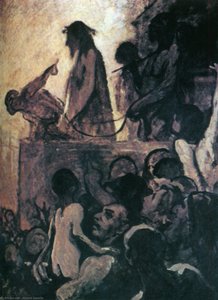 Honoré Daumier Želimo Barabu (Ecce Homo) We want Barabbas (Ecce Homo)1852
 The Third-class Carriage1860
 Unknown, maybe Hippolyte Lucien-Joseph Lucas (1807-1878), a Journalist, maybe P.Mendez de Vigo (1790-1860) a Spanish General, but Most Probably the Count Pelet de la Lozere (1785-1871), a Politician1833
 Ratapoil (front view)1850
Eseji o djelu The Reader
 The Art of the Gaze: A Collector's Guide to Mastering Portrait Composition and Emotional DepthMaster the nuances of portrait composition with our expert guide for collectors. Discover how light, gaze, and texture create emotional dep…
 Spontaneity and Matter: Distinguishing CoBrA from Art InformelMaster the differences between CoBrA and Art Informel with our expert guide. Learn to identify these post-war movements today.
 Ink and Light: How Impressionist Painters Captured the Act of ReadingExplore how masters like Renoir and Vermeer captured the intimacy of reading. Discover the profound link between literature and fine art.