Pregledaj u stvarnoj veličini
 Podijeli
 Podijeli
 Detalji
 Vodič
Vodič

 Preuzmi datoteku
 Slični predmeti
 Rentgenska snimka
 Slide show
 Statistika
An Amazon


 Pročitajte više
Djelo prikazano na ovoj stranici zaštićeno je autorskim pravima, što znači da zakonski ne možemo izraditi niti prodati identičnu reprodukciju. Ova se zaštita provodi u skladu s međunarodnim sporazumima kao što su Bernska konvencija i nacionalnim zakonima, uključujući i one koji su utvrđeni u Američki zakon o autorskom pravu – Title 17.
Ova metoda u potpunosti je usklađena s autorskim pravima jer ne uključuje kopiranje ili dupliciranje zaštićenih umjetničkih djela. Umjesto toga, riječ je o kreativnoj reinterpretaciji – novoj slici koja je dobila utjecaj na izvornik, ali nije identična njemu.
Giclée / Umjetnički otisak
Giclée tisak muzejske kvalitete ili otisak na platnu uz brzu proizvodnju i fleksibilne opcije završne obrade. ( Naručite ručno oslikano reprodukciju Prebacite na digitalnu prodaju slika)




P118B €10

P118H €10

P118W €10

P438Z €10

P508JH €12

P508YH €12

P805H €10

P805Z €10

P919BZ €10

P919G €10

P919XJ €10

P959ZH €10

P968JZ €12

W106C €8

W218G €10

W218JH €8

W218Y €10

W307PJ €10

W316G €10

W316PJ €8

W316Y €10

W398PJ €8

W4111J €10

W500HY €15

W500JH €15

W692G €12

W849H €8

W940BG €15

W953PJ €8




Odaberite jednu od naših unaprijed definiranih veličina koje odgovaraju izvornim proporcijama umjetničkog djela.

Možete unijeti vlastite dimenzije kako biste umjetničko djelo prilagodili specifičnom okviru ili prostoru. Ako odabrana veličina ne odgovara proporcijama izvornog rada, izrezat ćemo dio slike ili je proširiti pomoću ogledalnog efekta ili jednobojne rubne površine. Digitalni prikaz (mockup) bit će vam poslan na odobrenje prije početka proizvodnje.
Imajte na umu da pregled na zaslonu ne odražava stvarno izrezivanje ili proširivanje. Samo će mockup točno prikazati konačnu kompoziciju.
Iako su dostupne prilagođene veličine, preporučujemo odabir dimenzije iz unaprijed definirane liste kako biste očuvali izvorne proporcije.
Dostava širom svijeta () u roku od 2 tjedna umjesto standardnih 4/5 tjedana. (12 Listopad)

Besplatna ekspresna dostava širom svijeta

Visokokvalitetno laneno platno

Potpuno osiguranje transporta

Jamstvo povrata carine i uvoznih poreza

Jamstvo vjernosti boja

Politika povrata u roku od 100 dana (samo u slučaju nedostataka)

Jamstvo povrata 100% novca

Popust na više proizvoda
 Opcija stakla dostupna je samo za dimenzije manje od 110 cm

An Amazon
Giclée / Umjetnički otisak
Veličina reprodukcije
-


Ukupna cijena
€ 69
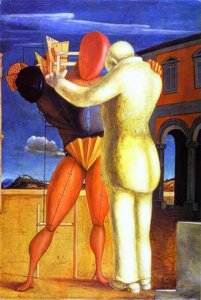
A Vision of Isolation: The Haunting Dreamscape of An Amazon
In the quiet, unsettling corridors of early twentieth-century modernism, few images possess the arresting power of Giorgio de Chirico’s "An Amazon." Completed in 1913, this masterpiece serves as a profound cornerstone of what would become known as Surrealist art, capturing a moment that feels suspended between reality and a fever dream. At first glance, the viewer is met with a striking tableau: a woman clad in a vibrant scarlet dress, perched atop a magnificent chestnut horse against the backdrop of a desolate, sun-scorched hillside. Yet, to look merely at the surface is to miss the profound existential weight de Chirico intended to convey. The painting is not simply a portrait of a rider; it is a meticulously crafted window into the human psyche, designed to provoke contemplation about solitude, strength, and the heavy silence of the unknown.
The subject matter draws deeply from the well of classical mythology, invoking the legendary Amazons—the fierce, independent warrior women of antiquity. By placing this mythic figure within such a stark, lonely landscape, de Chirimento injects a sense of heroic grandeur into an otherwise bleak setting. However, he deliberately avoids the trappings of romantic idealism. Instead of a triumphant conqueror, we see a woman whose gaze is directed inward, suggesting a state of deep introspection or perhaps a quiet resignation to her isolation. The horse, too, transcends its role as a mere beast of burden; it stands as a symbol of stability and groundedness amidst the turbulent, unseen emotions that haunt the composition.
The Architecture of a Dream: Technique and Spatial Distortion
De Chirico’s technical mastery lies in his ability to blend meticulous realism with a disorienting, dreamlike abstraction. He employs a precise hand to render the tactile details of the scene—the coarse texture of the horse’s mane, the heavy folds of the scarlet fabric, and the ruggedness of the rocky terrain. This level of detail creates a convincing illusion of reality that makes the subsequent distortions all the more unsettling. Through a technique reminiscent of Cubism but pushed toward a much more profound psychological depth, de Chirico manipulates perspective and scale to create an illogical space. The hillside does not follow the rules of conventional landscape painting; instead, it exists in muted, oppressive tones of ochre and brown, creating a sense of heavy, stagnant air.
This chromatic harmony—or perhaps disharmony—is central to the painting's emotional impact. The sudden, piercing brightness of the woman’s red dress acts as a focal point that vibrates against the desaturated earth tones, pulling the viewer’s eye into the center of this lonely drama. For collectors and interior designers, this piece offers a unique tension; it possesses the classical elegance required for sophisticated spaces, yet its avant-garde spirit provides a conversational edge that challenges the mundane. It is a work that does not merely decorate a wall but commands the atmosphere of a room, inviting guests to linger in its shadows and wonder about the stories hidden within its stillness.
A Legacy of Metaphysical Mystery
To understand "An Amazon," one must understand the era of Metaphysical Art that de Chirico pioneered. Influenced by the existential philosophies of Nietzsche and Schopenhauer, the artist sought to reveal the unsettling poetry hidden within the mundane. His work often features long, stretching shadows and empty spaces that evoke a sense of nostalgia and dread. In "An Amazon," this is achieved through the deliberate use of negative space and the isolation of the central figures. The presence of other distant figures in the periphery only serves to heighten the feeling of being alone in a vast, indifferent world.
For those seeking to bring a piece of art history into their personal collections, a high-quality reproduction of "An Amazon" offers more than just visual beauty; it offers an entry point into the subconscious. It is a painting for the thinker, the dreamer, and the aesthete—a timeless reminder that beneath the surface of our daily lives, there exists a deeper, more mysterious layer of reality waiting to be explored. Whether placed in a contemporary gallery setting or a classic study, this work continues to resonate with the same haunting, beautiful intensity it possessed over a century ago.
Pitanja i odgovori
Je li "An Amazon" u cjelini svjetlija ili tamnija?
Za djelo "An Amazon" autora Giorgio De Chirico zabilježena je svjetlina od deep_shadow, uz luminancu od Dark.
Koja je dominantna nijansa djela "An Amazon" autora Giorgio De Chirico?
"An Amazon" naginje prema Golden Yellow Range tonu.
Mogu li pregledati "An Amazon" autora Giorgio De Chirico prije narudžbe?
Pregled djela "An Amazon" autora Giorgio De Chirico dostupan je na stranici Pregled za to umjetničko djelo.
O kakvoj se vrsti umjetničkog djela radi kod "An Amazon" autora Giorgio De Chirico?
"An Amazon" autora Giorgio De Chirico klasificirano je kao WallArt. Ova kategorija opisuje vrstu umjetničkog djela kojem original pripada.
Je li "An Amazon" poznato djelo Surrealist Dreamscape pokreta?
"An Amazon" je zabilježeno kao Iconic među djelima Surrealist Dreamscape u katalogu.
Gdje mogu kupiti digitalnu sliku djela "An Amazon" autora Giorgio De Chirico?
Kako biste dobili digitalnu datoteku djela "An Amazon" autora Giorgio De Chirico, naručite preuzimanje digitalne slike visoke rezolucije na ova stranica.
Postoje li djela slična djelu "An Amazon"?
Djela slična djelu "An Amazon" navedena su na stranici Slična djela tog umjetničkog djela.
Koja je koloristička identiteta djela "An Amazon" autora Giorgio De Chirico?
Koloristički identitet djela "An Amazon" autora Giorgio De Chirico: paleta u nijansama Earthy, s dominantnom bojom Sap Green (#73643e).
Biografija umjetnika
Giorgio de Chirico (1888–1978): The Architect of Dreamlike Landscapes
Giorgio de Chirico, born in Volos, Greece, on July 10th, 1888, to Italian parents—a Genoese mother and a Sicilian father—was an artist whose life was inextricably linked with the intellectual currents of his time. From a young age, he demonstrated an exceptional talent for drawing and painting, nurtured by a formal education at Athens Polytechnic where he honed his skills in classical techniques. However, it was his relocation to Munich in 1906 that truly propelled him onto the artistic stage, immersing him in the vibrant atmosphere of German Symbolism and fostering connections with artists like Arnold Böcklin and Max Klinger—figures whose haunting landscapes and symbolic imagery profoundly shaped his aesthetic sensibilities. These encounters instilled within him a fascination for mythology and a preoccupation with exploring the hidden realities beneath the surface of perception.The Genesis of Metaphysical Art
Around 1909, de Chirico embarked on an unprecedented artistic endeavor: the creation of “Metaphysical” art—a style that defied conventional categorization and sought to capture the unsettling poetry residing within familiar spaces. Inspired by the philosophical writings of Friedrich Nietzsche, Arthur Schopenhauer, and Otto Weininger—who wrestled with questions of existentialism and the irrationality of human desire—he began to depict scenes populated by enigmatic figures and architectural elements rendered in jarring juxtapositions. His most iconic works, such as *The Vexations of the Thinker* and *The Enigma of an Autumn Afternoon*, exemplify this distinctive aesthetic: desolate cityscapes bathed in melancholic shadows, inhabited by mannequins and statues imbued with a palpable sense of loneliness—a visual language that resonated deeply with the anxieties of the era. This groundbreaking style quickly gained recognition within the artistic community, establishing him as a pioneer of Surrealism and influencing artists like René Magritte and Salvador Dalí.A Collaborative Spirit & Early Recognition
In 1919, de Chirico moved to Paris alongside his brother Alberto Savinio—a partnership that proved pivotal in shaping their artistic trajectory. Together, they founded the Scuola Metafisica, a collective dedicated to exploring the metaphysical principles of art and challenging established conventions. Their initial exhibitions at the Salon d’Autoumne and Salon des Indépendants garnered critical acclaim and cemented their connections with influential figures like Guillaume Apollinaire—who penned one of his earliest biographical texts—and Paul Guillaume—who secured him his first commercial contract. Notably, he befriended Mario Tozzi, Massimo Campigli, Alberto Magnelli and Gino Severini, all Italian artists who were operating in Paris during this period.Expanding Horizons & Embracing Surrealism
The Second World War interrupted de Chirico’s artistic pursuits but did not diminish his influence on the burgeoning Surrealist movement. He continued to paint prolifically, experimenting with diverse styles and subjects—from monumental sculptures inspired by classical mythology to intimate portraits reflecting a profound engagement with human psychology. His exploration of architectural spaces and enigmatic figures—recurring motifs in his oeuvre—became emblematic of Surrealism’s quest for dreamlike imagery and subconscious expression. Despite facing criticism from some quarters regarding the perceived decline in quality of his later works, de Chirico remained steadfast in his artistic convictions, revisiting themes from his formative years while maintaining a meticulous attention to craftsmanship and technical skill.Legacy & Enduring Influence
Giorgio de Chirico’s contribution to art history transcends stylistic innovation; it represents a fundamental rethinking of perception and representation—a challenge to the accepted norms of Western painting that continues to inspire artists today. His pioneering exploration of metaphysical principles paved the way for Surrealism, influencing generations of creatives who sought to capture the elusive realm of dreams and unconsciousness. Beyond his artistic achievements, de Chirico’s intellectual engagement with Nietzsche and Schopenhauer—and his unwavering commitment to humanist values—solidified his place as a visionary artist whose work embodies the spirit of an era marked by profound philosophical questioning and aesthetic experimentation. His paintings remain treasured artifacts of 20th-century art, inviting viewers to contemplate the mysteries of existence and the transformative power of imagination.
Giorgio De Chirico
1888 - 1978 , Грчка
Brzi pregled
- Artistic Movement Or Style: Metafizička umjetnost
- Artists Who Influenced This Artist:
- Arnold Böcklin
- Max Klinger
- Friedrich Nietzsche
- Date Of Birth: 10 srpnja 1888.
- Date Of Death: 20. studenoga 1978.
- Full Name: Giorgio de Chirico
- Nationality: Talijan
- Notable Artworks:
- The Vexations of the Thinker
- The Enigma of an Autumn Afternoon
- Place Of Birth: Volos, Grčka
Povezani članci

Oil on Canvas: A Historical & Technical Exploration of a Timeless Artistic Medium
Explore the rich history & enduring techniques of oil painting on canvas. Discover the science behind its longevity, conservation practices, and contemporary relevance. Expert insights for art enthusiasts.

The Enduring Legacy of Oil on Canvas: Technique, History & Aesthetic Impact
Explore the rich history & techniques of oil painting – from Renaissance masters to Impressionism. Discover pigments, layering methods, and why this timeless medium endures. Expert insights for artists & art enthusiasts.

Crimson Threads of Narrative: Exploring Symbolism & Representation in Artworks Featuring the Red Dress
Explore the rich symbolism of the red dress in art history! From ancient power displays to iconic portraits like Cézanne’s 'Madame Cezanne', discover the cultural and artistic significance behind this captivating color. Expert analysis & insights.
The Noble Steed on Canvas: A Historical & Artistic Exploration of Horse Painting Across Cultures
Explore the rich history of horse painting! Discover masterpieces from Stubbs to Munnings & learn about symbolism, techniques & artists. Find museum-quality reproductions at OriginalUniqueArt.

The Enduring Power of Painting: A Historical & Contemporary Exploration of Form and Emotion
Explore the rich history & enduring techniques of oil painting with OriginalUniqueArt. Discover masterpieces, learn about art collecting, and find authentic handmade reproductions crafted by skilled artists.