

 Pregledaj u stvarnoj veličini
 Podijeli
 Podijeli
 Detalji
 Vodič
Vodič

 Preuzmi datoteku
 Slični predmeti
 Rentgenska snimka
 Slide show
 Statistika
Red Blue Yellow


 Pročitajte više
Djelo prikazano na ovoj stranici zaštićeno je autorskim pravima, što znači da zakonski ne možemo izraditi niti prodati identičnu reprodukciju. Ova se zaštita provodi u skladu s međunarodnim sporazumima kao što su Bernska konvencija i nacionalnim zakonima, uključujući i one koji su utvrđeni u Američki zakon o autorskom pravu – Title 17.
Kao poštovana i legalna alternativa, nudimo prilagođena, ručno oslikana umjetnička djela inspirirana originalom. Naši vješti i profesionalni umjetnici pažljivo proučavaju stil, raspoloženje i umjetničku bit originala kako bi stvorili novo, jedinstveno djelo koje izaziva isti osjećaj – ostajući pritom vlastito, originalno stvaralaštvo.
Ova metoda u potpunosti je usklađena s autorskim pravima jer ne uključuje kopiranje ili dupliciranje zaštićenih umjetničkih djela. Umjesto toga, riječ je o kreativnoj reinterpretaciji – novoj slici koja je dobila utjecaj na izvornik, ali nije identična njemu.
Ručno rađena uljana reprodukcija
Ručno oslikano uljanim bojama na platnu u dimenzijama i okviru po vašem izboru, izrađeno po narudžbi od strane naših umjetnika. ( Prebacite na prodaju printova Prebacite na digitalnu prodaju slika)




P118B €10

P118H €10

P118W €10

P438Z €10

P508JH €12

P508YH €12

P805H €10

P805Z €10

P919BZ €10

P919G €10

P919XJ €10

P959ZH €10

P968JZ €12

W106C €8

W218G €10

W218JH €8

W218Y €10

W307PJ €10

W316G €10

W316PJ €8

W316Y €10

W398PJ €8

W4111J €10

W500HY €15

W500JH €15

W692G €12

W849H €8

W940BG €15

W953PJ €8




Odaberite jednu od naših unaprijed definiranih veličina koje odgovaraju izvornim proporcijama umjetničkog djela.

Unesite širinu i visinu koja vam je potrebna, kako bi odgovarali vašem okviru ili zidu. Budući da je ovo ručno oslikano djelo, umjetnik može malo proširiti rubove slike ili ih skratiti kako bi postigao željeni oblik — izbor je vaš. Prije početka slikanja poslat ćemo vam digitalni prikaz (mockup) radi potvrde. Slika prikazana na ovoj stranici ne predstavlja stvarni rezultat — samo digitalni prikaz to čini.
Nakon narudžbe, tim OriginalUniqueArt.com kontaktirat će klijenta putem e-pošte radi dobivanja uputa te dostaviti probni prikaz (mockup)
Isporuka širom svijeta () u roku od 3-4 tjedna umjesto standardnih 5 tjedana. (23 Listopad). Bez kompromisa u kvaliteti.

Besplatna ekspresna dostava širom svijeta

Visokokvalitetno laneno platno

Potpuno osiguranje transporta

Jamstvo povrata carine i uvoznih poreza

Jamstvo vjernosti boja

Politika povrata u roku od 100 dana (samo u slučaju nedostataka)

Jamstvo povrata 100% novca

Popust na više proizvoda
 Opcija stakla dostupna je samo za dimenzije manje od 110 cm

Red Blue Yellow
Tehnika izrade
Veličina reprodukcije
-


Ukupna cijena
€ 264
The Enigmatic Dance of Color: Gerhard Richter’s “Red Blue Yellow”
Gerhard Richter's "Red Blue Yellow," painted in 1972, isn’t merely a painting; it’s an immersion into the heart of abstract expressionism and a profound meditation on color itself. Born in Dresden amidst the tumultuous backdrop of post-war Germany, Richter’s early life instilled within him a sensitivity to uncertainty and a deep questioning of representation – qualities that would become central to his artistic exploration for decades to come. This work, created during a pivotal period of experimentation for the artist, embodies this spirit, moving beyond literal depiction towards an evocative realm where color and emotion coalesce. It’s a piece that invites prolonged contemplation, revealing new layers with each viewing.A Symphony of Brushstrokes: Composition and Technique
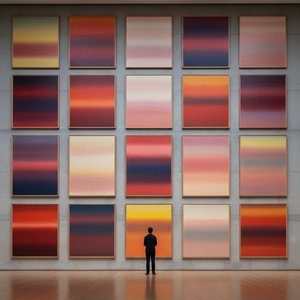
The immediate impact of “Red Blue Yellow” is one of dynamic complexity. Richter masterfully employs interconnected lines – not sharply defined outlines, but rather hazy, gestural strokes – to create a layered composition that feels both chaotic and meticulously controlled. These lines vary dramatically in thickness and direction, building depth and suggesting movement across the canvas. The painting isn’t about precise forms; instead, it's about the *process* of applying paint, the tangible evidence of Richter’s hand shaping color into an evocative space. Vibrant hues – a fiery red, a cool blue, a sunny yellow, punctuated by hints of orange and green – are applied with seemingly intuitive abandon, yet the overall effect is remarkably balanced. The artist's technique leans heavily on layering, allowing colors to bleed subtly into one another, creating a sense of atmospheric depth and blurring the boundaries between individual elements. It’s a testament to Richter’s ability to harness the inherent qualities of paint itself – its viscosity, its reflectivity, its capacity for both solidity and dissolution.Echoes of Neo-Figurative Art and Beyond
While firmly rooted in abstract expressionism, “Red Blue Yellow” also resonates with the emerging movement of Neo-Figurative art. This trend, which arose as a reaction against the purely subjective concerns of earlier abstraction, sought to reintroduce elements of recognizable form while retaining an underlying sense of ambiguity. Richter’s work occupies a fascinating space between these two approaches, refusing to commit fully to either. The painting subtly evokes memories – perhaps of landscapes glimpsed through a hazy recollection, or fragments of color associations—without ever resolving into concrete imagery. It's this deliberate refusal to provide easy answers that contributes to the piece’s enduring power and invites viewers to project their own experiences and emotions onto its surface. Richter was also deeply influenced by the work of artists like Malevich and Newman, whose explorations of pure color and non-representational forms paved the way for his own innovations.Decoding the Palette: Color as Emotion
Richter’s deliberate choice of colors is far from arbitrary. He wasn't simply interested in creating a visually pleasing arrangement; he was exploring the emotional resonance of each hue. Red, often associated with passion and energy, is tempered by the coolness of blue, suggesting introspection and contemplation. Yellow introduces a sense of optimism and warmth, while the subtle greens hint at growth and renewal. The interplay between these colors creates a dynamic tension—a visual dialogue that mirrors the complexities of human experience. Richter’s series of “inpaintings,” including "Red Blue Yellow," represents a significant shift in his artistic practice, moving away from representational painting towards an exploration of pure color and its expressive potential. It's a bold move that solidified his position as one of the most innovative artists of his generation.A Legacy of Innovation
“Red Blue Yellow” stands as a pivotal work in Gerhard Richter’s oeuvre—a testament to his willingness to challenge conventions, experiment with new techniques, and delve into the profound mysteries of color and perception. Its influence can be seen in subsequent generations of abstract artists, and its enduring appeal lies in its ability to evoke a wide range of emotions and interpretations. For those seeking a high-quality reproduction of this captivating masterpiece, OriginalUniqueArt offers meticulously crafted hand-painted reproductions that faithfully capture the essence of Richter’s vision. To learn more about Gerhard Richter's life and work, we encourage you to explore resources such as the Museum of Modern Art (MoMA) and WikiArt.org.Pitanja i odgovori
Koji umjetnički pravac obuhvaća "Red Blue Yellow" autora Gerhard Richter?
Umjetnički pravac povezan s djelom "Red Blue Yellow" autora Gerhard Richter je Abstract Expressionism. Ova klasifikacija smješta rad među povezane umjetnike i umjetnička djela.
Kakvu bojnu harmoniju prikazuje "Red Blue Yellow" autora Gerhard Richter?
"Red Blue Yellow" autora Gerhard Richter prikazuje Strong Color Unity kolorističku harmoniju.
Koje raspoloženje i emociju izražava "Red Blue Yellow" autora Gerhard Richter?
U djelu "Red Blue Yellow", Calm raspoloženje prati Reflective emocija.
Biografija umjetnika
A Life Shaped by Division: The Early Years and Artistic Formation of Gerhard Richter
Gerhard Richter’s story is inextricably linked to the fractured history of 20th-century Germany. Born in Dresden in 1932, his childhood unfolded under the shadow of a rising National Socialist regime. This formative period, marked by displacement – his family moved several times during the war years – instilled within him a profound sense of uncertainty and a questioning spirit that would permeate his artistic practice for decades to come. The idyllic landscapes of his early upbringing in Reichenau and Waltersdorf were soon disrupted by conflict, leaving an indelible mark on his psyche. His father, though not a fervent supporter of the Nazi party, navigated the complexities of life under authoritarian rule as a schoolteacher, while his mother fostered a love for literature and music within the family. This duality – a pragmatic acceptance of circumstance alongside a yearning for cultural expression – became a defining characteristic of Richter’s own artistic approach. He began formal training at the Dresden Academy of Fine Arts in 1951, initially immersed in the tradition of socialist realism demanded by the East German state. However, even within this constrained environment, a desire for artistic freedom simmered beneath the surface, fueled by growing dissatisfaction with ideological constraints and a longing to explore more expansive creative possibilities.Exploring Artistic Horizons: Düsseldorf and the Birth of Photorealism
The decisive turning point arrived in 1961 when Richter, alongside Marianne Eufinger, bravely abandoned East Germany for Düsseldorf – a city brimming with artistic energy and intellectual ferment. This relocation represented a radical departure from his formative years, liberating him from the confines of socialist dogma and propelling him toward groundbreaking experimentation. Düsseldorf became Richter’s crucible where he dismantled the stylistic conventions of socialist realism, embracing techniques that would reshape the landscape of contemporary art. He swiftly adopted photorealism, meticulously reproducing photographic images with astonishing precision—a method that interrogated the very nature of visual perception and challenged accepted notions of artistic representation. Simultaneously, Richter wrestled with abstraction, generating canvases layered with vibrant hues and dynamic brushstrokes—often utilizing a revolutionary squeegee technique to manipulate paint in unpredictable ways. This embrace of chance and spontaneity underscored his conviction that artistic innovation resided not merely in mastering technical skills but also in relinquishing control and welcoming unforeseen outcomes. His collaboration with Sigmar Polke yielded the provocative term ‘Capitalist Realism,’ encapsulating their shared skepticism toward established artistic norms and their appropriation of imagery from advertising and mass media—a conceptual gesture that continues to resonate today.The Language of Color and Texture: Expanding Artistic Vocabulary
Richter’s artistic vocabulary expanded throughout the 1960s and onward, encompassing a remarkable spectrum of methods and thematic concerns. His photorealistic paintings weren't simply reproductions; they were investigations into how we perceive reality—a process Richter dissected with meticulous detail while simultaneously questioning its veracity. He countered this approach by delving into abstraction, generating canvases infused with bold colors and expressive brushstrokes—often employing the squeegee technique to introduce an element of serendipity into his creative process. This method deliberately disrupted conventional artistic conventions, prioritizing spontaneity over calculated precision. Furthermore, Richter’s ‘Color Charts,’ systematic arrangements of colored squares, served as a conceptual challenge—a deliberate dismantling of traditional painting practices and a questioning of what constituted “painting” itself. These works weren't about stylistic preferences but rather about exploring the fundamental properties of color and its organizational potential—a testament to Richter’s unwavering commitment to artistic exploration.Influence and Legacy: Shaping Contemporary Art
Gerhard Richter’s influence on contemporary art is undeniable. His willingness to defy categorization, his relentless pursuit of innovation, and his profound engagement with historical and political themes have cemented his position as one of the most significant artists of our time—a figure who continues to inspire generations of creatives. He resisted easy stylistic definitions, prioritizing conceptual rigor alongside technical virtuosity—a combination that earned him widespread critical acclaim and commercial success. Richter’s art speaks to the anxieties and uncertainties inherent in modern existence—grappling with issues of memory, identity, and the elusive quest for meaning amidst fragmentation. His refusal to offer definitive answers prompted viewers to confront their own assumptions and engage in critical reflection—a characteristic that distinguishes his work from many others produced during his era. His legacy transcends mere artistic achievement; it resides in his unwavering conviction that art should provoke thought and challenge conventional perspectives. Richter’s enduring influence can be discerned in the oeuvre of countless artists who have adopted his experimental techniques and embraced his philosophical stance—a testament to his transformative contribution to the visual arts. Richter's impact extends far beyond the confines of his own artistic practice—he remains a pivotal voice in contemporary art, inspiring ongoing dialogue and fostering a deeper understanding of the complexities of our time.
Gerhard Richter
1932 - , Njemačka
Brzi pregled
- Artistic Movement Or Style:
- Fotorealizam
- Abstrakcija
- Artists Or Movements Influenced By This Artist: ['Sigmar Polke']
- Artists Who Influenced This Artist:
- Pablo Picasso
- Jean Arp
- Date Of Birth: 9. veljače 1932.
- Full Name: Gerhard Richter
- Nationality: Njemački
- Notable Artworks:
- Život u kvadratima
- Gilbert
- S. s Dijetevim
- Place Of Birth: Dresden, Njemačka
Povezani članci

Kandinsky's Masterpieces: 25 Paintings That Define Abstract Art | OriginalUniqueArt
Journey through Wassily Kandinsky's 25 most iconic abstract paintings. Explore his revolutionary use of color, form & spiritual expressionism. Find museum-quality Kandinsky reproductions and elevate your home decor with OriginalUniqueArt.com. Discover all masterpieces on OriginalUniqueArt.com!

Gerhard Richter: A Retrospective on Abstraction, Memory & the Photographic Source
Explore the profound world of Gerhard Richter's abstract paintings. Discover his techniques, influences, and lasting impact on contemporary art – a guide for discerning collectors.
Mark Rothko: 25 Remek-djela Apstraktne Ekspresije za Vaš Dom | OriginalUniqueArt
Istražite 25 najpoznatijih djela Marka Rothka, majstora apstraktne ekspresije. Otkrijte priče iza njegovih platna, bogatih bojama i emocijama. Reprodukcije vrhunske kvalitete dostupne na OriginalUniqueArt.com – inspiracija za vaš dom!

Slate Blue Masterpieces: 10 Iconic Paintings & Timeless Home Decor Ideas
Immerse yourself in the captivating world of slate blue! Explore 10 iconic paintings by Monet, Van Gogh & Renoir. Discover their stories, techniques & find museum-quality art reproductions for your home at .

Desetak Remek-djela koja su Definirala Apstraktni Ekspresionizam: Uljane Slike i Moderna Dekoracija
Otkrijte 10 remek-djela koja su definirala apstraktni ekspresionizam! Jackson Pollock, Mark Rothko i drugi majstori uljane umjetnosti. Ispričajte priču svojim zidovima uz OriginalUniqueArt - vrhunske reprodukcije za vaš dom.


