
 Pregledaj u realnoj veličini
 Pošalji
 Podijeli
 Detalji o umjetničkom djelu
 Vodič
Vodič

 Preuzmi umjetničko djelo
 Slični predmeti
 Rentgenska snimka
 Slide show
 Pitanja i odgovori
 Statistika
Glastonbury Abbey

- 124.0 x 146.0 cm

 Prikaži više
Preuzmite datoteku spremnu za tisak koja kvalitom daleko nadilazi web prikaz. Svaka digitalna slika koju prodajemo prosljeđuje se iz visokorezolucijske master datoteke iz naše baze — obično širine od 5.000 do 15.000 piksela — što vam omogućuje tisak velikih dimenzija, precizno izrezivanje ili sigurnu reprodukciju najfinijih detalja.
Nijedna datoteka ne napušta naš studio netaknuta. Digitalni stručnjak uspoređuje boje s izvornim slikama i po potrebi ih ispravlja, a zatim poboljšava jasnoću i detalje pomoću profesionalnih alata za retuširanje — uvijek ostajući vjerni umjetnikovim potezima četkice i stilu. Rezultat je prikaz koji izgleda kao prava slika, a ne kao sken s filtrima.
Odobravanje prije završetka: naš stručnjak šalje sliku e-poštom u roku od 72 sata na vaš pregled. Niste zadovoljni? Zatražite poboljšanja ili ispravke, ili tražite povrat novca ako kvaliteta ne ispunjava vaša očekivanja.
To je kvaliteta na koju se oslanjaju izdavači, dizajn studiji, galerije i tiskare.
Digitalna slika
Preuzmite datoteku visoke rezolucije za osobnu izložbu, tisak i kreativne projekte. ( Prebacite na printove Kupi ručno oslikano djelo)
Uključeno uz svaku narudžbu digitalne slike
Profesionalna digitalna dostava, zajamčena
Odabirom OriginalUniqueArt.com ne dobivate samo sliku – dobivate profesionalno unapređeno digitalno umjetničko djelo, izrađeno s najvećom preciznošću uz jamstvo zadovoljstva. Evo svega što automatski dolazi uz vašu narudžbu:

Brza dostava e-poštom
Vaša digitalna slika visoke rezolucije bit će vam poslana e-mailom u roku od 72 sata od trenutka narudžbe – spremna za neposrednu upotrebu.

Digitalna datoteka poboljšana umjetnom inteligencijom
Vaše umjetničko djelo profesionalno je optimizirano pomoću naprednih AI alata i ručnog uređivanja, čime se osigurava maksimalna razina detalja, oštrine i točnosti boja.

Besplatna doživotna ponovna dostava
Slučajno ste obrisali ili izgubili svoju datoteku? Ne brinite – ponovno ćemo vam je poslati u bilo kojem trenutku, potpuno besplatno.

Bez uvoznih pristojnika – ikada
Uživajte u svojim umjetničkim djelima trenutno, bez carina, pristojbi ili troškova dostave – digitalni downloadi uvijek su oslobođeni poreza.

Jamstvo točnosti boja
Uz pomoć profesionalnih alata i upravljanja bojama, osiguravamo da vaša digitalna slika što vjernije odražava izvorne boje.

Jamstvo zadovoljstva u trajanju od 100 dana
Ako niste zadovoljni svojom digitalnom slikom, revidirat ćemo je ili vratiti 100% iznosa u roku od 100 dana – bez suvišnih pitanja.

100% Jamstvo povrata novca
Niste zadovoljni? Osigurajte puni povrat novca u roku od 100 dana od primitka digitalne datoteke – bez suvišnih pitanja.

Popusti na velike narudžbe
Kupite 3 slike, uštedite 10% - Kupite 5 slika, uštedite 15% - Kupite 10+ slika, uštedite 20%. Odlično za kreativne projekte, galerije i agencije.
Artistic Significance
The scene captures the beauty of the old stone buildings as they stand in the midst of decay and disrepair. The sky above the abbey appears to be cloudy, adding an ominous atmosphere to the image. In the foreground, several people are walking around the ruins, likely admiring the historical site or exploring its remains. This adds a sense of life and interest to the otherwise solemn atmosphere of the abandoned abbey. Key Features of the painting include:- The use of oil on copper, which gives the piece a unique texture and depth.
- The attention to detail in the depiction of the abbey's architecture and the surrounding landscape.
- The sense of atmosphere and mood created by the cloudy sky and the presence of people in the scene.
Artist Background
George Arnald was a prolific artist known for his landscapes and historical scenes. His work can be found in various museums, including the Museum of Somerset, which features an impressive collection of artworks that reflect the rich cultural heritage of the region. For more information on the museum's collection, visit Discovering the Artworks of Museum of Somerset, United Kingdom. To learn more about George Arnald and his work, including Glastonbury Abbey, visit Painting by 'George Arnald' | George Arnald:Glastonbury Abbey on OriginalUniqueArt.com.For those interested in purchasing a handmade oil painting reproduction of Glastonbury Abbey, OriginalUniqueArt.com offers high-quality reproductions that capture the essence and beauty of the original piece.
Pitanja i odgovori
Kakvu paletu boja koristi "Glastonbury Abbey"?
Paleta djela "Glastonbury Abbey" autora George Arnald opisana je kao Earthy. To je sažet opis boja ovog umjetničkog djela.
Postoji li prezentacija u obliku slajdova za "Glastonbury Abbey" autora George Arnald?
Dostupna je i prezentacija slika na stranici Galerija slika za djelo "Glastonbury Abbey" autora George Arnald.
Kolika je luminancija djela "Glastonbury Abbey" autora George Arnald?
"Glastonbury Abbey" autora George Arnald ima luminancu od Soft Shadow. Luminancija opisuje koliko se čini da boje reflektiraju svjetlosti.
Biografija umjetnika
The Poetic Vision of George Arnald
In the grand tapestry of British Romanticism, where the dramatic skies of Turner and the pastoral sincerity of Constable often command the spotlight, the name George Arnald (1763–1841) whispers of a more intimate, yet equally profound, connection to the landscape. A painter of remarkable sensitivity, Arnald possessed the rare ability to transform topographical accuracy into emotive storytelling. His journey from the humble beginnings of a domestic servant to an established figure within the Royal Academy is a testament to a raw, burgeoning talent that sought to capture not just the physical contours of the earth, but the very spirit of the places he depicted.
Though the precise details of his early years remain shrouded in the mists of history—with accounts placing his birth anywhere from Northamptonshire to Berkshire—his artistic evolution was shaped by the rigorous guidance of William Pether. Under Pether’s tutelage, Arnald mastered the art of the landscape and engraving, learning to balance meticulous observation with a poetic sensibility. This training allowed him to contribute significantly to the illustrated county histories of his era, providing topographical views that were as much about atmosphere as they were about geography.
A Legacy of Light and History
Arnald’s oeuvre is characterized by a remarkable versatility, ranging from the quiet, sun-drenched ruins of Scotland to the thunderous, salt-sprayed chaos of naval warfare. His work often reflects a deep engagement with the Romantic ideal—the belief that art should stir the soul through the sublime and the beautiful. One might find himself lost in the serene sunset of Ruins of Rosslyn Castle, where the decay of stone meets the eternal glow of twilight, or transported to the rugged Yorkshire countryside in his depiction of Loading a Timber Wagon in the Park of Cave Castle, where dramatic skies hint at the untamed power of nature.
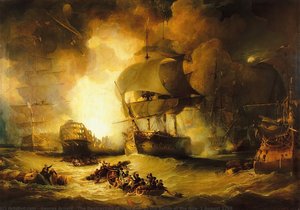
However, it was perhaps his departure from the purely pastoral that secured his place in the annals of maritime history. His most celebrated and monumental achievement, The Destruction of L'Orient at the Battle of the Nile, stands as a breathtaking masterwork of historical drama. Commissioned as part of a prestigious competition for the Greenwich Hospital, this painting captures the catastrophic moment of a naval titan’s demise. In this work, Arnald transcends mere documentation, utilizing light and shadow to evoke the terror and heroism inherent in Britain's maritime triumphs.
The Critic's Eye and Artistic Standing
Despite his prolific output—exhibiting an astounding 176 works at the Royal Academy throughout his career—Arnald’s ascent was marked by a certain bittersweet complexity. While he achieved the status of an Associate Member of the Royal Academy in 1810, he never reached the pinnacle of full fellowship. This lack of ultimate institutional acclaim famously drew the poignant commentary of the poet William Wordsworth. Wordsworth, reflecting on the Romantic necessity of intellectual depth, lamented that Arnald’s genius might have been even more profound had it been paired with a stronger literary foundation, suggesting that a true mastery of landscape requires a "tincture of the Poetic Spirit."
Yet, to judge Arnald solely through the lens of institutional rank is to miss the enduring magic of his brushwork. His significance lies in his ability to bridge the gap between the precise topographical record and the emotive power of the Romantic movement. Through his eyes, we see a Britain defined by both its historical struggles and its quiet, pastoral grace, ensuring that his contribution to the British artistic canon remains as vital and evocative as the landscapes he so lovingly rendered.
George Arnald
1763 - 1841
Kratki pregled
- Artistic Movement Or Style: Romantic Landscape
- Artists Or Movements Influenced By This Artist: ['Thomas Davidson']
- Artists Who Influenced This Artist: ['William Pether']
- Date Of Birth: 1763
- Date Of Death: 1841
- Full Name: George Arnald
- Nationality: British
- Notable Artworks: ['Battle of the Nile']
- Place Of Birth: Northamptonshire (Bedfordshire)