Prebacite na printove
 Prikaži više







































 Za umjetnička djela ili reprodukcije veće od 105 cm (približno 41 inč) na bilo kojoj strani, okvir će biti isporučen u obliku rastavljenog seta za montažu. Ovaj način osigurava sigurnu dostavu i sprječava oštećenja tijekom transporta.


The Composition of Honfleur
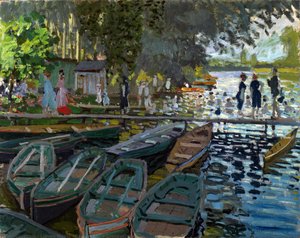
The canvas presents a view of a maritime harbor in Normandy, centered on the movement of several sailing boats upon the water. Near the foreground and along the pier, various figures are positioned, some attending to vessels and others moving along the wooden structure. The water of Étretat Bay occupies much of the lower composition, reflecting shades of blue and green. These colors are interrupted by patches of ochre and lemon yellow that mark the hulls of the boats and the clothing of the people on the shore. The boats themselves vary in scale; some appear close to the viewer near the pier, while others are smaller, situated further out toward the horizon. The sky and water meet in a way that suggests a heavy, moisture-laden atmosphere.
The application of paint relies on impasto, where thick layers of pigment create a physical texture on the surface. This technique allows the light to catch the ridges of the brushstrokes, simulating the way sunlight hits the undulating surface of the bay. Through color modulation, the artist blends different hues to suggest depth and the hazy quality of the air. The strokes are visible and rapid, particularly where the water meets the boats, capturing the immediate visual impression of the scene rather than fine, sharp outlines.
Context and Observation
Painted in 1866, this work emerged from the practice of plein air painting, a method of working outdoors to record shifting light. This approach was learned through the influence of Eugène Boudin, who encouraged observing nature directly. The scene reflects the scientific interest in optics and color perception prevalent during this period. By placing unmixed colors side-by-side, the eye is forced to blend the pigments from a distance, creating an illusion of luminosity.
The subject matter carries specific weight through its depiction of the natural and human elements. The stillness of the bay provides a sense of quietude, while the presence of the boats and people introduces a layer of maritime activity. The interaction between the light on the water and the solid forms of the masts creates a tension between the permanent structures of the harbor and the fleeting, changing qualities of the daylight. This focus on the transient moment defines the technical approach used to render the Normandy coast.
Pitanja i odgovori
Koja je osnovna nijansa koja prožima "Sailing Boats at Honfleur" autora Claude Monet?
"Sailing Boats at Honfleur" naginje prema Green to Violet Spectrum tonu.
U kojem je razdoblju nastalo "Sailing Boats at Honfleur" autora Claude Monet?
"Sailing Boats at Honfleur" pripada razdoblju 19th Century.
Gdje se "Sailing Boats at Honfleur" smješta unutar opsega djela umjetnika Claude Monet?
"Sailing Boats at Honfleur" pripada djelu Claude Monet iz pokreta Impressionism, čije su zabilježene teme uključivale light & atmosphere, coastal normandy views, impressionist technique, nature observation, monet’s legacy.
 Pregledaj u realnoj veličini
 Pošalji
 Podijeli
 Detalji o umjetničkom djelu
 Vodič
Vodič

 Preuzmi umjetničko djelo
 Slični predmeti
 Rentgenska snimka
 Slide show
 Pitanja i odgovori
 Statistika