
() ·
A print made for you, with care
Giclée / Umjetnički otisak
Giclée tisak muzejske kvalitete ili otisak na platnu uz brzu izradu i raznolike opcije završne obrade. ( Kupi ručno oslikano djelo Prebacite na digitalnu sliku)
Biografija umjetnika
Dutch painter Gerard Sanders specialized in portraits and landscapes like Archibald Hope the Elder. Discover his exquisite fine art collection.
 Prikaži više
od ·
Poglavlje 1
On which medium should it be printed?
Canvas is printed with giclée inks and can be stretched or framed like a painting; paper comes flat, or framed behind glass.
Poglavlje 2
Koje bi dimenzije trebalo imati?
Povucite kako biste promijenili dimenziju; slika s lijeve strane prikazuje okvir u njegovoj stvarnoj širini. Zadržane su proporcije originala.
Odaberite jednu od naših unaprijed definiranih veličina koje odgovaraju izvornim proporcijama umjetničkog djela.

Unesite potrebnu širinu i visinu kako bi odgovarali vašem okviru ili zidu. Print se može samo izrezati, nikada ne može biti veći od slike, stoga format s drugačijim omjerom stranica uzrokuje gubitak dijela slike. Prije bilo kakve štampe šaljemo vam digitalni prikaz (mockup) na odobrenje. Slika prikazana na ovoj stranici ne prikazuje stvarni rez — to prikazuje isključivo digitalni prikaz.
Poglavlje 3
U kakvom bi stanju trebalo stići?
Odaberite rubove platna
Odaberite svoj okvir

Bijela rubna traka €1

Zamućeni rubovi €1

Prošireno €1

P118B €10

P118H €10

P118W €10

P438Z €10

P508JH €12

P508YH €12

P805H €10

P805Z €10

P919BZ €10

P919G €10

P919XJ €10

P959ZH €10

P968JZ €12

W106C €8

W218G €10

W218JH €8

W218Y €10

W307PJ €10

W316G €10

W316PJ €8

W316Y €10

W398PJ €8

W4111J €10

W500HY €15

W500JH €15

W692G €12

W849H €8

W940BG €15

W953PJ €8

H24-GOLD €30

H24-SILVER €30

H36-GOLD €45

H36-SILVER €45
Uokvireno
Profil: . Ukupna veličina s okvirom: .
Poglavlje 4
Dostava širom svijeta () u roku od 2 tjedna umjesto standardnih 4/5 tjedana. (22 Studeni)
Završni dodir
Pločica s natpisom, kao u muzeju?
Detalji gravirane brončane pločice
This elegant plaque features the artist's name and the title of the artwork, finely engraved for a timeless presentation.
It is made from bronze with a refined, elegant finish. The text is precisely laser-engraved for a sharp and permanent result. Measuring 9x2 cm, the plaque is compact yet easy to read. It's built to be durable and scratch-resistant, offering a professional, museum-quality look. Mounting is simple thanks to the included adhesive backing.
Detalji prozirne akrilne pločice
The plaque includes essential engraved details such as the artist's name, the title of the artwork, the date it was created, the type of media used-like oil on canvas or watercolor-a brief description of the piece, and a QR code that links to the complete artwork information.
It is crafted from clear acrylic, offering a sleek, modern appearance. The text is UV-engraved in black to ensure strong visual contrast. With a size of 10x15 cm, it ensures optimal readability. It comes equipped with two metal hooks for secure wall mounting. The plaque is designed to be weather-resistant, making it suitable for various environments, and it includes interactive features that work seamlessly with smartphone scanning.
Detalji crne akrilne pločice
This elegant plaque includes engraved information such as the artist's name, the title of the artwork, the date it was created, the type of media used (like oil on canvas or watercolor), a short description of the artwork, and a QR code for quick access to more information.
The plaque itself is made from refined black acrylic with a premium finish. The text is laser-engraved in white for high contrast and readability. Its size is 10x15 cm, designed to be easy to read. It comes with two metal hooks for professional mounting. The design is sleek and fits any interior style. It is also weather-resistant and durable, with built-in digital integration for mobile compatibility.
Zaštitni lak?
Kada vam je potrebno?
Poglavlje 5
Your print, as you ordered it

Amorous Couple
Tehnika reprodukcije
Veličina reprodukcije
-

Okvir za reprodukciju
-
-
Za umjetnička djela ili reprodukcije veće od 105 cm (približno 41 inč) na bilo kojoj strani, okvir će biti isporučen u obliku rastavljenog seta za montažu. Ovaj način osigurava sigurnu dostavu i sprječava oštećenja tijekom transporta.
Potrebna je profesionalna montaža – ovo nije proizvod za samostalnu izradu.
Set mora sastaviti i platno zategnuti iskusni profesionalni uokvirivač, koristeći drvno ljepilo (nije uključeno u set), kljeste za zatezanje platna i stege kako bi se održao pravilan kut letvica dok se ljepilo suši. Nepravilna montaža ili neravnomjerno zategnuto platno mogu trajno oštetiti umjetničko djelo, a takva oštećenja nisu pokrivena našim jamstvom.
 Za umjetnička djela ili reprodukcije veće od 105 cm (približno 41 inč) na bilo kojoj strani, okvir će biti isporučen u obliku rastavljenog seta za montažu. Ovaj način osigurava sigurnu dostavu i sprječava oštećenja tijekom transporta.
Sve letvice od punog drveta su uključene, precizno izrezane po mjeri.
Montira se pomoću priloženih vijaka, uz dodatak ljepila za drvo za spojeve u kutovima, koje nije uključeno u set i koje vaš okviraš mora vlastito nabaviti.
Potrebni su profesionalni alati koji nisu uključeni: škripc za zatezanje platna (zatezač) i stezaljke za održavanje pravokonačnosti letvica tijekom sušenja ljepila.
Važno:
Za spojeve u kutovima potrebno je ljepilo za drvo, letvice se moraju pričvrstiti stezgama dok se ljepilo potpuno ne osuši, a za zatezanje platna na sastavljenom okviru potreban je alat za zatezanje platna. Nijedan od ovih alata nije uključen u set. Molimo vas da prije narudžbe ove veličine osigurate uslugu iskusnog profesionalnog uokvirivača.

Natpisna pločica
-
-

Zaštitni lak
Sjajni lak (pojačava intenzitet boja, štiti od svjetlosti i vlage)
-

Hitna dostava
Dostava širom svijeta () u roku od 2 tjedna umjesto standardnih 4-5 tjedana. (22 Studeni)
-
Brza dostava
Dostava širom svijeta () u roku od 4-5 tjedana. (29 Studeni).
Uključeno u cijenu
Ukupna cijena
€ 72
Opcija stakla dostupna je samo za dimenzije manje od 110 cm
Uključeno uz svaku narudžbu
- Besplatna ekspresna dostava širom svijeta
- Visokokvalitetno laneno platno
- Potpuno osiguranje dostave
- Jamstvo povrata carine i uvoznih poreza
- Jamstvo vjernosti boja
- Politika povrata u roku od 100 dana (samo u slučaju nedostataka)
- Jamstvo povrata 100% novca
- Popust na više proizvoda


 Pregledaj u realnoj veličini

 Pošalji
 Podijeli
 Detalji o umjetničkom djelu
 Vodič


 Preuzmi umjetničko djelo
 Slični predmeti
 Rentgenska snimka
 Slide show
 Pitanja i odgovori
 Statistika
U brojkama
- 1752godina nastanka
- 29okviri koji možete odabrati
- standardne dimenzije, u vlastitim proporcijama
- 5tjedana za slikanje i dostavu
O izvornom djelu

- 41.0 x 36.0cm


Ovo djelo je zaštićeno autorskim pravima
Djelo prikazano na ovoj stranici zaštićeno je autorskim pravima, što znači da zakonski ne možemo izraditi niti prodati identičnu reprodukciju. Ova se zaštita provodi u skladu s međunarodnim sporazumima kao što su Bernska konvencija i nacionalnim zakonima, uključujući i one koji su utvrđeni u Američki zakon o autorskom pravu – Title 17.
Kao poštovana i legalna alternativa, nudimo prilagođena, ručno oslikana umjetnička djela inspirirana originalom. Naši vješti i profesionalni umjetnici pažljivo proučavaju stil, raspoloženje i umjetničku bit originala kako bi stvorili novo, jedinstveno djelo koje izaziva isti osjećaj – ostajući pritom vlastito, originalno stvaralaštvo.
Ova metoda u potpunosti je usklađena s autorskim pravima jer ne uključuje kopiranje ili dupliciranje zaštićenih umjetničkih djela. Umjesto toga, riječ je o kreativnoj reinterpretaciji – novoj slici koja je dobila utjecaj na izvornik, ali nije identična njemu.

Gerard Sanders
1702 - 1767
Brzi pregled o Gerard Sanders
- Artists Who Influenced This Artist:
- Tobias van Nijmegen
- Elias van Nijmegen
- Full Name: Gerard Sanders
- Nationality: Dutch
- Notable Artworks:
- Archibald Hope the Elder
- Amorous Couple
- Portrait of Johannes Wilhelmus Bussingh
- Portrait of Elisabeth van der Linden
- Place Of Birth: Wesel am Rhein, Germany
- Date Of Birth: 1702
- Date Of Death: 1767
Biografija umjetnika
Early Life, Family and Training
Born in 1702 in Wesel am Rhein, Germany, Gerard Sanders entered a world of visual craft through the intimate ties of family. His early years were shaped by a significant transition when his mother remarried Tobias van Nijmegen. This change in family structure provided the young artist with his first formal introduction to the arts, as he became a pupil of his stepfather. Under Tobias's guidance, Sanders began to develop the foundational skills of a painter and draughtsman, learning the nuances of composition and form within a domestic apprenticeship.
The trajectory of his education shifted when he reached the age of eighteen. Seeking to broaden his technical horizons, he moved to Rotterdam to study under Elias van Nijmegen. This period of study was essential in refining his ability to navigate both portraiture and landscape, preparing him for a career that would eventually see him decorating the interiors of the social elite. Throughout his life, he was occasionally known by the alias Gerhard Sanders, a variation that reflects the shifting linguistic borders of his era.
Patrons, Workshop and Commissions
Sanders’s professional life was defined by his ability to navigate the social hierarchies of the eighteenth century, moving between the private splendor of aristocratic homes and the public dignity of civic institutions. His early training under his stepfather, Tobias van Nijmegen, provided a foundation in the art of decoration, a skill that would lead him to decorate the interiors of the elite. This expertise in large-scale decorative schemes allowed him to secure significant placements, including work for the Elector Palatinate in Düsseldorf. Such commissions required a versatility that bridged the gap between fine art and the functional requirements of interior design.
His reputation for handling both private and public spaces is evident in the varied nature of his patronage. He was entrusted with the decoration of the house of Isaac Hope, a commission that placed his work within the intimate, domestic settings of the wealthy. This ability to cater to the specific tastes of prominent families ensured a steady presence in the high-society circles of the era. His work was not confined to the private sphere, however; he also engaged with the civic identity of the Netherlands. In 1764, he was commissioned to paint several scenes of civic virtues for the Town Hall of Middelburg, a task that required a shift from the personal nuances of portraiture to the formal demands of public morality.
Key Works and Artistic Subjects
Sanders focused his creative energy on the formal demands of portraiture, history subjects, and landscapes. His ability to navigate these diverse genres allowed him to move between the intimate scale of a private study and the grander requirements of civic decoration. In 1730, he produced a portrait historiée of a mother with her children, a work that suggests an interest in the allegorical or narrative potential of the human figure. This interest in character and status is further evidenced by his 1737 portrait of Archibald Hope the Elder, a piece that captures the dignity of its subject within the social hierarchies of the era.
As his career progressed, his output continued to reflect the tastes of the Dutch elite. He turned his attention to the likenesses of prominent individuals, including a portrait of Johannes Wilhelmus Bussingh (1727-1782) and a portrait of Elisabeth van der Linden (1735-1783), both dating to about 1760. These works demonstrate a steady hand in capturing the specificities of his sitters. Beyond the human form, he also engaged with the natural world, as seen in his 1763 watercolor over graphite, Fleurs et châtaignes sur un entablement.
- Portrait historiée of a mother with her children (1730)
- Portrait of Archibald Hope the Elder (1737)
- Portrait of Johannes Wilhelmus Bussingh (1727-1782) (about 1760)
- Portrait of Elisabeth van der Linden (1735-1783) (about 1760)
- Fleurs et châtaignes sur un entablement (1763)
Technique and Style
Sanders operated with the versatility required of a professional working in the Dutch tradition, moving fluidly between the roles of painter, draughtsman, and decorator. His training under his stepfather and later in Rotterdam provided him with a technical foundation that allowed him to navigate diverse commissions. Whether he was executing large-scale decorations for the interiors of the elite or working on more intimate studies, his hand remained steady and purposeful. He was as comfortable as a schilder handling canvas as he was a tekenaar capturing the essential lines of a subject.
In his more delicate works, Sanders demonstrated the precision of an aquarellist. He frequently employed watercolor over graphite on laid paper, a method that allowed for a controlled yet expressive application of color. This technique was particularly suited to his botanical studies and his ability to render the subtle textures of still life. The use of graphite provided a structural clarity to his compositions, ensuring that even his most light-handed washes of color maintained a sense of formal order.
His stylistic range was dictated by the demands of his environment. As a decorator, his work had to harmonize with the architectural spaces of the wealthy, requiring a sense of scale and decorative rhythm. In his portraiture and history subjects, he focused on the clarity of form and the character of his sitters. This adaptability—the ability to shift from the broad requirements of interior decoration to the fine, meticulous detail of a watercolor on paper—defined his professional practice.
Srodni članci
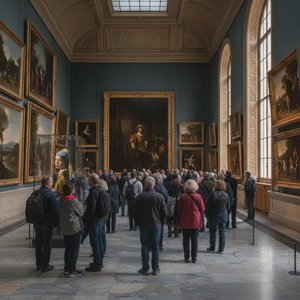
Masterpieces of the Dutch Soul: Top 25 Must-See Artworks in Amsterdam's Rijksmuseum
Embark on a journey through the Dutch Golden Age. From Rembrandt's drama to Vermeer's light, explore 25 iconic Rijksmuseum masterpieces and find museum-quality art reproductions for your decor. Discover all masterpieces on OriginalUniqueArt.com.

Masterpieces Unveiled: The Top 25 Artworks at the J. Paul Getty Museum
Explore 25 iconic masterpieces from the J. Paul Getty Museum. From Renaissance to Baroque, discover the legends on OriginalUniqueArt.com.