

 Pregledaj u stvarnoj veličini
 Podijeli
 Podijeli
 Detalji
 Vodič
Vodič

 Preuzmi datoteku
 Slični predmeti
 Rentgenska snimka
 Slide show
 Statistika
Autumn Flowers


 Pročitajte više
Giclée / Umjetnički otisak
Giclée tisak muzejske kvalitete ili otisak na platnu uz brzu proizvodnju i fleksibilne opcije završne obrade. ( Naručite ručno oslikano reprodukciju Prebacite na digitalnu prodaju slika)




P118B €10

P118H €10

P118W €10

P438Z €10

P508JH €12

P508YH €12

P805H €10

P805Z €10

P919BZ €10

P919G €10

P919XJ €10

P959ZH €10

P968JZ €12

W106C €8

W218G €10

W218JH €8

W218Y €10

W307PJ €10

W316G €10

W316PJ €8

W316Y €10

W398PJ €8

W4111J €10

W500HY €15

W500JH €15

W692G €12

W849H €8

W940BG €15

W953PJ €8




Odaberite jednu od naših unaprijed definiranih veličina koje odgovaraju izvornim proporcijama umjetničkog djela.

Možete unijeti vlastite dimenzije kako biste umjetničko djelo prilagodili specifičnom okviru ili prostoru. Ako odabrana veličina ne odgovara proporcijama izvornog rada, izrezat ćemo dio slike ili je proširiti pomoću ogledalnog efekta ili jednobojne rubne površine. Digitalni prikaz (mockup) bit će vam poslan na odobrenje prije početka proizvodnje.
Imajte na umu da pregled na zaslonu ne odražava stvarno izrezivanje ili proširivanje. Samo će mockup točno prikazati konačnu kompoziciju.
Iako su dostupne prilagođene veličine, preporučujemo odabir dimenzije iz unaprijed definirane liste kako biste očuvali izvorne proporcije.
Dostava širom svijeta () u roku od 2 tjedna umjesto standardnih 4/5 tjedana. (3 Listopad)

Besplatna ekspresna dostava širom svijeta

Visokokvalitetno laneno platno

Potpuno osiguranje transporta

Jamstvo povrata carine i uvoznih poreza

Jamstvo vjernosti boja

Politika povrata u roku od 100 dana (samo u slučaju nedostataka)

Jamstvo povrata 100% novca

Popust na više proizvoda
 Opcija stakla dostupna je samo za dimenzije manje od 110 cm

Autumn Flowers
Giclée / Umjetnički otisak
Veličina reprodukcije
-


Ukupna cijena
€ 69
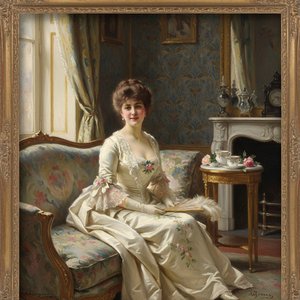
A Portrait of a Moment: The Enigmatic Beauty of *Autumn Flowers*
Alfred Stevens’s *Autumn Flowers*, painted in 1867, isn't merely a depiction of a woman amidst flowers; it’s an exquisitely crafted meditation on stillness, light, and the subtle poetry of everyday life. At first glance, the painting presents a seemingly simple arrangement: a seated lady, her posture suggesting quiet contemplation, surrounded by a still-life tableau of fabrics, blossoms, and a delicately rendered table. Yet, beneath this surface lies a profound exploration of form, color, and the very essence of observation – a hallmark of Stevens’s unique artistic vision.
Stevens, a pivotal figure in 19th-century Belgian art, deliberately eschewed the prevailing trends of his time. Rejecting the fleeting effects of Impressionism's vibrant light and atmosphere, he instead focused on capturing an immutable quality – the frozen gesture, the fixed expression, the enduring presence of the subject. This deliberate choice is powerfully evident in *Autumn Flowers*. The woman’s hand, poised as if about to touch a flower, isn’t caught in motion; it's suspended, imbued with a sense of timelessness. Her gaze, directed slightly off-canvas, invites us into her private world, suggesting an inner life beyond the immediate scene.
The Language of Color and Texture: Stevens’s Masterful Technique
What immediately draws the eye is Stevens's extraordinary command of color and texture. He employs a remarkably restrained palette – primarily shades of grey, black, and muted browns – punctuated by flashes of pastel pink, chestnut brown, and the glossy sheen of the table cover. This deliberate limitation isn’t a sign of restraint but rather a strategic choice to emphasize form and light. The artist masterfully utilizes chiaroscuro, creating dramatic contrasts between light and shadow that sculpt the figures and objects with remarkable precision. Notice how the highlights on the woman's chignon and the delicate folds of her dress draw our attention while simultaneously deepening the shadows around her face, lending a sense of mystery and depth.
Stevens’s technique is equally noteworthy for its meticulous detail. He employs a smooth, almost polished surface – reminiscent of 17th-century Dutch masters like Rembrandt and Vermeer – achieved through careful layering of paint and the use of a knife to blend colors seamlessly. This creates an illusion of tactile reality, inviting us to reach out and touch the fabrics, feel the texture of the flowers, and appreciate the subtle variations in color and tone. The artist’s attention to detail extends beyond mere representation; it's a deliberate attempt to capture the *essence* of each element within the composition.
Symbolism and the Portrait of Modernity
Beyond its technical brilliance, *Autumn Flowers* is rich in symbolic meaning. The woman herself represents a type of modern femininity – poised, elegant, and seemingly detached from the bustle of Parisian life. Her attire, with its jet frills and flounces, speaks to the fashionable trends of the era while simultaneously conveying a sense of quiet dignity. The surrounding still-life elements—the fabrics, flowers, and table—are not merely decorative; they function as a carefully constructed visual language, hinting at themes of luxury, domesticity, and the fleeting beauty of life.
Stevens’s comparison to Gustave Vanzype – that the painting is a still life composed of the fabrics in which she is dressed and the things around her – reveals a deeper intention. He wasn't simply depicting a woman; he was creating a miniature world, a carefully orchestrated tableau that captures a specific moment in time and reflects the values and aesthetics of his era. The reference to Whistler’s ambition to “use colours to compete with the musician who uses sounds” underscores Stevens’s own desire to elevate color from mere decoration to an expressive element within the painting.
A Legacy of Stillness: Stevens's Enduring Appeal
*Autumn Flowers* stands as a testament to Alfred Stevens’s singular artistic vision. It is a painting that rewards careful observation, inviting us to linger and contemplate its subtle nuances. Its enduring appeal lies not in dramatic gestures or fleeting effects but in its quiet beauty, its masterful technique, and its profound exploration of the human condition. Reproductions of this captivating work offer a window into a bygone era, capturing the elegance and sophistication of 19th-century Parisian life while simultaneously reminding us of the timeless power of stillness and observation.
Pitanja i odgovori
Mogu li vidjeti "Autumn Flowers" autora Alfred Stevens na svom zidu prije kupnje?
Djelo "Autumn Flowers" ima pregled proširene stvarnosti: stranica AR pregled djela prikazuje ga u vašem vlastitom prostoru pomoću kompatibilnog uređaja.
Koliko je godina imao/la Alfred Stevens kada je stvarao/la "Autumn Flowers" u 1867. godini?
Alfred Stevens je imao/la 44 godina u trenutku stvaranja djela "Autumn Flowers" u 1867 godini. Dob je izračunata na temelju godine umjetnikovog rođenja, 1823.
Kako "Autumn Flowers" uspostavlja ravnotežu između svjetla i tame?
Za djelo "Autumn Flowers" autora Alfred Stevens zabilježena je svjetlina od deep_shadow, uz luminancu od Dark.
Tko je umjetnik koji stoji iza djela "Autumn Flowers"?
Autor djela "Autumn Flowers" je Alfred Stevens. Rad je katalogiziran pod imenom Alfred Stevens.
U kojoj je godini nastalo djelo "Autumn Flowers" autora Alfred Stevens?
"Autumn Flowers" autora Alfred Stevens nastalo je 1867.
Je li "Autumn Flowers" autora Alfred Stevens portret, pejzaž ili kvadratna kompozicija?
"Autumn Flowers" autora Alfred Stevens je kompozicija u Portrait formatu. Razmjer je vrijedno provjeriti prije odabira veličine printa.
Postoje li djela slična djelu "Autumn Flowers"?
Djela slična djelu "Autumn Flowers" navedena su na stranici Slična djela tog umjetničkog djela.
Biografija umjetnika
ranije godine i edukacija
Alfred Émile Léopold Stevens, čuveni belgijski slikar, rođen je 11. svibnja 1823. godine u Bruxellesu. Njegova obitelj bila je duboko ukorijenjena u svijetu vizualnih umjetnosti; njegov stariji brat Joseph (1816–1892) i sin Léopold (1866–1935) bili su slikari, dok je još jedan brat, Arthur (1825–99), bio trgovac umjetninama i kritičar.umjetnička karijera
Stevens je svoje umjetničko putovanje započeo na Kraljevskoj akademiji likovnih umjetnosti u Bruxellesu, gdje je studirao pod vodstvom Françoisa Navez, neoklasicističkog slikara. Godine 1843. preselio se u Pariz kako bi se pridružio svom bratu Josephu te je primljen na École des Beaux-Arts. Iako je predmet rasprava pitanje je postao li on učenik Jean Auguste Dominique Ingresa, Stevensova rana djela, poput platna Oproštaj ili apsolucija (Hermitage, Sankt Peterburg), potpisanog i datiranog 1849. godine, pokazuju njegovo majstorstvo u konvencionalnom naturalističkom stilu, snažno pod utjecajem holandskog žanrovskog slikarstva 17. stoljeća.uspon prema slavi
Stevensova djela prvi su javno izložena 1851. godine na salonu u Bruxellesu, što mu je donijelo medalju treće klase na pariškom salonu 1853. godine te medalju druge klase na Univerzalnoj izložbi u Parizu 1855. Njegova slika Ce qu'on appelle le vagabondage (Musée d'Orsay, Pariz) privukla je pažnju Napoleona III., što je dovelo do značajne promjene u načinu tretiranja siromašnih.značajna djela i naslijeđe
- La Dame en Rose ili Žena u ružičastom (Kraljevski muzeji likovnih umjetnosti u Belgiji, Bruxelles), naslikana 1866. godine, predstavlja vrhunac Stevensova rada u tom razdoblju, spajajući elegantno odjevenu ženu s detaljnim istraživanjem japanskih predmeta.
- Stevens je 1863. godine od francuske vlade primio orden Legije časti (Chevalier), a 1867. godine je unapređen u čin oficira Legije časti.

Alfred Stevens
1823 - 1906 , Belgija
Brzi pregled
- Artistic Movement Or Style: Akademski realizam
- Artists Who Influenced This Artist:
- Jean Auguste Dominique Ingres
- Dutch Masters
- Date Of Birth: 11. svibnja 1823.
- Date Of Death: 1906.
- Full Name: Alfred Émile Léopold Stevens
- Nationality: Belgijski
- Notable Artworks:
- La Dame en Rose
- Posjet studiju
- Pripremna crtež za 'Panorama du siècle', 'L'Impératrice Joséphine et sa Cour'
- Place Of Birth: Bruxelles, Belgija
Povezani članci

Sir Alfred Munnings' Masterpieces: 25 Paintings That Define Equine Art | OriginalUniqueArt
Explore 25 iconic Sir Alfred Munnings paintings! Discover the beauty of British Impressionism, equine art & rural England. Find museum-quality reproductions and elevate your home decor with OriginalUniqueArt. Explore the full collection online.

Alfred Stevens: Capturing Parisian Life with Intimate Realism & Symbolist Flair
Explore the captivating world of Alfred Stevens, a pioneer of intimate realism & Symbolist painting. Discover his elegant portraits of Parisian women and learn about his Dutch influences & lasting legacy. Art history insights at OriginalUniqueArt.
Alfred Stevens: Capturing Parisian Elegance & Fin-de-Siècle Intimacy
Discover the captivating world of Alfred Stevens, master of Parisian elegance & intimate portraiture. Explore his techniques, influences, and legacy – a prized collection for discerning art enthusiasts.

Romantic Realism's Finest: 10 Masterpieces for Your Home | OriginalUniqueArt
Explore 10 defining masterpieces of Romantic Realism! Discover Courbet, Millet & Daumier's powerful paintings—capturing emotion and social realities. Find museum-quality reproductions for your home at OriginalUniqueArt.com.
Realism's Masters: 10 Artworks That Capture Life's Essence | OriginalUniqueArt
Explore 10 iconic realism artworks by Courbet, Millet & more! Discover the stories behind these masterpieces of 19th-century painting. Find museum-quality art reproductions and elevate your home decor with OriginalUniqueArt.com.