A Quiet Sanctuary of the Mind: Exploring the Freud Museum London
The Freud Museum in London is a museum dedicated to Sigmund Freud, located in the house where Freud lived with his family during the last year of his life. In 1938, after escaping Nazi annexation of Austria he came to London via Paris and stayed for a short while at 39 Elsworthy Road before moving to 20 Maresfield Gardens, where the museum is situated. Although he died a year later in the same house, his daughter Anna Freud continued to stay there until her death in 1982. It was her wish that after her death it be converted into a museum. It was opened to the public in July 1986.
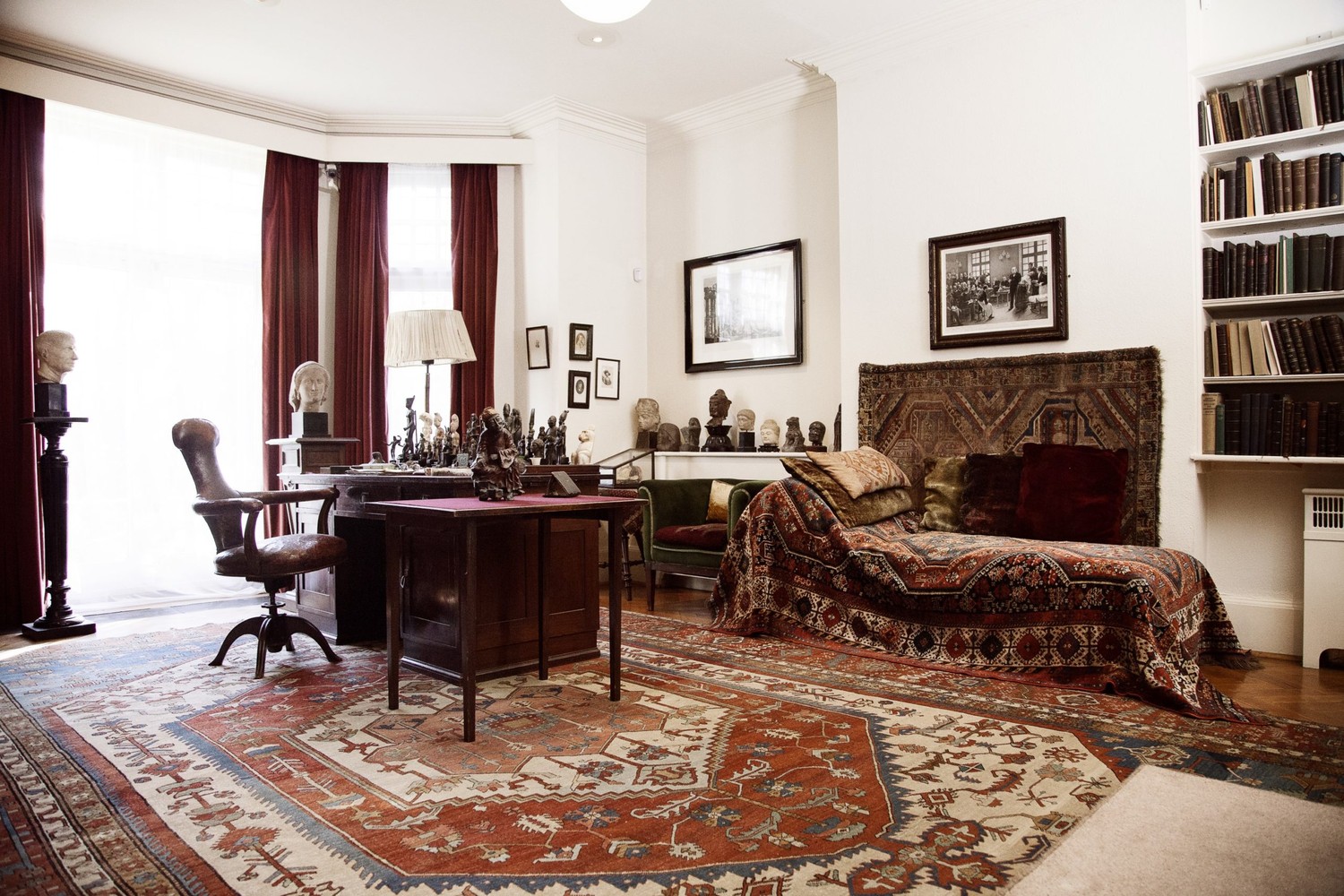
Freud continued to work in London and it was here that he completed his 1939 book Moses and Monotheism. He also maintained his practice in this home and saw a number of his patients for analysis. The centrepiece of the museum is the couch brought from Berggasse 19, Vienna on which his patients were asked to say whatever came to their mind without consciously selecting information, named the free association technique by him.
The museum was the subject of Part 2 of Richard Macer’s three-part BBC documentary series Behind the Scenes at the Museum in 2010.
-
Location:
Hampstead, London
-
Established:
July 1986
-
Address:
20 Maresfield Gardens NW3 5SX
Building and Context
The house had only finished being built in 1920 in the British Queen Anne Revival style. A small sun room in a modern style was added at the rear by Ernst Ludwig Freud (en) (one of his six children) that same year. Freud was over eighty at this time, and he died the following year, but the house remained in his family until his youngest daughter Anna Freud, who was a pioneer of child therapy, died in 1982. The building has a well maintained garden which is still much as Freud would have known it. Hampstead, a leafy suburb of London, has always attracted intellectuals and artists—a place where ideas flourished alongside beauty.
The Collection: A Window into Freud’s World
The Freuds moved all their furniture and household effects to London. There are Biedermeier chests, tables and cupboards, and a collection of 18th century and 19th century Austrian painted country furniture. The museum owns Freud's collection of Egyptian, Greek, Roman, and Oriental antiquities, and his personal library. Among the treasures housed within its walls is Freud’s iconic couch—brought directly from his Vienna study—a silent witness to countless hours of free association, a cornerstone of Freudian therapy where patients explored their innermost thoughts and feelings. The very fabric seems to hold the weight of untold stories, transporting visitors back to moments of intense self-discovery. Beyond this powerful focal point, Freud’s meticulously preserved study and library beckon. Here, surrounded by his favorite authors—Goethe, Shakespeare, Heine, Multatuli, and Anatole France —one can almost feel the presence of a mind constantly at work, synthesizing literature, philosophy, and clinical observation into groundbreaking theories. A fascinating array of antiquities—Egyptian, Greek, Roman, and Oriental artifacts—further illuminates Freud’s personal passions and the diverse influences that shaped his thinking; these objects weren't merely decorative but served as tangible links to the past, inspiring his interpretations of dreams and mythology. The museum also houses a remarkable collection of artworks, including a portrait of Freud painted by Salvador Dalí.
Notable Exhibitions and Research
The Freud Museum regularly hosts temporary exhibitions that breathe new life into its walls. These exhibits often explore contemporary art and themes directly related to Freudian concepts—from examining the influence of dreams on modern cinema to investigating the role of unconscious desires in contemporary culture. The museum’s president is David Freud, the great-grandson of Sigmund Freud and architect of Universal Credit. The Freud Museum's Sixth Series of our podcast ‘Freud in Focus’ discussing some of Freud’s metapsychological works.
A Sanctuary for Psychoanalytic Thought
The Freud Museum stands as a testament to Anna Freud’s unwavering commitment to continuing her father’s work and ensuring its accessibility for generations to come. It is a place where history, art, and psychology converge, offering a unique and profoundly enriching experience. The museum invites visitors to engage with Freud’s ideas on a personal level—a journey into the depths of the human psyche.