
Sommaire
Informations clés
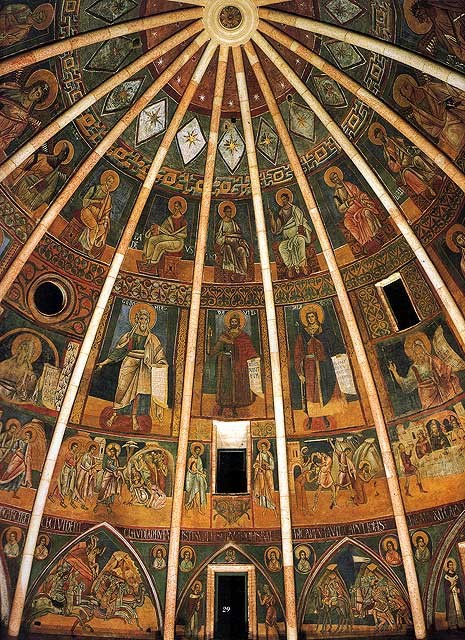
- Location: Parme, Italie
- Featured artists: benedetto antelami
- Alternate names:
- Battistero di Parma
- Baptiste de Parme
- San Giovanni Battista Baptistere
- Baptiste Saint-Jean-Baptiste
- Baptistery of Parma
- Works on APS: 6
Quiz d'art
Chaque question ne comporte qu'une seule réponse correcte.
Question 1:
Quel style architectural caractérise le Baptistère de Parme ?
Question 2:
Les panneaux du Zooforo sont connus pour représenter des éléments décoratifs tels que:
Question 3:
Qui a sculpté les sculptures remarquables ornées du Baptistère ?
Question 4:
Les fresques représentent principalement des histoires tirées de:
Question 5:
Quel symbole représente le plan octagonal du Baptistère ?
Artistes de la collection

Benedetto Antelami
Découvrez Benedetto Antelami : sculpteur lombard de l'école romane. Admirez ses sculptures réalistes et émouvantes, influencées par les styles provençal, classique et byzantin.

Articles connexes
Lumières et Mutations : L'Art du XIVe Siècle, Entre Tradition Gothique et Prémices de la Renaissance
Explorez l'art du XIVe siècle : de l'apogée de l'enluminure gothique à la révolution naturaliste de la peinture italienne. Découvrez Giotto, Duccio et les prémices de la Renaissance avec OriginalUniqueArt.
L'Héritage Durable de la Renaissance : Innovation, Humanisme et Maîtrise Artistique
Explorez l'héritage de la Renaissance : innovation artistique, humanisme et maîtrise technique. Découvrez les grands maîtres et leurs œuvres emblématiques avec .
The Enduring Legacy of Architecture in Art: A Historical Survey of Representation & Meaning
Explore the rich history of architecture in art, from Renaissance theory to 19th-century reconstructions. Discover key artists & movements shaping visual representation – a guide for discerning collectors.
Collection d'œuvres d'art
Aucune œuvre d'art trouvée.


Abonnez-vous à notre newsletter
Restez informé(e) des dernières actualités artistiques, des offres exclusives et des idées de décoration.
Recevez 3 suggestions d'œuvres d'art gratuites
Parlez-nous de votre projet et nos experts en art vous proposeront 3 suggestions d'œuvres personnalisées.
Not Sure Where to Start?
Let Us Curate 3 Options Just for You - Free!