En bref
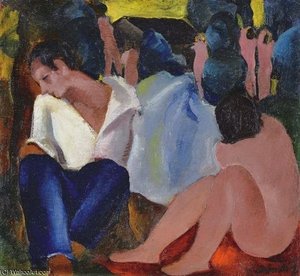
Aux yeux de la galerie, la peinture la plus célèbre de David Jandi est Bathers. Circus et Sicilian Landscape complètent ce trio que tout le monde reconnaît. Parmi les 33 œuvres de David Jandi présentes dans notre catalogue, la galerie présente ci-dessous les 33 plus célèbres, chacune étant une œuvre originale avec son année, son musée et ce qui la rend unique.
Les 10 meilleures peintures de David Jandi de la galerie
Peintures de David Jandi, classées de 11 à 33
Les sujets qui ont captivé David Jandi
Les quatre thèmes qui reviennent le plus souvent dans ces œuvres originales, chacun illustré par son plus bel exemple.
Landscape 4 œuvres
Scenes 4 œuvres
Nude figure 3 œuvres
Hungarian art 3 œuvres
Les peintures de David Jandi : la galerie répond
Quelle est la peinture la plus célèbre de David Jandi ?Révéler la réponse
Bathers. Circus et Sicilian Landscape suivent.
Quelles sont les 10 plus grands tableaux de David Jandi ?Révéler la réponse
Bathers, Circus, Sicilian Landscape, Female Nude White Lepellel, Erotic Scene, Nagybánya, Haystacks,, Horses, Music et In The Mountains. Le classement ci-dessus indique l'année et le musée de chacun.
Combien d'œuvres David Jandi a-t-il créées ?Révéler la réponse
Notre catalogue comprend 33 œuvres de David Jandi.
Quels sont les sujets que David Jandi a le plus explorés ?Révéler la réponse
Landscape (4), Scenes (4) et Nude figure (3), à travers les 33 œuvres de cette page.
À quel mouvement David Jandi est-il associé ?Révéler la réponse
Impressionism et Post-impressionism, à en juger par les originaux de cette page.
Puis-je faire reproduire une peinture de David Jandi à la main ?Révéler la réponse
Oui, en tant que reproduction : l'original reste dans son musée, mais n'importe quelle peinture de cette page peut être peinte à la main pour vous, réalisée sur commande une à la fois, depuis la page propre à la peinture.
David Jandi : l'artiste
David Jandi: Bridging Impressionism and Hungarian Landscape
David Jandi (1893-1944) remains a relatively obscure figure in the annals of Hungarian art history, yet his canvases hold a remarkable beauty and capture a pivotal moment in artistic evolution – the confluence of Impressionist ideals with the burgeoning Hungarian landscape school. Born in Budapest, Hungary, Jandi’s formative years coincided with the rise of Symbolism and Art Nouveau, exposing him to stylistic explorations that would ultimately shape his distinctive oeuvre. However, it was his unwavering dedication to capturing the essence of Italian landscapes and Hungarian countryside that cemented his legacy as one of Hungary's foremost Impressionist painters.- Early Influences: Jandi’s artistic journey began amidst a vibrant cultural landscape dominated by Symbolism and Art Nouveau. Artists like Gustav Klimt and Edvard Munch profoundly impacted him, fostering an appreciation for expressive color palettes and evocative imagery—elements that would later permeate his own paintings.
- Formal Training & Parisian Exposure: Recognizing the importance of honing artistic skills, Jandi pursued formal training at the Budapest Academy of Fine Arts. Crucially, he spent several formative years in Paris during the Belle Époque, immersing himself in the epicenter of Impressionist innovation and engaging with artists like Claude Monet and Camille Pissarro. This Parisian experience instilled within him a deep understanding of plein air painting techniques and encouraged experimentation with light and color.
The Hungarian Landscape School & Jandi’s Vision
Jandi's artistic sensibilities were decisively molded by the burgeoning Hungarian landscape school, spearheaded by József Szilágyi. This movement championed a return to tonal painting—a reaction against the shimmering brilliance of Impressionism—emphasizing atmospheric perspective and capturing the subtle nuances of Hungarian landscapes. Despite this influence, Jandi skillfully blended tonal considerations with Impressionistic color harmonies, resulting in paintings that possessed both depth and luminosity. He sought to convey not merely what he saw but also how he *felt* about the natural world – a characteristic deeply rooted in the Romantic tradition.- Notable Subjects: Jandi’s artistic output focused primarily on Hungarian landscapes, particularly those surrounding Nagybánya (Bathory), where he established his studio. He depicted serene lakeshores, rolling hills dotted with wildflowers, and dramatic mountain vistas—subjects rendered with meticulous detail and infused with a palpable sense of tranquility.
- Technique & Style: Jandi’s technique involved layering thin glazes of color onto toned canvases, creating surfaces that shimmered with reflected light. His brushstrokes were loose yet controlled, conveying movement and texture without sacrificing compositional clarity. He skillfully employed atmospheric perspective to heighten the illusion of depth, mirroring the stylistic innovations championed by Szilágyi.