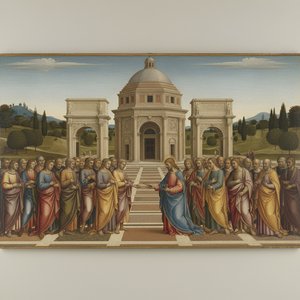
The Brief, Sharp Impact of Pietro Faccini
To look at the surviving works of Pietro Faccini is to witness a sudden, energetic rupture in the Bolognese tradition. He did not spend a lifetime refining a single method; instead, he arrived late to the canvas and left the stage far too soon. Born in Bologna in 1562, Faccini bypassed the typical early apprenticeship, entering the Carracci academy around 1583 only after an initial career in commerce. This lack of early, rigid indoctrination allowed him to bypass the heavy, linear constraints of his mentors, Ludovico and Annibale Carracci. By 1594, he had already broken away to establish his own academy, a move driven by a desire for a personal, more experimental language.
His output is small, documented at only about a dozen painterly works, yet the technical shifts he introduced are undeniable. He moved away from the disciplined draughtsmanship of the Carracci toward something far more restless. His brushwork often appears flickering or nervous, a technique that gives his figures a sense of movement rather than static permanence. In works like The Martyrdom of Saint Lawrence, painted in 1590, one sees a heavy, thick application of paint that pulls directly from Venetian traditions. He did not merely mimic the masters; he synthesized the light-saturated colors of Titian and the atmospheric qualities of Tintoretto with the more fluid, soft execution found in the works of Correggio.
A Technical Departure
Faccini’s true strength lay in his ability to manipulate light and texture to create tension. While his contemporaries often sought a balanced, academic ideal, Faccini leaned into the grotesque and the exaggerated. His etchings, such as The Blind Beggar and The Blind Man Guided by a Dog, utilize fine lines to build an atmosphere that feels both ethereal and brutal. This duality defines his entire body of work. He could move from the delicate, light-filled Annunciation in the Pinacoteca Nazionale, Bologna, to the dark, sober textures found in his final work, Virgin with Saint Dominic.
The artist’s versatility extended deeply into draughtsmanship. While his paintings are rare, his drawings were prolific and highly sought after by collectors like Cardinal Leopoldo de' Medici. His sketches, often executed in pen and ink wash, red chalk, or watercolor, possess a gran spirito—a spirited, darting rhythm that suggests a much larger, more expansive vision than his surviving oil paintings allow us to see. These drawings, many of which reside in the Uffizi and the Louvre, reveal an artist obsessed with the human form, particularly the male nude, executed with a frankness that often led viewers to mistake them for those of Annibale Carracci.
The End of a Career
Faccini’s career was a short-lived bridge between the structured Mannerism of the late sixteenth century and the emerging emotional turbulence of the Baroque. He achieved significant local status, being elected as one of fifteen consiglieri of the Compagnia dei Pittori in Bologna in 1599. However, his death in 1602 cut short a trajectory that was clearly moving toward a more idiosyncratic, luminous style. He left behind no long-standing school of followers, but his influence remained visible in the way later artists approached the interplay of light and flesh.
- Primary Mediums: Oil on copper, etching, pen and ink, watercolor, red and black chalk.
- Key Influences: Tintoretto, Correggio, Bassano, Titian, and the Carracci academy.
- Notable Locations of Work: Bologna, Mirandola, Guastalla, and Rome.
Questions et réponses
Existe-t-il une visite virtuelle en 3D des œuvres de Pietro Faccini ?
La Musée en 3D de Pietro Faccini vous permet de découvrir les œuvres de l'artiste au sein d'une galerie virtuelle en trois dimensions.
Comment trouver des œuvres de Pietro Faccini par thème ?
La page Par mots-clés de Pietro Faccini regroupe les œuvres de l'artiste par mots-clés.
Puis-je étudier l'utilisation de la couleur par Pietro Faccini à travers l'ensemble de ses œuvres ?
La ADN de la palette de Pietro Faccini présente le profil chromatique de l'ensemble de son œuvre.
Combien d'œuvres de Pietro Faccini sont disponibles à la consultation ?
Vous pouvez parcourir 7 œuvres œuvres de Pietro Faccini sur la page Toutes les œuvres d'art.