Le Pionnier Vénitien de la Synthèse Byzantine et Gothique
Paolo Veneziano (v. 1333 – 1358) s'impose comme une figure monumentale de l'histoire de l'art vénitien, universellement reconnu comme le peintre vénitien le plus important du XIVe siècle. Né au sein d'une lignée artistique au cœur même de Venise — son père étant lui-même un artiste de renom — la carrière brève mais brillante de Veneziano a coïncidé avec une période transformatrice de la peinture européenne. Il a agi comme un pont vital, comblant le fossé stylistique entre la grandeur rigide et dorée de la tradition byzantine et l'élégance naissante et plus fluide du style gothique. Son héritage s'étend bien au-delà de sa courte existence, l'établissant comme le véritable fondateur de l'école vénitienne, un mouvement artistique qui allait dominer la production tout au long du siècle et influencer profondément les maîtres ultérieurs tels que Lorenzo Veneziano.
L'essence du génie de Veneziano réside dans sa capacité à harmoniser des mondes disparates. Bien que sa formation fût profondément ancrée dans les influences byzantines qui imprégnaient la République de Venise — un style caractérisé par une stabilité iconographique, une préciosité et un sentiment du divin — il possédait une conscience aiguë des développements contemporains provenant de Rimini et d'autres centres artistiques italiens. En incorporant des éléments gothiques dans ses compositions, il a introduit un nouveau niveau de sophistication et de mouvement. Ce double engagement a permis à son œuvre de ne pas simplement faire écho aux gloires du passé, mais de participer activement au paysage dynamique et en pleine mutation du milieu du XIVe siècle.
Un Chef-d'œuvre de Dévotion et de Mécénat
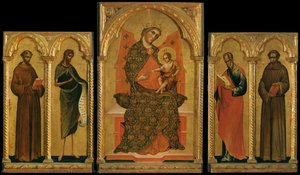
Le zénith de la réussite artistique de Veneziano est peut-être capturé avec le plus de vivacité dans sa participation à la Pala Feriale, ou retable de semaine, commandé pour la prestigieuse basilique Saint-Marc à Venise. Ce projet monumental fut un triomphe collaboratif, entrepris aux côtés de ses fils, Marco et Luca. Le polyptyque qui en résulte sert de témoignage époustouflant du mécénat vénitien et de sa prouesse technique. Dans cette œuvre, on peut observer l'application méticuleuse de la feuille d'or et l'agencement soigneux des figures sacrées, créant une vision céleste qui reflète à la fois la richesse de la République et la profonde piété de ses citoyens.
À travers de telles commandes de grande envergure, Veneziano a démontré sa capacité à gérer des programmes iconographiques complexes qui satisfaisaient à la fois les exigences religieuses et les désirs esthétiques de l'État vénitien. Sa technique reposait sur :
- L'utilisation de fonds d'or lumineux pour évoquer un sentiment de lumière divine et éternelle.
- Une ornamentation complexe qui faisait écho aux textiles luxueux et aux mosaïques que l'on trouvait à Venise même.
- <Un équilibre délicat entre la ligne et la couleur permettant l'émergence de draperies gothiques plus naturalistes sur les formes byzantines traditionnelles.
Signification Historique et Héritage Durable
Bien que sa vie fut tragiquement courte, s'achevant en 1358, l'impact de Paolo Veneziano sur la trajectoire de l'art occidental est incommensurable. Il ne s'est pas contenté de peindre ; il a défini un langage visuel pour un empire maritime. En synthétisant l'influence orientale de Byzance avec les innovations occidentales de la période gothique, il a créé un style « vénitien » unique — un style opulent, international et profondément évocateur. Cette synthèse stylistique a fourni le fondement sur lequel les maîtres plus célèbres de la Renaissance allaient plus tard bâtir leur art.
Son importance pour l'histoire de l'art ne peut être surestimée, car il a transformé Venise, passant du statut de simple destinataire de styles artistiques étrangers à celui de créateur principal de sa propre identité esthétique distincte. La lignée qu'il a établie à travers son atelier et ses fils a assuré que l'école vénitienne resterait une force dominante dans l'art européen pendant des générations, laissant une marque indélébile sur l'histoire de la Renaissance italienne.
Questions et réponses
À quelle période historique Paolo Veneziano a-t-il exercé ?
Paolo Veneziano a œuvré durant la période Bas Moyen Âge. Cette période situe l'activité de l'artiste dans l'histoire.
Existe-t-il un récit chronologique de la carrière de Paolo Veneziano ?
Un récit chronologique de l'œuvre de Paolo Veneziano est disponible sur la page Chronologie de l'artiste, où les œuvres défilent par ordre de création, chapitre par chapitre.
Puis-je explorer les œuvres de Paolo Veneziano par mot-clé ?
La page Par mots-clés de Paolo Veneziano regroupe les œuvres de l'artiste par mots-clés.