early life and training
Jean-Étienne Liotard, a Genevan painter, art connoisseur, and dealer, was born on December 22, 1702, in Geneva, Switzerland. His parents, French Protestants, had fled to Geneva after 1685. Liotard's artistic journey began under the guidance of professors Daniel Gardelle and Petitot, whose enamels and miniatures he skillfully replicated. Gardelle’s meticulous craftsmanship instilled in him a profound appreciation for detail and precision—qualities that would define his entire oeuvre. Petitot fostered Liotard’s understanding of composition and perspective, shaping his artistic vision from its earliest stages.artistic career
Liotard's wanderings spanned Europe, notably Paris, Rome, Constantinople (Istanbul), and Vienna, where his portraits commanded considerable prestige. He honed his skills under Jean-Baptiste Massé and François Lemoyne in Paris, absorbing the stylistic innovations of Rococo. These masters championed a style characterized by elegance, asymmetry, and playful ornamentation—influences that subtly permeated Liotard’s own artistic endeavors. His expedition to Constantinople between 1738 and 1742 proved transformative; encountering Claude Alexandre de Bonneval (Humbaraci Ahmed Pacha) broadened his horizons and exposed him to Ottoman culture. This experience fueled his fascination with orientalism, evident in numerous pastel depictions capturing the vibrant atmosphere of Turkish domestic life. Liotard’s dedication to artistic excellence was recognized by the Académie royale de peinture et de sculpture, though his ambitious tableau of David au Temple was rejected due to its stylistic divergence from prevailing tastes.notable works and style
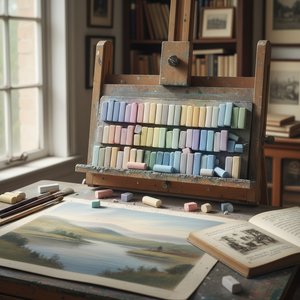
Liotard's mastery of pastel is spectacularly demonstrated in masterpieces such as “Dutch Girl at Breakfast,” a luminous depiction showcasing his exceptional ability to convey emotion through subtle tonal variations. Similarly, "La Liseuse, The Chocolate Girl" exemplifies his delicate draughtsmanship and meticulous attention to detail—characteristics that cemented his reputation as one of the foremost pastel artists of his time. His portrait of Maria Frederike van Reede-Athlone at Seven, housed in the Getty Museum, stands as a testament to his naturalistic approach and profound understanding of human anatomy. Liotard’s distinctive style combined meticulous observation with expressive brushwork, resulting in images imbued with both realism and poetic beauty.legacy and later life
Liotard continued to produce captivating landscapes and still lifes until his death on June 12, 1789, in Geneva. Beyond his artistic achievements, he left an indelible mark as a scholar and intellectual—most notably through the publication of “Traité des principes et des règles de la peinture” (Treatise on the Principles and Rules of Painting) in 1781. This seminal work established Liotard as a pivotal figure in shaping artistic discourse during the Enlightenment, advocating for direct observation and rejecting academic conventions. His legacy persists today, inspiring artists and scholars alike to revisit his extraordinary creations with renewed appreciation.Questions et réponses
Où et en quelle année Jean-Étienne Liotard est-il né ?
Jean-Étienne Liotard est né à Geneva en 1702.
À quelle période historique Jean-Étienne Liotard a-t-il exercé ?
Jean-Étienne Liotard a œuvré durant la période L'époque moderne. Cette période situe l'activité de l'artiste dans l'histoire.
Puis-je explorer les œuvres de Jean-Étienne Liotard par spectre de couleurs ?
Les œuvres de Jean-Étienne Liotard peuvent être explorées par couleur sur la page Index spectral de l'artiste.