Portrait de Jan Vonck

Peintures de Jan Vonck : les 20 plus célèbres, selon le regard d'une galerie

Mis à jour en novembre 2026 · classé selon notre score de popularité (recherches, visites et commandes pour chaque œuvre) · 22 œuvres de Jan Vonck dans notre catalogue

En bref

Aux yeux de la galerie, le tableau le plus célèbre de Jan Vonck est Un chien attaquant un chat (1650), dont l'original est exposé au Musée National de Varsovie, à Varsovie. Nature morte de chasse avec lièvre suspendu et oiseaux (1657) et Dead Game complètent ce trio que tout le monde reconnaît. Parmi les 22 œuvres de Jan Vonck présentes dans notre catalogue, la galerie présente ci-dessous les 20 plus célèbres, chacune étant une œuvre originale avec son année, son musée et ce qui la rend unique.

1631 – 1664, Toruń Plus d'œuvres : Musée National de Varsovie

Les 10 meilleures peintures de Jan Vonck de la galerie

1
Un chien attaquant un chat (1650) de Jan Vonck

Un chien attaquant un chat

1650 · Peinture à l'huile · Musée National de Varsovie, Varsovie

Dans cette peinture à l'huile, un chien de couleur claire occupe le premier plan en bas à droite, la tête tournée vers le haut avec une expression de vigilance. Le pelage de l'animal est rendu par des coups de pinceau fins, révélant la texture de chaque poil sur un fond plus sombre. Sur la gauche, un ensemble d'animaux et de gibier est drapé sur un monticule ou un panier, comprenant…

2
Nature morte de chasse avec lièvre suspendu et oiseaux (1657) de Jan Vonck

Nature morte de chasse avec lièvre suspendu et oiseaux

1657 · Peinture à l'huile · Musée Des Beaux, Strasbourg

L'air dans la pièce semble pesant, chargé de ce silence épais qui succède à un mouvement soudain et violent. Un grand lièvre pend, suspendu par ses pattes arrière, son poids tirant sur une chaîne fine et tendue qui fend l'obscurité. La fourrure de la créature, rendue dans des tons doux d'ocre et de crème, accroche un éclat de lumière, révélant la réalité tactile de sa texture face au vide. À…

3
Dead Game de Jan Vonck

Dead Game

Oil

A dark, shadowed environment provides the stage for this visceral encounter between life and death. In the center of the composition, a bird lies lifeless, its head severed, surrounded by other avian figures and a dead animal. The scene is set in a dim, perhaps subterranean or nocturnal space, where the natural order is stripped to its most primal elements. Small birds are scattered throughout the darkness, adding layers of…

4
Dead Swan (1655) de Jan Vonck

Dead Swan

1655 · Oil On Canvas · Musée Groninger, Groningen

Created in 1655, this work emerges from the tradition of 17th-century Dutch still life. It captures a moment of absolute repose, where the vitality of the natural world has been replaced by a profound quiet. The painting explores the tension between the softness of the feathers and the hard reality of death. It is a meditation on the cycle of existence, rendered with a precision that makes the silence feel…

5
Vanitas Still Life (1654) de Jan Vonck

Vanitas Still Life

1654 · Oil · Musée Groninger, Groningen

Shadows stretch across a dark, stone-like ledge, claiming the space where life once resided. A human skull rests heavily in the center, its weathered surface catching a sharp, directional light that spills from the upper left. Beside it, a small candle sits in its holder, its flame extinguished, leaving only a tiny, ghostly wisp of smoke that curls upward into the darkness. The air feels heavy with the silence of…

6
Still Life with Dead Birds and a Flower Pot (1652) de Jan Vonck

Still Life with Dead Birds and a Flower Pot

1652 · Oil On Canvas · Musée Boijmans Van Beuningen, Rotterdam

This 1652 oil painting presents a somber and dramatic Dutch still life set within a dark, atmospheric environment. The composition is characterized by an asymmetrical arrangement, featuring a cluster of hanging birds on the left side that is balanced by birds resting on a stone ledge in the lower right. The scene is rendered in a chiaroscuro style, utilizing a strong directional light source from the upper left to illuminate…

7
Dead birds on a stone ledge (1660) de Jan Vonck

Dead birds on a stone ledge

1660 · Oil On Panel · Musée d'Art de Dordrecht, Dordrecht

A collection of dead birds rests upon a thick, grey stone ledge, their forms arranged centrally against a dark, shadowed background. The composition is horizontal, emphasizing the weight of the stone protrusion that extends from the left. Light enters from the upper left, casting a sharp chiaroscuro effect across the scene. This illumination catches the granular texture of the stone and the delicate, downy layers of plumage, while leaving the…

8
Still Life of Dead Birds (1660) de Jan Vonck

Still Life of Dead Birds

1660 · Oil · Minneapolis Institute of Art, Minneapolis

A heavy silence rests upon the stone ledge. Several dead birds lie in a quiet, asymmetrical arrangement, their forms slumped against the hard, cold surface. The composition pulls the eye downward, where the weight of the subjects settles in the lower half of the frame. Deep browns and charcoal grays dominate the shadows, creating a space of profound stillness. Through the gloom, sudden flashes of crimson, orange, and white emerge…

10
Game Birds (1650) de Jan Vonck

Game Birds

1650 · Oil On Canvas · Bergen Kunstmuseum, Bergen

A heavy, silent weight settles over the ledge where a collection of game birds lies in a dense, horizontal cluster. The scene is caught in a moment of profound stillness, a quiet aftermath of the hunt. Deep browns and ochres dominate the palette, grounding the composition in earthy tones that feel as though they have risen from the forest floor itself. Amidst the muted greens and creams, a sudden flash…

Peintures de Jan Vonck, classées de 11 à 20

Les sujets qui ont captivé Jan Vonck

Les quatre thèmes qui reviennent le plus souvent dans ces œuvres originales, chacun illustré par son plus bel exemple.

Les musées qui conservent les œuvres originales de Jan Vonck

Les 8 musées qui détiennent la plupart des peintures de cette page.

Musées Ville Œuvres de Jan Vonck Peintures de cette liste
Musée National de Varsovie, VarsovieMusée National de Varsovie Varsovie 2 Un chien attaquant un chat, Dog attacking a cat
Musée Groninger, GroningenMusée Groninger Groningen 2 Dead Swan, Vanitas Still Life
Musée Boijmans Van Beuningen, RotterdamMusée Boijmans Van Beuningen Rotterdam 2 Still Life with Dead Birds and a Flower Pot, Dead Birds
Musée d'Art de Dordrecht, DordrechtMusée d'Art de Dordrecht Dordrecht 2 Dead birds on a stone ledge, Trompe-l'œil Still Life with Dead Birds
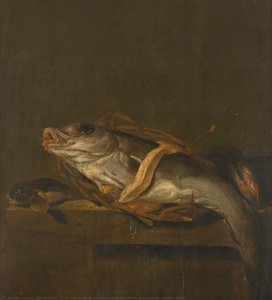
Rijksmuseum, AmsterdamRijksmuseum Amsterdam 2 Still Life with a Haddock and Gurnard, Jan Vonck, 1640 - 1662, Dead Birds, Jan Vonck, 1640 - 1662
The Ashmolean Museum of Art and Archaeology, OxfordThe Ashmolean Museum of Art and Archaeology Oxford 2 Still Life of dead Birds, Still Life of Game on a stone Sill
Musée Des Beaux, StrasbourgMusée Des Beaux Strasbourg 1 Nature morte de chasse avec lièvre suspendu et oiseaux
Minneapolis Institute of Art, MinneapolisMinneapolis Institute of Art Minneapolis 1 Still Life of Dead Birds

Jan Vonck, les œuvres emblématiques de chaque année

La carrière de Jan Vonck sur cette page s'étend sur 14 ans, de 1650 à 1663 : chaque année est présentée avec ses œuvres originales les plus célèbres.

Œuvres par année

Choisissez une année pour voir les œuvres originales.

Les peintures de Jan Vonck : la galerie répond

Quelle est la peinture la plus célèbre de Jan Vonck ?Révéler la réponse

Un chien attaquant un chat (1650), Musée National de Varsovie, Varsovie. Suivus de Nature morte de chasse avec lièvre suspendu et oiseaux (1657) et Dead Game.

Quel âge avait Jan Vonck lors de la création de Un chien attaquant un chat ?Révéler la réponse

19 ans : Un chien attaquant un chat date de 1650, et Jan Vonck est né(e) en 1631.

Quelles sont les 10 plus grands tableaux de Jan Vonck ?Révéler la réponse

Un chien attaquant un chat, Nature morte de chasse avec lièvre suspendu et oiseaux, Dead Game, Dead Swan, Vanitas Still Life, Still Life with Dead Birds and a Flower Pot, Dead birds on a stone ledge, Still Life of Dead Birds, Dead Birds et Game Birds. Le classement ci-dessus indique l'année et le musée de chacun.

Combien d'œuvres Jan Vonck a-t-il créées ?Révéler la réponse

Notre catalogue comprend 22 œuvres de Jan Vonck, datées de 1650 à 1663.

Où sont exposées les œuvres originales les plus célèbres de Jan Vonck ?Révéler la réponse

Principalement dans Musée National de Varsovie (Varsovie), Musée Groninger (Groningen) et Musée Boijmans Van Beuningen (Rotterdam). Le tableau des musées ci-dessus les répertorie tous.

Quand Jan Vonck a-t-il créé ses peintures les plus célèbres ?Révéler la réponse

En 1660 : 3 des 20 œuvres de cette page ont été créées à cette époque, dont Dead birds on a stone ledge.

Quelles sont les premières et les dernières œuvres célèbres de Jan Vonck ?Révéler la réponse

Sur cette page, la plus ancienne date de Un chien attaquant un chat (1650) et la plus récente de Trompe-l'œil Still Life with Dead Birds (1663).

Quels sont les sujets que Jan Vonck a le plus explorés ?Révéler la réponse

Feathers (9), Dead birds (8) et Stone ledge (4), à travers les 20 œuvres de cette page.

Avec quel médium Jan Vonck a-t-il le plus travaillé ?Révéler la réponse

Oil, pour 4 des 20 œuvres de cette page.

Quelles œuvres originales de Jan Vonck le Musée National de Varsovie détient-il ?Révéler la réponse

Un chien attaquant un chat et Dog attacking a cat : le Musée National de Varsovie, Varsovie détient 2 des œuvres de cette page.

Jan Vonck : l'artiste

Jan Vonck: A Dutch Master of Living Birds

Born in Torun, Poland, in 1631, Jan Vonck’s artistic journey began amidst the turmoil of a shifting political landscape. His early life was shaped by his father, Elias Vonck – also a painter – who instilled in him a deep appreciation for depicting the natural world, particularly its feathered inhabitants. This familial legacy proved pivotal, establishing a foundation rooted in meticulous observation and a commitment to capturing the vitality of birds within their environments. Vonck’s career unfolded primarily in Amsterdam, a vibrant hub of artistic activity during the Dutch Golden Age, where he honed his skills and established himself as a respected artist specializing in a remarkably specific yet captivating genre: the still life of living birds.

Vonck's artistic development was profoundly influenced by the masters who preceded him. He clearly drew inspiration from the techniques of Joannes Fijt, Jan Baptist Weenix, Alexander Adriaenssen, and Melchior Hondecoeter – all renowned for their masterful depictions of animals in natural settings. These artists established a precedent for portraying birds with an astonishing level of realism, capturing not just their physical appearance but also their inherent movement and alertness. Vonck’s work can be seen as a continuation of this tradition, building upon the foundations laid by his predecessors while imbuing it with his own unique style.

The Art of the Living Still Life

Vonck's fame rests almost entirely on his series of still life paintings featuring birds. These weren’t simply depictions of animals; they were carefully constructed narratives, often set within richly detailed landscapes. He frequently portrayed hunting scenes – a common motif during that era – showcasing dead poultry alongside the living birds, creating a poignant commentary on the cycle of life and death. The inclusion of elements like flower pots, fruits, and other domestic objects added layers of meaning to these compositions, suggesting themes of abundance, mortality, and the relationship between humanity and nature.

What distinguishes Vonck’s work is his extraordinary ability to convey a sense of immediacy and dynamism. He meticulously rendered each feather, capturing its texture and sheen with remarkable precision. His birds weren't static subjects; they appeared poised for flight, alert to their surroundings, or engaged in various behaviors – preening, foraging, or observing the viewer. This attention to detail, combined with his skillful use of light and shadow, created a powerful illusion of life within the painted surface.

Notable Works and Influences

Among Vonck’s most celebrated works is “Stilleven met dode vogels en een bloempot” (Still Life with Dead Birds and a Flower Pot), currently housed at the Rijksmuseum in Amsterdam. This painting exemplifies his signature style, seamlessly blending elements of realism, symbolism, and narrative. Another significant piece is "Dode Vogels" (Dead Birds), also held by the Rijksmuseum, which further demonstrates his ability to evoke emotion through the juxtaposition of life and death.

Interestingly, Vonck’s work has been linked to the landscapes of Jacob van Ruysdael. There are documented instances where he painted birds within Ruysdael's compositions, suggesting a collaborative relationship or an exchange of ideas between these two masters. This association highlights the broader artistic context in which Vonck operated and underscores his position as a key figure in the Dutch Golden Age.

Legacy and Historical Significance

Jan Vonck’s career was tragically cut short at the relatively young age of 32, dying in Amsterdam in 1664. Despite his brief life, he left behind a significant body of work that continues to captivate art lovers today. His meticulous depictions of birds have earned him a place among the most accomplished artists of the Dutch Golden Age, and his influence can be seen in the works of subsequent generations of painters.

Vonck’s legacy extends beyond his technical skill; he represents a pivotal moment in the history of still life painting. By elevating the depiction of animals to an art form, he demonstrated that nature itself could serve as a source of profound beauty and intellectual inquiry. His work remains a testament to the power of observation, the artistry of representation, and the enduring fascination with the natural world.