James Jacques Joseph Tissot (1836-1902): A Victorian Visionary Bridging Realism and Impressionism
James Jacques Joseph Tissot, born October 15th, 1836, in Paris, France, was a prolific painter whose career spanned decades and cemented his place as one of the most celebrated artists of the Victorian era. Though initially trained as an architect, Tissot swiftly abandoned this path for the captivating allure of painting, dedicating himself to capturing the grandeur and intricacies of Parisian society alongside profound biblical narratives. His distinctive style—a masterful blend of realism and Impressionistic techniques—continues to fascinate art historians and collectors alike.Early Life & Artistic Training
Tissot’s formative years were marked by a privileged upbringing within a wealthy family, affording him access to exceptional artistic instruction. He studied architecture at École Polytechnique before transitioning to drawing under Alexandre Cabanel and Jean-Léon Gérôme, absorbing the stylistic influences of academic realism prevalent during his time. These foundational experiences instilled in him a meticulous attention to detail and a disciplined approach to composition—traits that would characterize his entire oeuvre. The influence of Gustave Courbet’s earthy palette and Millet’s depiction of rural life subtly shaped his early artistic sensibilities.Victorian Paris & Societal Portraiture
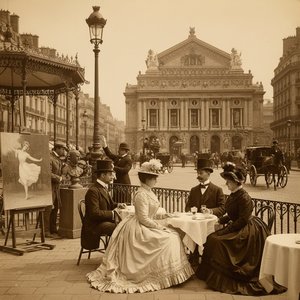
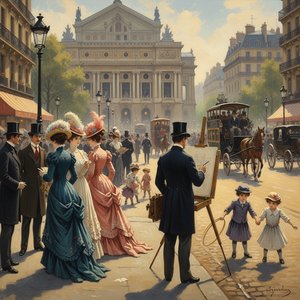
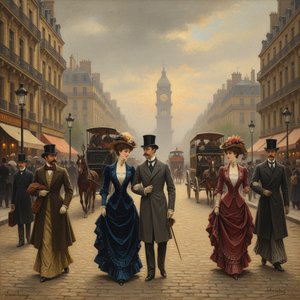
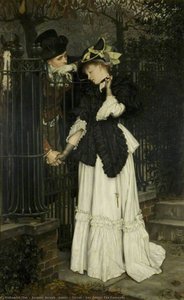
Tissot’s artistic breakthrough arrived with his depictions of Parisian life during the Belle Époque. He meticulously documented scenes from theaters, opera houses, and fashionable gatherings, capturing not only visual splendor but also subtle nuances of social behavior. His canvases—such as “The Rubens Hat” and “Tea”—became iconic representations of Victorian elegance and sophistication, reflecting the anxieties and aspirations of a rapidly changing society. These paintings are notable for their meticulous observation of costume and décor, conveying a palpable sense of atmosphere and capturing the spirit of the age with remarkable accuracy.Biblical Narratives & Dramatic Composition
Beyond urban landscapes, Tissot excelled in portraying biblical stories with remarkable theatricality. He approached these narratives with an unwavering commitment to historical accuracy combined wit h expressive brushwork—a hallmark of Impressionism—creating emotionally resonant images that captivated audiences. Notable works include “The Finding of the Holy Grail” and “The Last Supper,” demonstrating his ability to convey spiritual depth alongside visual dynamism. Tissot’s meticulous research into biblical sources ensured that his depictions were both aesthetically compelling and intellectually stimulating, establishing him as a pioneer in narrative painting.Technique & Artistic Evolution
Tissot’s artistic technique evolved considerably throughout his career. Initially favoring academic realism—a style characterized by smooth surfaces and precise delineation—he gradually embraced Impressionistic influences, experimenting with looser brushstrokes and capturing fleeting moments of light and color. This stylistic shift allowed him to imbue his paintings with a palpable sense of atmosphere and emotion—a departure from the static formality of earlier works. He skillfully blended traditional compositional principles with innovative techniques, resulting in a distinctive visual language that distinguishes his oeuvre from contemporaries.Legacy & Historical Significance
Jacques Joseph Tissot died August 8th, 1902, leaving behind an impressive body of work that continues to inspire admiration. His paintings are housed in prominent museums worldwide, including the Bibliothèque Nationale Centrale and the Getty Museum, testament to his enduring artistic legacy. More than simply documenting his era, Tissot elevated painting to a form of storytelling—a powerful blend of observation and imagination that solidified his position as one of the most influential artists of the Victorian period. His contribution to the art history canon remains substantial, securing his place among the foremost figures of 19th-century artistic innovation.Further Exploration
You can delve deeper into Tissot’s artistic journey by visiting these resources:- James Tissot - Wikipedia:https://en.wikipedia.org/wiki/James_Tissot
- Jacques Joseph Tissot - Getty Museum:https://www.getty.edu/art/collection/person/103KY1
- Jacques Joseph Tissot: A Chronicle of Parisian Life & Narrative Evolution:/en/articles/jacques-joseph-tissot-a-chronicle-of-parisian-life-narrative-evolution-en/
- James Tissot (1836-1902), Ambiguously modern | Musée d’Orsay:https://www.musee-orsay.fr/en/whats-on/exhibitions/presentation/james-tissot-1836-1902-ambiguously-modern
Questions et réponses
Dans quelle ville et quel pays Jacques Joseph Tissot est-il/elle né(e) ?
Jacques Joseph Tissot est né à Paris, en France.
Où peut-on trouver les œuvres de Jacques Joseph Tissot regroupées par technique ?
Les œuvres de Jacques Joseph Tissot peuvent être consultées par technique sur la page Par technique de l'artiste.
Existe-t-il une visite virtuelle en 3D des œuvres de Jacques Joseph Tissot ?
Retrouvez les œuvres de Jacques Joseph Tissot dans une galerie 3D sur la page Musée en 3D de l'artiste.