A Forerunner of the Dutch Golden Age: The Life and Art of Cornelis Cornelisz van Haarlem
Cornelis Cornelisz van Haarlem, born in Haarlem around 1562, stands as a pivotal figure bridging the late Mannerist period with the dawn of the Dutch Golden Age. His journey was one of stylistic evolution and significant influence, particularly on Frans Hals, cementing his place among the most celebrated artists of his time. Initially steeped in the highly stylized conventions prevalent at the time—influenced by masters like Bartholomeus Spranger whose drawings circulated throughout Europe—van Haarlem’s formative years were marked by a profound engagement with artistic innovation and cultural dynamism. His parents, fleeing Haarlem during the tumultuous siege of 1572-73 by Spanish forces—a defining moment in the Eighty Years' War—left young Cornelis under the tutelage of Pieter Pietersz., establishing him on a path toward mastering the techniques of his era. This early training instilled within him not only artistic skill but also an unwavering connection to Haarlem’s cultural identity, themes that would subtly permeate his later oeuvre. The siege itself served as a catalyst for artistic experimentation and a heightened awareness of political realities—a context crucial for understanding van Haarlem's evolving worldview.From Mannerist Grandeur to Netherlandish Realism
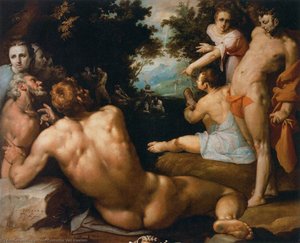
Van Haarlem’s initial artistic output was characterized by large-scale compositions featuring dramatically posed figures—often Italianate nudes—with an emphasis on artifice and exaggerated anatomy. These works, while demonstrating considerable skill, reflected the prevailing Northern Mannerist aesthetic heavily influenced by artists like Bartholomeus Spranger whose drawings were introduced to Haarlem by Carel van Mander in 1585. However, a distinct shift began to emerge as van Haarlem matured. He gradually moved away from these highly stylized forms toward a more grounded and realistic approach rooted in the Netherlandish tradition—a movement mirroring broader societal changes towards greater naturalism and emotional depth. This transformation wasn’t abrupt but rather a considered evolution, reflecting not only his artistic growth but also a burgeoning interest in humanist ideals. His stylistic development mirrored the intellectual currents of the Renaissance, signaling a move away from purely formal concerns toward capturing human emotion and experience with unprecedented sensitivity.Key Works and Civic Recognition
Throughout his prolific career—spanning roughly 1580-1638—van Haarlem secured numerous commissions that attest to his growing reputation and skill. One of his earliest significant achievements was The Banquet of the Haarlem Civic Guard (1583), a monumental depiction of Haarlem’s militia company showcasing his mastery of group dynamics and meticulous attention to detail. This ambitious undertaking solidified his position within the city’s artistic landscape and established him as a reliable artist capable of fulfilling prestigious civic obligations. Equally noteworthy is The Fall of the Titans (1588-1590)—a dramatic mythological scene demonstrating van Haarlem's command of complex compositions and narrative storytelling—a testament to his ability to convey grand themes with visual eloquence. These monumental paintings weren’t merely displays of technical prowess; they were statements of civic pride and artistic ambition, reflecting the spirit of Haarlem during its golden age. He became deeply involved in the Haarlem art community, participating in informal drawing groups with Hendrick Goltzius and Carel van Mander—a collective often referred to as the “Haarlem Mannerists”—where ideas were exchanged and new artistic directions explored.Influence on Frans Hals and Beyond
Cornelis van Haarlem’s legacy extends far beyond his own impressive output, notably through his profound influence on Frans Hals—one of the most revered portrait painters of the Dutch Golden Age. While the precise nature of their relationship remains a subject of scholarly debate, it's undeniable that van Haarlem served as an important mentor and source of inspiration for Hals’ younger colleague. His emphasis on capturing individual character and psychological depth in his portraits likely paved the way for Hals’ groundbreaking approach to portraiture—characterized by spontaneity, vitality, and remarkable ability to convey personality. Van Haarlem’s role as city painter of Haarlem further solidified his artistic significance, ensuring that his vision continued to shape the cultural landscape of the region. His students included Salomon de Bray, Cornelis Jacobsz Delff, and Gerrit Pietersz Sweelink—continuing his influence into subsequent generations. His paintings remain powerful testaments to an era of artistic innovation and cultural transformation.Questions et réponses
Comment puis-je trouver des œuvres de Cornelis Cornelisz van Haarlem dans une palette spécifique ?
La page Par palettes regroupe les œuvres de Cornelis Cornelisz van Haarlem par leurs palettes de couleurs.
À quelle période historique Cornelis Cornelisz van Haarlem a-t-il exercé ?
Cornelis Cornelisz van Haarlem a œuvré durant la période Renaissance. Cette période situe l'activité de l'artiste dans l'histoire.
Où trouver les œuvres de Cornelis Cornelisz van Haarlem classées par couleur ?
La page Index spectral organise les œuvres de Cornelis Cornelisz van Haarlem par couleur.