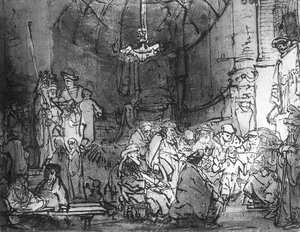
Une vie brève et illuminée : l'univers énigmatique de Carel Fabritius
Carel Fabritius, un nom murmuré avec révérence par les connaisseurs de l'Âge d'or néerlandais, demeure une figure insaisissable malgré l'impact profond que sa brève carrière a eu sur le développement de la peinture. Né à Middenbeemster en 1622, et tragiquement emporté par l'explosion de la poudrière de Delft en 1654 à seulement trente-deux ans, Fabritius a laissé derrière lui une œuvre remarquablement restreinte mais d'une puissance intense qui continue de captiver et d'inspirer. Ses peintures ne sont pas de simples représentations de la réalité ; elles sont des investigations sur la lumière, la perception et l'essence même de l'expérience visuelle.
Le voyage artistique de Fabritius a débuté dans le cadre nourricier de son foyer familial. Son père, Pieter Carelsz Fabritio, était lui-même peintre — un instituteur qui pratiquait également son art, instillant chez le jeune Carel un goût précoce pour les arts. Ce fondement l'a conduit à Amsterdam vers 1641, où il intégra l'atelier de Rembrandt van Rijn. Bien que la durée exacte de son apprentissage fasse encore débat, l'influence du maître est indéniable. Cependant, Fabritius ne fut pas un simple imitateur. Il commença rapidement à tracer sa propre voie, s'écartant du ténébrisme caractéristique de Rembrandt pour développer un style unique privilégiant la clarté, des harmonies froides et une observation presque scientifique des effets de la lumière.
L'École de Delft et une vision distinctive
Après son passage auprès de Rembrandt, Fabritius s'établit à Delft, devenant membre de la guilde locale des peintres en 1652. C'est ici, au sein de la communauté artistique florissante connue sous le nom d'École de Delft, que son style mature s'épanouit véritablement. Contra qu'à nombre de ses contemporains qui se concentraient sur de grands récits historiques ou des scènes de genre animées, Fabritius gravitait vers les intérieurs domestiques intimes et les études soigneusement observées d'objets du quotidien. Ses peintures possèdent un calme remarquable, une intensité tranquille qui entraîne le spectateur dans un monde suspendu hors du temps.
Ce qui distingue Fabritius est sa manipulation magistrale de la lumière. Il ne se contentait pas de dépeindre l'illumination ; il l'analysait, capturant ses subtiles gradations et sa capacité à définir les formes et à créer une atmosphère. Cette fascination pour l'optique le poussa à expérimenter la perspective — employant souvent des points de vue inhabituels qui renforcent le sentiment de réalisme et plongent le spectateur au cœur de la scène. Le Chardonneret, peut-être son œuvre la plus célèbre, en est l'exemple parfait. La représentation apparemment simple d'un chardonneret enchaîné contre un mur blanc immaculé est, en réalité, un tour de force de technique trompe-l'œil et d'illusion spatiale. L'oiseau semble planer juste au-delà du plan du tableau, ses plumes rendues avec un détail stupéfiant, tandis que le jeu d'ombre et de lumière crée une sensation de profondeur presque palpable.
Œuvres majeures et héritage durable
Au-delà du Chardonneret, l'œuvre de Fabritius comprend d'autres pièces fascinantes qui témoignent de sa vision singulière. Vue de Delft (1652) est un paysage urbain captivant, remarquable par sa perspective unique et son rendu atmosphérique de l'architecture de la ville. Le tableau n'est pas simplement un registre topographique ; c'est une évocation du lieu, imprégnée d'un sentiment de tranquillité et d'une beauté poétique. La Sentinelle, peinte peu avant sa mort, est peut-être son œuvre la plus énigmatique — un portrait hanté d'un soldat solitaire qui invite à la contemplation des thèmes du devoir, de l'isolement et de la condition humaine.
La carrière tragiquement courte de Fabritius signifie qu'il n'a produit qu'une douzaine environ de peintures survivantes. Pourtant, ces quelques œuvres ont exercé une influence disproportionnée sur les générations suivantes d'artistes. Son utilisation innovante de la lumière et de la perspective est largement considérée comme ayant profondément marqué Johannes Vermeer, qui partageait une fascination similaire pour les effets optiques et les intérieurs domestiques. Les tonalités froides, le rendu précis et l'intimité silencieuse qui caractérisent les chefs-d'œuvre de Vermeer trouvent leurs racines dans le travail pionnier de Fabritius.
Un peintre en avance sur son temps
L'explosion à Delft a interrompu non seulement la vie de Fabritius, mais aussi une trajectoire artistique potentiellement révolutionnaire. Ses peintures offrent un aperçu de l'esprit d'un artiste qui repoussait les limites de la représentation, explorant la nature même de la vision et de la perception. Alors que ses contemporains étaient souvent préoccupés par le récit ou le symbolisme, Fabritius se concentrait sur les éléments fondamentaux de la peinture — la lumière, la couleur, la forme — créant des œuvres à la fois visuellement éblouissantes et intellectuellement stimulantes.
Aujourd'hui, Carel Fabritius est reconnu comme une figure pivot de l'Âge d'or néerlandais, un peintre dont la carrière brève mais brillante a laissé une marque indélébile dans l'histoire de l'art. Ses peintures continuent de résonner auprès des spectateurs, offrant un témoignage intemporel de la puissance de l'observation, de l'innovation et de la beauté éternelle de la lumière.
Questions et réponses
Dans quelle ville et quel pays Carel Fabritius est-il/elle né(e) ?
Carel Fabritius est né à Muiden, en Pays-Bas.
Combien d'œuvres de Carel Fabritius sont disponibles à la consultation ?
Vous pouvez parcourir 21 œuvres d'art œuvres de Carel Fabritius sur la page Toutes les œuvres.
Puis-je explorer les œuvres de Carel Fabritius par spectre de couleurs ?
La page Index spectral organise les œuvres de Carel Fabritius par couleur.