Contemporary Art · 1985
Mask (Yi Eungro, 1985)
Yi Eungro (1904–1989) a réalisé Mask. Elle date de 1985. Il appartient au mouvement Contemporary Art. Réalisée en Wood. Il est conservé au Musée Lee Ungno à Daegu, South Korea. Ses dimensions sont 30 × 4 cm.
- 1985
- Wood
- 30 × 4 cm
- Musée Lee Ungno, Daegu

 Peinture à l'huile faite main
 Envoyer
 Partager
 Fiche pédagogique


 Télécharger l'image
 Articles similaires
 Diaporama
 Questions et réponses

 Statistiques
Mask, en bref
- Titre
- Mask
- Artiste
- Yi Eungro (1904–1989)
- Lieu de naissance de l'artiste
- Séoul, Corée du Sud
- Date
- 1985
- Technique
- Wood
- Dimensions
- 30 × 4 cm
- Où le voir
- Musée Lee Ungno, Daegu, South Korea
- Mouvement
- Contemporary Art
- Période
- Modern
- Sujet
- mask, sculpture, face, wood carving, portrait, distorted face
Que représente Mask ?
The Soul Within the Wood: A Glimpse into Yi Eungro’s Mask
In the quiet intimacy of Mask, we encounter a profound dialogue between form and raw material. Created in 1985, this evocative sculpture serves as a hauntingly beautiful testament to the late-career explorations of the master Korean-French artist, Yi Eungro. While much of his legacy is anchored in the fluid grace of ink wash landscapes and the delicate precision of traditional Korean motifs, this piece reveals a more visceral, tactile dimension of his creative spirit. The work presents a face carved with an almost primal intensity, where the grain of the wood meets the deliberate, distorted contours of a human expression. It is a piece that does not merely sit in a space; it commands it, inviting the viewer to peer into the very essence of identity and the masks we wear in the theater of existence.
The technique employed here speaks to a mastery of texture and volume. The artist has manipulated the medium to create a striking interplay of light and shadow, particularly within the hollowed recesses of the eyes and the jagged, rhythmic placement of the teeth. There is a deliberate roughness to the surface that honors the organic nature of the wood, yet the anatomical distortions suggest a sophisticated understanding of movement and emotion. This sculptural approach allows the piece to transcend the two-dimensional plane, offering a physical presence that feels both ancient and strikingly modern. For the discerning collector or interior designer, such a work offers a centerpiece of immense character, providing a grounding, earthy element that pairs exquisitely with contemporary minimalist settings or more traditional, curated galleries.
Beyond its physical attributes, Mask carries a heavy symbolic weight. The concept of the mask is universal—a symbol of protection, deception, and the multifaceted nature of the human psyche. By rendering this face with such raw, unpolished features, Yi Eungro strips away the veneer of social artifice to reveal something more fundamental and perhaps more unsettling. The visible teeth and the asymmetrical gaze evoke a sense of primal vulnerability, reminding us of the wilder, untamed aspects of our shared humanity. It is an artwork that resonates on an emotional level, stirring feelings of curiosity, introspection, and even a touch of melancholy.
Integrating a high-quality reproduction of this masterpiece into a collection allows for the preservation of this profound emotional experience within a domestic or professional environment. Whether placed under soft gallery lighting to highlight its carved depths or positioned as a focal point in a study, Mask serves as a constant source of inspiration. It is more than a mere object; it is a window into the historical intersection of Korean tradition and French modernism, captured through the hands of an artist who spent his life bridging two worlds to find a singular, universal truth.
Dans quel musée se trouve Mask ?
Musée Lee Ungno
Daegu, South Korea
Une symphonie d'encre et de modernité : l'héritage de Lee Ungno Au cœur du paysage culturel de Daejeon, le Musée Lee Ungno s'érige comme un témoignage profond du pouvoir transformateur de la vision artistique. Cette institution sert de pont entre les époques, offrant un aperçu rare de l'âme d'un homme qui a réussi à synthétiser le poids méditatif de la peinture à l'encre orientale avec les frontières audacieuses et expérimentales du modernisme occidental. Franchir le seuil de ce musée, c'est pénétrer dans un espace où les traditions ancestrales de la calligraphie coréenne rencontrent l'énergie électrique de l'expressionnisme abstrait européen, créant un dialogue qui résonne à travers les générations.
Images haute résolution de Mask

Protégé par le droit d'auteur : ces fichiers sont destinés à un usage personnel et ne constituent pas une licence de republication.
Yi Eungro, Mask (1985).
Yi Eungro (1904–1989), Mask, 1985, wood, Musée Lee Ungno, Daegu, South Korea. Crédit photo : OriginalUniqueArt.com.
Questions sur Mask, réponses
Où puis-je voir l'original de «Mask» de Yi Eungro ?
L'original de «Mask» de Yi Eungro est conservé au Musée Lee Ungno, Daegu, South Korea. Une reproduction permet d'exposer l'œuvre chez soi.
En quelle année "Mask" a-t-il été réalisé ?
Quelle est la technique utilisée pour «Mask» de Yi Eungro ?
Quelles sont les dimensions de l'œuvre originale « Mask » ?
«Mask» mesure 4 x 30 cm dans sa forme originale. Les dimensions originales constituent une référence utile lors du choix de la taille d'une reproduction.
Que représente «Mask» de Yi Eungro ?
L'œuvre «Mask» de Yi Eungro est-elle dans le domaine public ?
Qui est l'auteur de "Mask" ?
À quel mouvement artistique appartient «Mask» de Yi Eungro ?
« Mask » est une œuvre issue du Contemporary Art. Ce mouvement définit la tradition artistique à laquelle l'œuvre appartient.
À propos de l'artiste, Yi Eungro

1904–1989, Corée du Sud
Yi Eungro
Early Life and Training Yi Eungro (이응노), also known as Lee Ungno, was born in Seoul, South Korea in 1904. His childhood was shaped by a brief foray into Hongseong Botong Hakyo (홍성보통학교, 홍城초등학교, 洪城普通學校), after which he dedicated himself to mastering painting under Yeomjae Song Tae-hoe from 1920. This formative influence instilled in him the foundational principles of Korean classical painting and set the stage for his artistic journey. Artistic Career in Korea and Japan Lee Ungno’s artistic vocation blossomed when he relocated to Seoul in 1922, becoming an apprentice to Haegang Kim Gyu-jin—a celebrated calligrapher-painter-photographer—who profoundly impacted his stylistic development.
Autres œuvres de Yi Eungro
 Untitled1969
 Composition1970
 I Ching 64 Hexagrams Sequence(山風蠱)1974
 People1979
Essais sur Mask
 Les 25 chefs-d'œuvre de Francis Bacon : l'art brut de l'émotionExplorez les 25 chefs-d'œuvre viscéraux de Francis Bacon. Découvrez ces icônes de l'expressionnisme sur OriginalUniqueArt.com.
 Les 25 chefs-d'œuvre de James Ensor : l'art du grotesque et du masquePlongez dans l'univers grotesque de James Ensor. Explorez ses 25 chefs-d'œuvre expressionnistes sur OriginalUniqueArt.com.
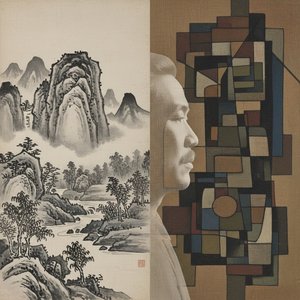 Yi Eungro: Bridging East & West in the Landscape of Korean ModernismExplore the captivating world of Yi Eungro (Lee Ungno), a pivotal figure in Korean modernism. Discover his unique fusion of Eastern and Wes…