- Accueil

- Reproduction de peinture à l'huile
- Wolfgang Voigt
- Mohn: Ebertplatz 2020 / Remixe
 Commander l'impression Acheter l'image haute résolution
 Partager
 Partager
 Détails de l'œuvre
 Ajouter aux favoris

 Télécharger
 Articles similaires
 Radiographie
 Diaporama
Mohn: Ebertplatz 2020 / Remixe


 Afficher la suite
Reproduction à l'huile faite à la main
Huile sur toile peinte à la main, avec cadre et dimensions personnalisés, réalisée sur commande par nos artistes.




P118B $10

P118H $10

P118W $10

P438Z $10

P508JH $12

P508YH $12

P805H $10

P805Z $10

P919BZ $10

P919G $10

P919XJ $10

P959ZH $10

P968JZ $12

W106C $8

W218G $10

W218JH $8

W218Y $10

W307PJ $10

W316G $10

W316PJ $8

W316Y $10

W398PJ $8

W4111J $10

W500HY $15

W500JH $15

W692G $12

W849H $8

W940BG $15

W953PJ $8




Choisissez parmi nos formats prédéfinis qui respectent les proportions originales de l’œuvre.

Vous pouvez saisir vos propres dimensions pour l'adapter à un cadre ou à un espace spécifique. Si la taille sélectionnée ne correspond pas aux proportions de l'image d'origine, nous recadrerons l'œuvre ou prolongerons la peinture avec des éléments peints à la main supplémentaires. Une maquette numérique vous sera envoyée pour approbation avant le début de la production.
Veuillez noter que l'aperçu à l'écran ne reflète pas le recadrage ou l'extension réels. Seule la maquette montrera fidèlement la composition finale.
Bien que des tailles personnalisées soient disponibles, nous vous recommandons de sélectionner une dimension dans la liste prédéfinie afin de préserver les proportions d'origine.
Après la commande, l’équipe OriginalUniqueArt.com contactera le client par e-mail pour obtenir ses instructions et lui fournira une maquette d’aperçu.
Livraison dans le monde entier () en 3 à 4 semaines au lieu des 5 semaines habituelles. (22 juillet). Aucune concession sur la qualité.

Livraison express gratuite dans le monde entier

Toile de lin de haute qualité

Assurance transport complète

Garantie de remboursement des frais de douane

Garantie de fidélité des couleurs

Politique de retour de 60 jours (uniquement en cas de défaut)

Garantie de remboursement à 100%

Réduction sur les achats groupés
 L'option verre n'est disponible que pour les dimensions inférieures à 110 cm.

Mohn: Ebertplatz 2020 / Remixe
Technique de reproduction
Format de reproduction
-


Prix total final
-
Description de l'œuvre
A Nocturnal Echo: Wolfgang Voigt’s “Mohn: Ebertplatz 2020 / Remixe”
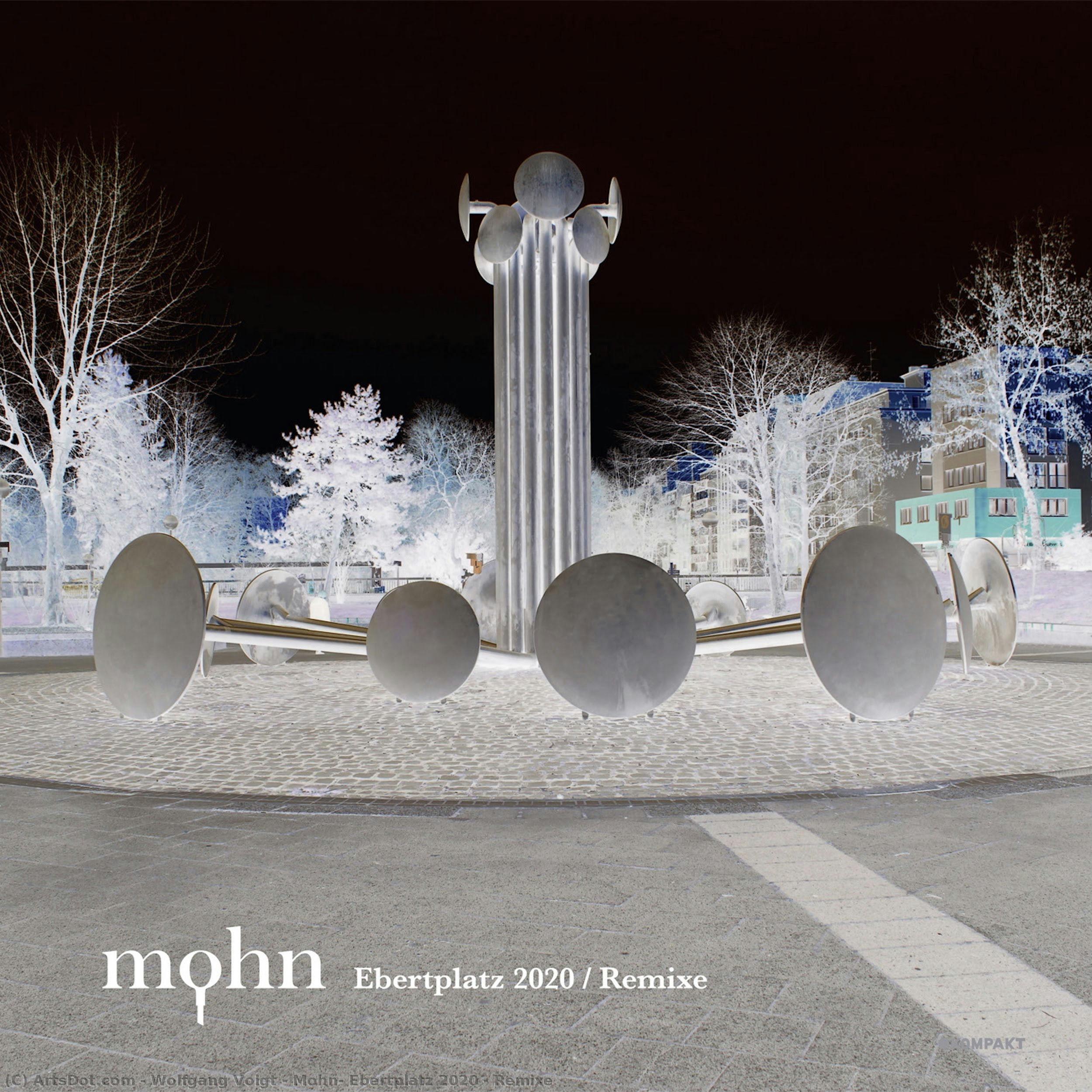
Wolfgang Voigt's "Mohn: Ebertplatz 2020 / Remixe" isn’t merely a photograph; it’s a carefully constructed sonic and visual landscape, a distilled moment of urban contemplation rendered in stark black and white. Captured at night within the sprawling expanse of the Ebertplatz sculpture park in Cologne, Germany, this image by Voigt—a titan of ambient techno and sound art—transports us to a space where industrial geometry meets the quiet grace of winter’s frost. The photograph immediately commands attention with its deliberate asymmetry; a towering, abstract sculpture dominates the frame, yet it's not centrally positioned, creating an immediate sense of unease and inviting the viewer into a dialogue with the artwork itself.
The sculpture, constructed from what appears to be polished metal, is a complex interplay of vertical and horizontal lines. Its spherical elements, suspended along a central axis and extending outwards on supporting structures, evoke both architectural precision and organic growth—a deliberate juxtaposition that speaks to Voigt’s signature ability to blend the mechanical with the natural. The surrounding environment – snow-dusted trees, weathered benches, and glimpses of distant buildings – provides a grounding context, anchoring the sculpture within a recognizable urban setting while simultaneously emphasizing its otherworldly presence. The lighting is crucial; an artificial glow casts dramatic shadows, highlighting the texture of the metal and creating a sense of depth that pulls us into this nocturnal scene.
Deconstructing Form: Composition and Technique
Voigt’s compositional choices are masterful in their restraint. The photograph utilizes a symmetrical balance, yet subtly disrupts it with the sculpture's off-center placement, preventing the image from feeling static or predictable. Leading lines—the horizontal supports of the sculpture—guide the eye across the frame, drawing us deeper into the scene and reinforcing its sense of scale. The monochrome palette is not simply stylistic; it’s a deliberate tool for stripping away distraction, forcing us to focus on form, texture, and light. The subtle gradations of gray – from deep black to bright white – create an illusion of volume and depth, mimicking the effects of atmospheric perspective often found in traditional landscape paintings.
Technically, the photograph appears to be a digital image, likely post-processed to enhance its tonal range and contrast. The sharpness of the metal surfaces suggests careful attention to detail during capture, while the subtle blurring in the background contributes to the overall sense of depth. The deliberate use of shadow is particularly noteworthy – it’s not merely darkness; it's a carefully sculpted element that defines the sculpture’s form and adds a layer of mystery to the scene.
Symbolism and Emotional Resonance
“Mohn: Ebertplatz 2020 / Remixe” transcends its literal depiction as an urban sculpture park photograph. It evokes a profound sense of solitude and introspection, mirroring the themes often explored in Voigt’s ambient soundscapes. The stark monochrome palette—a hallmark of his work—contributes to this feeling, creating a visual equivalent of silence or emptiness. The abstract nature of the sculpture itself invites interpretation; it could be seen as a representation of human ambition, technological progress, or simply the inherent beauty of geometric forms.
Furthermore, the presence of snow and frost suggests themes of transience and decay—a reminder that even in the midst of urban modernity, nature’s forces continue to exert their influence. The photograph's quiet stillness, combined with its dramatic lighting, creates a powerful emotional resonance, prompting viewers to contemplate the relationship between humanity and the environment, technology and art, and the search for meaning within an increasingly complex world.
Historical Context & Wolfgang Voigt’s Vision
To fully appreciate “Mohn: Ebertplatz 2020 / Remixe,” it's essential to consider Wolfgang Voigt’s broader artistic practice. A pioneer of minimal techno and ambient sound art, Voigt has consistently pushed the boundaries of electronic music, creating immersive sonic environments that challenge conventional notions of rhythm and melody. His work is characterized by a meticulous attention to detail, a fascination with texture and form, and a deep commitment to exploring the emotional potential of sound.
Born in Cologne in 1961, Voigt’s artistic journey began in the late 1980s, influenced by the rise of acid house. He quickly developed his own unique style, characterized by repetitive loops, subtle shifts in timbre, and a profound sense of space. His collaborations with his brother Reinhard (under the moniker Sweet Reinhard) and Jörg Burger within the Kompakt label have solidified his position as one of the most influential figures in contemporary electronic music. “Mohn: Ebertplatz 2020 / Remixe” is therefore not simply a photograph; it’s a microcosm of Voigt's artistic vision—a testament to his ability to transform ordinary subjects into extraordinary works of art.
Biographie de l'artiste
Wolfgang Voigt: The Architect of Ambient Soundscapes
Wolfgang Voigt stands as a singular figure in the realm of electronic music, recognized globally for his pioneering contributions to minimal techno and ambient sound art. Born in Cologne, Germany, in 1961, he embarked on a musical journey that would redefine sonic exploration and visual storytelling—a path marked by relentless experimentation and an unwavering dedication to crafting immersive experiences. His work transcends mere composition; it’s an invitation into meticulously constructed worlds where texture, rhythm, and subtle shifts of color converge to evoke profound emotional resonance.Early Influences & The Birth of Mike Ink
Voigt's formative years were deeply impacted by the burgeoning acid house movement of the late 1980s. This initial exposure ignited a passion for manipulating sound—specifically its ability to generate visceral reactions and create atmospheres that transcend conventional musical structures. He began his artistic endeavors under the moniker mike ink, releasing his debut EP “The Dialogue” in 1993, establishing a foundational aesthetic rooted in repetition and sonic minimalism. This early work foreshadowed Voigt’s broader exploration of textural landscapes and conceptual frameworks. The influence of acid house is palpable in Mike Ink's sound design—a deliberate embrace of distortion and rhythmic unpredictability that anticipates the core tenets of his later explorations into ambient techno.Founding Delirium & The Rise of Kompakt Records
Alongside his brother Reinhard Voigt, Jörg Burger, and Jürgen Paape, Wolfgang established “Delirium,” a Cologne-based record store that quickly evolved into Kompakt Records—a pivotal force in shaping the landscape of German electronic music. This collaborative venture wasn’t merely about commerce; it represented a shared commitment to nurturing innovative artists and fostering a community dedicated to pushing sonic boundaries. Kompakt became synonymous with Voigt's distinctive vision, propelling him to international acclaim and cementing his reputation as a curator of groundbreaking soundscapes. The label’s ethos—characterized by uncompromising artistic integrity and a focus on experimental music—perfectly mirrored Voigt’s own creative sensibilities.The GAS Project & Artistic Vision
Perhaps Voigt’s most enduring legacy resides in the GAS project—a moniker that encapsulates his artistic ethos: “Glitch Art Sound.” This ongoing endeavor has yielded over 160 albums, EP's and remixes across more than 30 aliases, demonstrating an astonishing breadth of creative exploration. GAS distinguishes itself through its deliberate use of digital manipulation—specifically glitch techniques—to generate unsettling yet mesmerizing sonic textures. These compositions aren’t simply music; they are visual narratives rendered audible, mirroring Voigt’s fascination with blending sound and image to convey complex emotions and ideas. Notable works include “GAS: Box” and “GAS: Nah Und Fern,” which exemplify his masterful ability to create immersive environments that captivate the listener's senses. He considers these projects as a form of visual storytelling—a way to communicate concepts and feelings beyond the limitations of traditional musical notation.Recognition & Influence Beyond Music
Voigt’s influence extends far beyond the confines of electronic music. His conceptual approach—particularly his exploration of visual storytelling—has garnered recognition from art critics and enthusiasts alike. He is considered one of the foremost practitioners of sound art, demonstrating a profound understanding of how sonic elements can communicate ideas and emotions in ways that surpass traditional artistic mediums. Furthermore, Voigt’s work has been showcased at prestigious institutions like Ludwig Museum Cologne, highlighting his contribution to contemporary sculpture and furthering his reputation as an artist who consistently challenges conventions and expands the horizons of creative expression. His dedication to pushing boundaries ensures that Wolfgang Voigt's impact on both music and art will continue to resonate for years to come.
Wolfgang Voigt
1961 - , Allemagne
En bref
- Artistic Movement Or Style: Minimal techno
- Artists Who Influenced This Artist: ['Acid House']
- Date Of Birth: 1961
- Full Name: Wolfgang Voigt
- Nationality: Allemand
- Notable Artworks:
- GAS: Nah Und Fern
- Burger/Voigt: Roter Platz
- Place Of Birth: Cologne, Germany
Articles connexes

Les 10 Chefs-d'œuvre Bronzes Qui Ont Révolutionné la Sculpture | OriginalUniqueArt
Plongez dans l'univers fascinant des 10 sculptures en bronze les plus emblématiques de l'histoire de l'art. Rodin, Degas et autres maîtres révélés ! Découvrez leur histoire, leurs techniques et trouvez l'œuvre parfaite pour sublimer votre intérieur sur OriginalUniqueArt.com.

The Enduring Form: Exploring Themes & Techniques in Sculpture Across Historical Periods
Explore the rich history of sculpture from ancient masterpieces to contemporary innovations. Discover key techniques, influential artists & investment potential for discerning art collectors.

Les 10 Chefs-d'œuvre en Bronze qui ont Révolutionné l'Art : Collection OriginalUniqueArt
Plongez dans l'univers fascinant des 10 chefs-d'œuvre en bronze qui ont marqué l'histoire de l'art. Découvrez Rodin, Degas et les secrets de ces sculptures iconiques. Reproductions d'art exceptionnelles sur OriginalUniqueArt.com – Explorez la collection !
The Enduring Form: Sculpture Across History, Technique & Emotional Resonance
Explore the rich history of sculpture with OriginalUniqueArt. Discover key techniques, influential artists & investment potential for discerning collectors. Expert insights into valuing and collecting timeless masterpieces.
Harmonies on Canvas: Exploring the Visual Representation of Music in Art History
Explore the fascinating history of music's visual representation in art! From ancient symbolism to modern abstraction, discover how artists have captured sound and emotion on canvas. Expert insights & stunning examples.