Passer au format impression
 Lire la suite







































 Pour les œuvres ou reproductions dont un côté mesure plus de 105 cm (environ 41 pouces), le cadre sera expédié sous forme de kit démonté. Cette méthode garantit une livraison sécurisée et prévient tout dommage pendant le transport.


Still Life (1945): A Testament to Emotion and Form
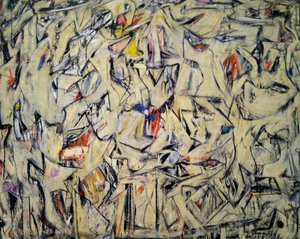
Willem de Kooning’s “Still Life” stands as an emblem of abstract expressionism, encapsulating the movement's core tenets—a rejection of representational art in favor of spontaneous gesture and emotional intensity. Painted in 1945, amidst the turbulent aftermath of World War II, this artwork transcends mere depiction; it embodies a profound exploration of human experience through color, texture, and compositional arrangement.
- Artist: Willem de Kooning (1904–1997) – A Dutch-American painter who revolutionized artistic expression.
- Year Painted: 1945 – Created during the period of intense upheaval and uncertainty following the Second World War, reflecting a desire to grapple with existential questions.
- Style: Abstract Expressionism – Characterized by loose brushstrokes, vibrant hues, and an emphasis on subconscious impulses rather than rational observation.
The painting’s palette is dominated by warm tones—primarily yellows, pinks, reds—creating a visual dynamism that immediately captivates the viewer. These colors aren't merely decorative; they convey emotion—passion, vulnerability, and perhaps even unease—mirroring the psychological landscape of its time.
- Color Palette: Warm hues (yellows, pinks, reds) – Used to generate visual excitement and express emotional depth.
- Texture: Thick impasto technique – De Kooning applied paint in dense layers, resulting in a tactile surface that invites contemplation and enhances the painting’s expressive power.
At its center lies a fleshy pink mass—representing a woman's body—surrounded by an amorphous expanse of color. The figure is rendered with angular lines and fragmented forms, eschewing traditional anatomical accuracy. This deliberate distortion serves not to diminish the subject’s presence but rather to liberate it from constraints imposed by realism, prioritizing emotional resonance over literal representation.
- Composition: Dynamic arrangement of shapes – The painting's asymmetrical composition contributes to its visual energy and reinforces the artist's rejection of conventional artistic conventions.
- Symbolism: Exploration of femininity—The woman’s body symbolizes vulnerability, strength, and the complexities of human emotion.
Influenced by Cubism and Surrealism, De Kooning blended these stylistic approaches to forge a distinctive visual language that resonated deeply with audiences worldwide. “Still Life” exemplifies this fusion, demonstrating how disparate artistic traditions can converge to produce a singular expression of feeling. It remains an enduring testament to the transformative potential of art—its ability to transcend mere imitation and communicate profound truths about the human condition.
- Influences: Cubism & Surrealism – De Kooning drew inspiration from these movements, integrating their techniques and conceptual ideas into his own artistic practice.
For those seeking to immerse themselves in the legacy of Willem de Kooning and experience the captivating beauty of “Still Life,” reproductions crafted by Artefact Art are available on OriginalUniqueArt.com. These meticulously executed prints allow art enthusiasts to appreciate this masterpiece’s enduring significance within the broader context of 20th-century Western art.
Further Exploration: Learn more about Willem de Kooning's life and artistic journey at Wikipedia: Willem De KooningQuestions et réponses
Où puis-je acheter une reproduction peinte à la main de «Still Life» de Willem de Kooning ?
«Still Life» est disponible en tant que une reproduction à l'huile peinte à la main sur toile de lin. Vous pouvez passer commande sur sa page Reproduction peinte à la main, avec un choix de formats disponibles.
Où puis-je télécharger «Still Life» de Willem de Kooning ?
L'image de «Still Life» de Willem de Kooning peut être téléchargée sur la page de téléchargement de l'œuvre : Téléchargement (téléchargement d'une image numérique haute résolution).
Quelle est la place historique de « Still Life » ?
Historiquement, « Still Life » est une œuvre Abstract Expressionism de la grande époque Époque moderne.
 Aperçu en situation
 Envoyer
 Partager
 Détails de l'œuvre
 Guide
Guide

 Télécharger l'image
 Articles similaires
 Radiographie
 Diaporama
 Questions et réponses
 Statistiques